Gravitational Shooting Gallery: Sighting in on Black Holes ✛ ✦
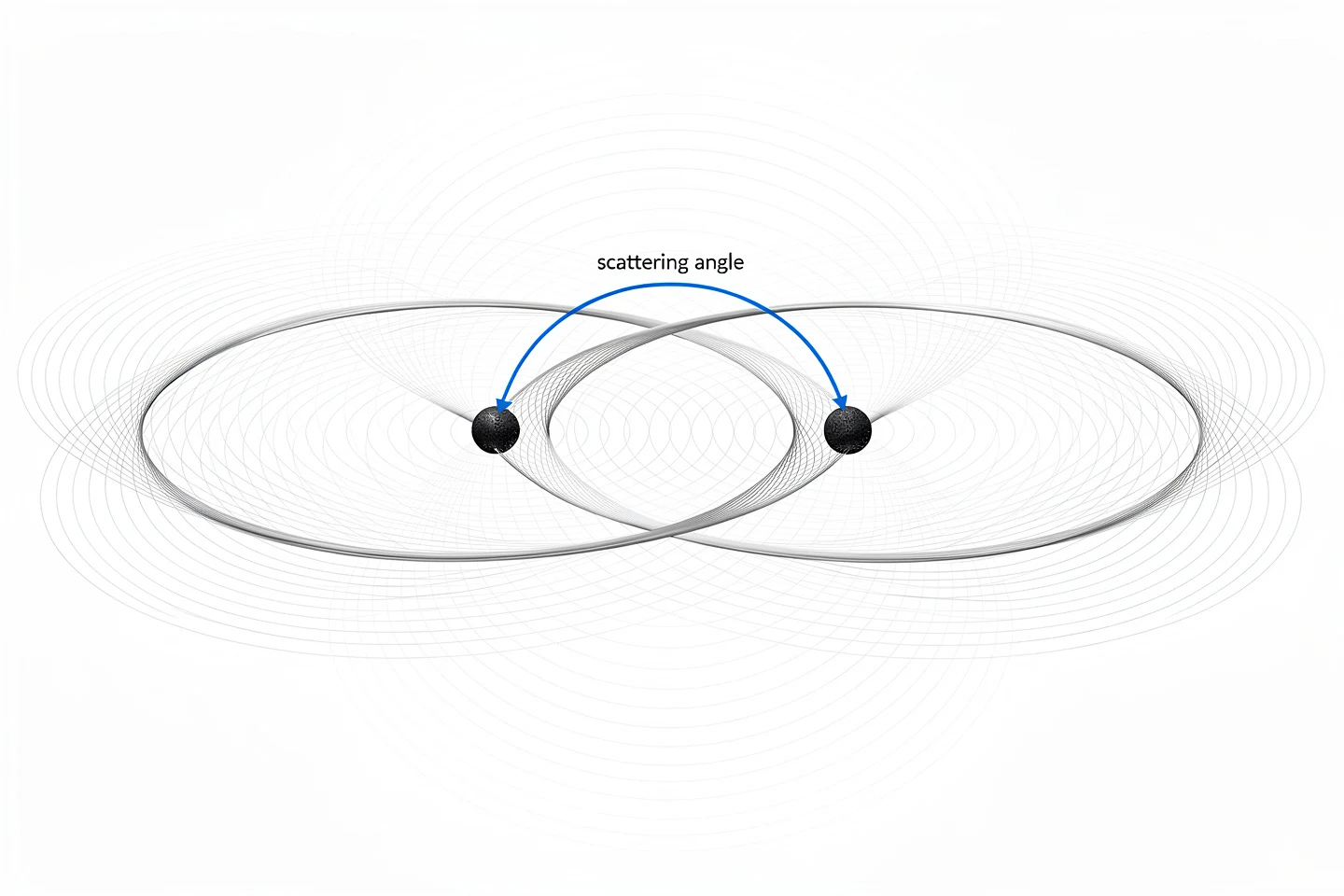
When black holes approach and then fly apart — without merging, just grazing each other's gravitational fields — they become ideal projectiles for testing the laws of gravity. In extreme fields, where time dilation reaches monstrous magnitudes, any crack in the theory would flash dazzlingly bright. Scientists set up a real gravitational shooting gallery: in a powerful numerical experiment, they accelerated a pair of equal-mass holes and sent them on a flyby trajectory. Their target: the scattering angle, a cosmic wind correction, to check against the predictions of a theory spiked with a scalar field.
The Einstein-scalar-Gauss-Bonnet theory inherits the great work of Albert Einstein, but adds a twist: a scalar field coupled to the Gauss-Bonnet invariant — a special contraction of spacetime curvature. As a result, black holes grow "scalar hair" — they begin to sense an invisible scalar ocean. This isn't a whim, but a way to tackle the mysteries of dark matter and quantum gravity that don't fit into the classical picture.
In the course of numerical simulations on adaptive grids — the digital embodiment of the gravitational shooting gallery — the emitted gravitational waves and trajectories were calculated with jewel-like precision. The boldest run: impact parameter 9.7 masses, black holes nearly scraping each other — and the scattering angle exceeded 200°. An analytical model based on the effective one-body formalism predicted almost the same angle — the difference fell short of a degree. It's like hitting a coin from a kilometer away using only rough ballistics. The simulations also confirmed rapid scalarization: black holes grew hair instantly, while their masses, tracked via Wald's entropy — a generalization of the famous entropy of Stephen Hawking — remained stable.
The triumph of precision opens a new era for detectors like LIGO, which Kip Thorne helped bring to life. Semi-analytical waveform templates built on this formalism will let us fish out of the noise the tiniest deviations from general relativity — those very cracks in the gravitational foundation that might point the way to solving the dark universe. And most intriguingly: despite growing hair, Wald entropy stayed unchanged — as if nature carefully watches the balance, not letting the holes drop a single bit of information. Ahead lies accounting for hole spin and scalar radiation, turning the gravitational shooting gallery into an ultraprecise instrument aimed at nature's deepest secrets.
Unlike slow accretion, black hole "hair" here grows almost instantly — within a couple of dynamical timescales. This makes them almost universal objects, carrying a memory of the field from birth.
In "Interstellar," Gargantua is a portal through time. Add a pervasive scalar field — and the black hole would grow "hair," becoming even more exotic, just like in this theory.