Area, in the context of formula anatomy, refers to the geometric measure of a two-dimensional surface. It is a fundamental quantity in physics, appearing in equations that describe everything from the cross-section of scattering processes to the surface area of black holes. The concept is often used to derive other physical quantities, such as flux, pressure, and entropy.
History
The concept of area dates back to ancient civilizations, but its formal mathematical treatment was developed by the Greeks, particularly Euclid and Archimedes. In physics, area became a key variable in the 19th century with the formulation of flux laws by Gauss and Faraday.
How it works
Area is typically calculated by integrating over a surface, or for simple shapes, using geometric formulas. In physics, it often appears as a factor in integrals that compute quantities like electric flux (Gauss's law) or gravitational flux. The area of a surface can also be a dynamic variable, as in general relativity where the area of an event horizon is related to black hole entropy.
In practice
Area calculations are used in engineering for structural analysis, in thermodynamics for heat transfer, and in astrophysics for estimating radiation from stars and black holes.
Fun fact
The area of a black hole's event horizon can never decrease, a law that resembles the second law of thermodynamics and led to the discovery of black hole entropy.
Units by system: SI: square meter · CGS: square centimeter · Planck: planck area · natural: square meter
When a heavy atomic nucleus splits into two fragments, an invisible quantum thread remains between them. This thread is entanglement: the state of one fragment is instantly linked to the state of the other, as if they were still a single whole. For the first time, physicists have precisely calculated how long and strong such a thread can be, tracing the fission process step by step.
A black hole is not just a dark spot in space. It has a temperature, and it radiates. It has entropy — a measure of hidden information encoded on its horizon's surface, like a pattern on a soap bubble.
Two light rays meet at a point and then diverge. Their paths form two intersecting surfaces in spacetime — null hypersurfaces (boundaries along which light propagates). It is on such a pair of surfaces that physicists can set initial data for Einstein's equations. This is called the characteristic Cauchy problem.
In 1953, mathematician Alexander Grothendieck proved a theorem that became a cornerstone in the theory of tensor products. It states that for ordinary function spaces, two natural norms, the projective and the injective, are equivalent up to a universal constant. In other words, two ways of measuring the 'size' of combinations of vectors give similar results.
Spacetime isn't a flat sheet, but a crumpled fabric: stars and planets leave creases on it. Information is written into every crease, and to erase it, heat would have to be released — that's how Landauer's principle works. Thus, the 'crumpledness' of space can be measured through entropy — the universal measure of disorder.
The event horizon of a black hole is often depicted as a one-way membrane: everything falls in, nothing comes out. But what if it's not an empty boundary but a cloud of the tiniest 'bits' of spacetime itself?
Physicists have mastered an elegant mathematical trick that lets them translate gravitational equations into the language of electricity. This method — double copy — works like a kind of dictionary: it replaces the complex geometry of curved spacetime, described by high-dimensional tensor fields, with the simpler rules of…
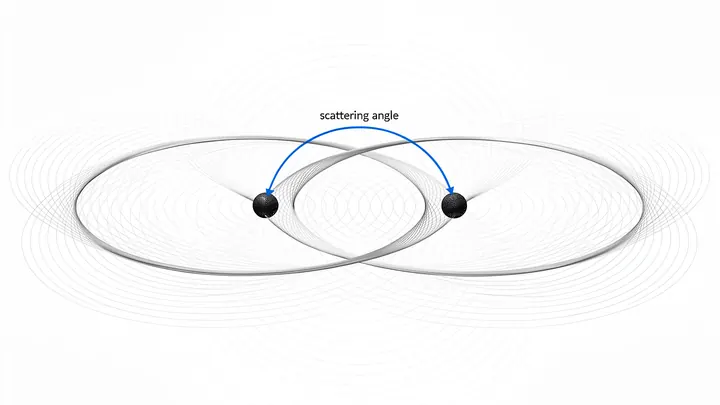
When black holes approach and then fly apart — without merging, just grazing each other's gravitational fields — they become ideal projectiles for testing the laws of gravity. In extreme fields, where time dilation reaches monstrous magnitudes, any crack in the theory would flash dazzlingly bright.
At the center of a black hole lies a singularity — a point where spacetime is crushed infinitely. Black holes can change state, much like water freezing or boiling. Usually, these transitions are noticed by observing the hole's surroundings.
A black hole isn't completely black. From its horizon, a faint thermal glow constantly seeps out, like steam rising from a cooling cup of tea. The temperature of this glow depends on the strength of gravity at the surface.