Gravitational Memory: A Key to Testing Gravity express
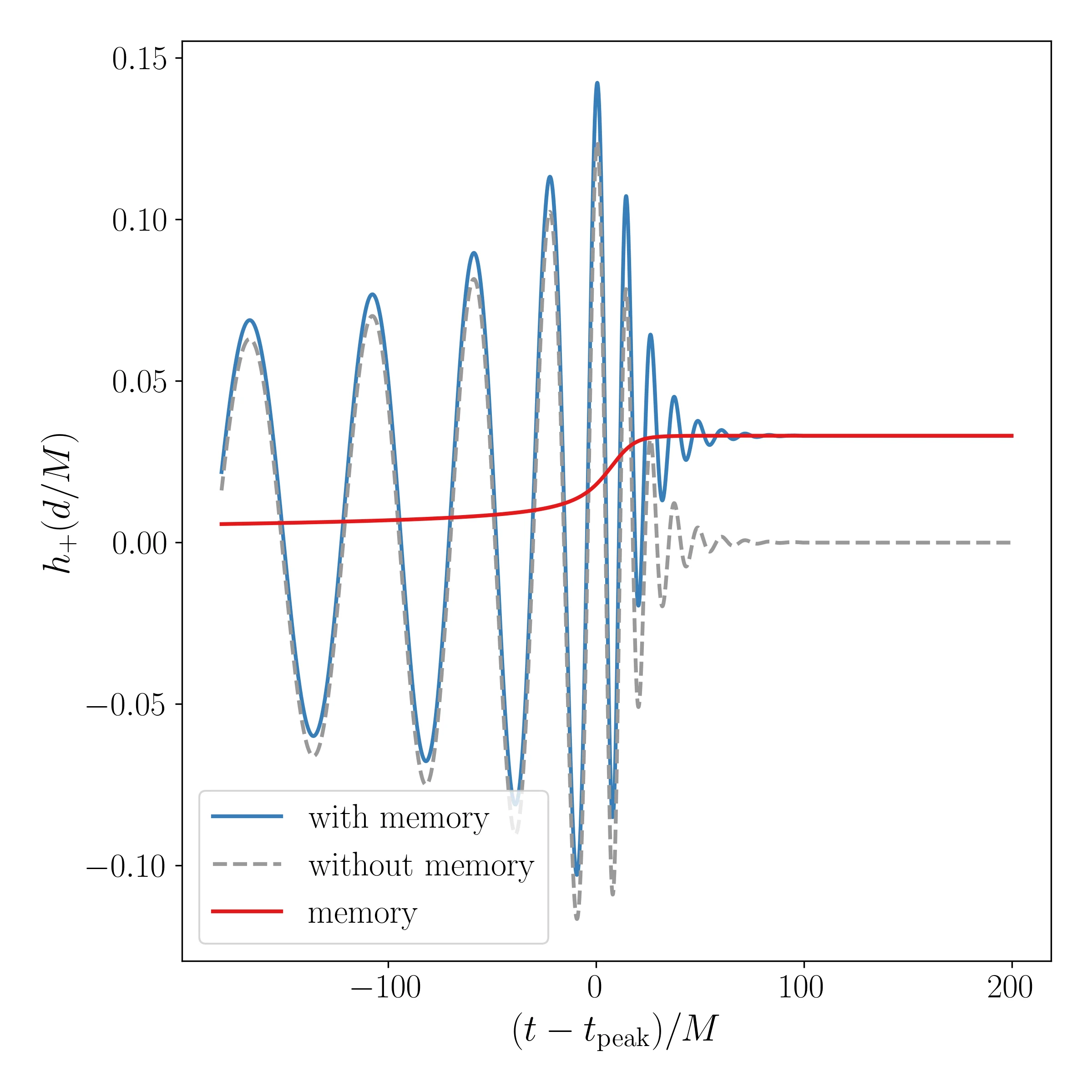
A black hole collision isn't just a burst of gravitational waves; it also leaves a lasting trace: an eternal curvature of spacetime — gravitational memory. Like a boat on water leaves a lingering wake, the cosmos 'remembers' the catastrophe.
Einstein's theory predicted this memory. But now, scientists have calculated it for an alternative theory of gravity for the first time and found: deviations from standard physics are especially noticeable at the moment of merger. Although they are just a few percent, future detectors will catch them.
Thus, gravitational memory becomes an ultra-sensitive tool. By comparing waves with and without memory, one can spot the tiniest departures from Einstein's theory. And the most surprising part: these traces accumulate across the Universe, and the space around us holds the imprints of countless ancient cataclysms.
Original abstract
as written by the authors arXiv:2605.07879v1
Gravitational-wave memory is a low-frequency, non-oscillatory signal that provides a promising probe of strong-field gravity. We present the first computation of memory from full inspiral--merger--ringdown waveforms in a theory beyond GR, focusing on scalar Gauss--Bonnet gravity. We find percent-level deviations from GR, mainly driven by modified merger dynamics, while scalar-induced contributions to tensor memory are strongly suppressed. We found that including memory greatly enhances the mismatch between GR and beyond-GR waveforms, highlighting its potential as a complementary observable for tests of gravity with next-generation detectors.
The signal of gravitational memory is incredibly weak: it deforms space by a billionth of an atom's size. That's why it hasn't been detected yet. But future detectors will be able to catch this ghostly trace.