In gravitational wave astronomy, an 'event' refers to a specific detection of a gravitational wave signal, typically labeled by the date it was observed, such as GW150914 for the first detection on September 14, 2015. Each event corresponds to a cataclysmic cosmic collision, most often the merger of two black holes or neutron stars, which sends ripples through spacetime that are measured by interferometers like LIGO and Virgo.
History
The first direct detection of a gravitational wave event, GW150914, was announced by the LIGO Scientific Collaboration and Virgo Collaboration on February 11, 2016. This confirmed a prediction of Einstein's general relativity made a century earlier and opened the field of gravitational wave astronomy.
How it works
When a gravitational wave passes through Earth, it causes tiny distortions in the lengths of the interferometer arms. The signal is extracted from the detector data by matching it against theoretical templates of expected waveforms. Each event is characterized by parameters such as the masses of the merging objects, their spins, and the distance to the source. The date-based naming convention (e.g., GW150914) encodes the year, month, and day of detection, making each event a unique entry in the growing catalog of cosmic collisions.
In practice
Gravitational wave events are used to test general relativity, measure the expansion rate of the universe (the Hubble constant), and study the population of black holes and neutron stars. Each event provides a unique probe of extreme gravity and dense matter.
Imagine an interpreter distracted by every rustle in the hall, turning a one-hour meeting into two. That's roughly how gravitational wave detectors behaved when analyzing long signals: each turn of the Earth added noise to the calculations, and processing a day-long neutron star merger threatened to stretch into weeks.
In active galactic nuclei, supermassive black holes are surrounded by a dense ring of dust that acts like a curtain: it hides everything happening at the center. If a star ventures too close to the black hole, tidal forces tear it apart, and the resulting flare is usually visible in optical and X-ray light.
A noisy café. You're trying to make out two quiet conversations: one from the table by the window (black hole mergers), the other a barely audible whisper from the far corner (echoes of the universe's birth). But the hiss of the espresso machine and street noise (detector jitter) drown everything out. New work teaches a computer to separate these sounds.
The first moments after the big bang: space expands rapidly — physicists call this period inflation. Inside this swelling fabric, like soap bubbles in a stream of air, regions of new vacuum begin to form — a first-order phase transition. Most bubbles pop or merge as soon as they appear.
On November 23, 2023, LIGO detectors caught something strange. The gravitational wave signal from a black hole merger, designated GW231123, pointed to record masses—137 and 101 solar masses, and anomalously fast spin. That would be the most massive and fastest-spinning pair ever detected.
The spiral of water draining into a sink spins faster and faster toward the center. In an ordinary black hole, that funnel ends in an infinitely sharp point — a singularity where the laws of physics break down. But this new work considers a different picture: the funnel doesn't taper to a needle but ends in a smooth, swelling bubble.
Space is full of invisible waves — ripples in the fabric of spacetime left behind by cataclysms like black hole mergers. An ordinary black hole swallows everything without a trace. But there are hypothetical exotic objects — ultradense clumps of matter without an event horizon (a surface from which not even light can escape).
A huge bowl of water. Drop a stone into it — ripples spread across the surface. The fabric of spacetime works much the same way: when two massive stars merge, they create ripples — gravitational waves. These waves travel to Earth and are picked up by giant detectors like LIGO and Virgo.
In 2034, a rocket leaves a spaceport with an unusual payload: two spheres the size of a large globe, each weighing nearly a ton. No engines, no electronics. Just a mirrored surface of hundreds of corner-cube reflectors — tiny prisms that return light exactly to where it came from. This is the future space tuning fork.
Predicted by Albert Einstein, gravitational waves are like beacons in the dark ocean of space. They flare up when black holes collide, sending ripples through the fabric of the Universe.
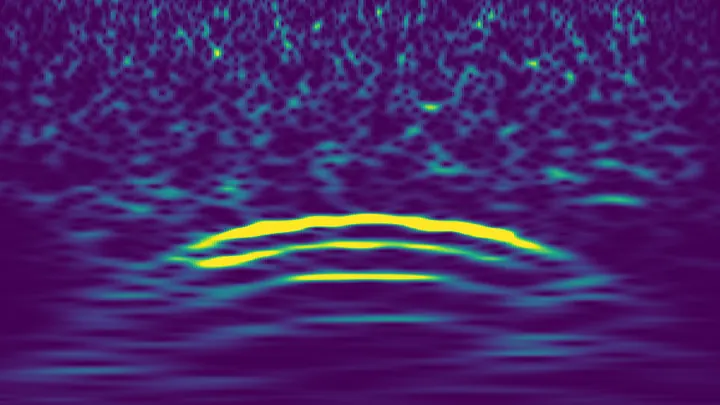
In 2019, the LIGO facility recorded a gravitational waves, a ripple in the fabric of spacetime, whose time-frequency map resembled a strange comb. Each such signal from a black hole merger leaves a unique pattern, like a fingerprint.
In May 2020, the LIGO and Virgo detectors picked up a gravitational-wave burst known as GW200105. Among the many similar gravitational waves recorded, this one stood out for an oddity: the orbit of the colliding neutron star and black hole was not a perfect circle, but a stretched ellipse.
Gravitational-wave detectors are like sensitive microphones, listening for the whispers of distant cataclysms. But every now and then, a sharp crack bursts in — a brief noise spike known as a glitch.
The LIGO detectors caught the signal GW250114—a gravitational wave from the merger of two black holes. After the main burst, a decaying 'tail' remained — direct waves from the newborn hole's horizon. It was expected that their damping would reveal the gravitational strength at the horizon's surface. But the measured value came out smaller.
Two neutron stars spiral closer and collide. The result: a gravitational wave, a ripple in spacetime, a short gamma-ray burst, and a faint glow astronomers call a kilonova. But sometimes the signal passes by a massive galaxy.
The universe rewrites its history again and again. Where ordinary astronomy sees only a point, a black hole, gravitational waves peel back thin layers of the past, like an ancient palimpsest. The idea that black holes can grow by devouring each other, and their offspring can enter new unions, has been discussed by astrophysicists for half a century.
In the ocean of space, every storm of birth or merger of supermassive black holes generates ripples — gravitational waves traveling at the speed of light. Over billions of years, these waves superimpose, merging into a low-frequency hum, like a distant surf.
Ever since Einstein predicted gravitational lensing, and gravitational waves were first heard by LIGO detectors, physicists have dreamed of catching the lensed echo — a repeating signal from one merger, multiplied by the gravity of a massive body.
The cosmos sets its own lenses in the path of gravitational waves. When two black holes merge, the resulting ripple travels through the universe. If it encounters a massive galaxy cluster along the way, its gravity bends the path of the waves — much like glass focuses light.
In the centers of distant galaxies, X-ray 'beacons' sometimes light up. They don't flash randomly but on a strict schedule: every few hours or days. These bursts are called quasi-periodic eruptions (repeating at nearly regular intervals).
Two dead stars circle in a final dance. Their approach creates ripples in space — gravitational waves. But there may be a third, invisible partner in this dance. Its gravity accelerates the pair, and the signal changes pitch slightly, like the siren of a passing car.
LIGO and Virgo detectors catch ripples in spacetime, but some signals force us to rewrite the scripts of stellar death. GW190814 — the merger of a black hole of 23 solar masses with a compact object of 2.6 solar masses — is a discordant chord in the symphony of standard models.
A gravitational wave observatory is like a set of microphones scattered across the Earth. When a signal arrives from space (say, from a black hole merger or a supernova explosion) each microphone hears something slightly different.
A hum resonates across the universe. It is not sound, but a trembling of space itself — the gravitational wave background. It is produced by pairs of supermassive black holes circling each other at the centers of distant galaxies. Each pair is like a bass instrument in a vast orchestra.
A tightrope walker spirals over an abyss, each loop drawing closer to the center. Their path is not a smooth glide but a series of sharp jerks and pauses. That is roughly how a tiny black hole behaves when it is pulled toward a supermassive neighbor.
In 2015, detectors caught a gravitational wave for the first time — a ripple in space that traveled from merging black holes. Since then, such signals have become a new window into the universe for astrophysics. But gravitational waves can do more: they carry the imprint of the very theory of gravity.
At the heart of nearly every large galaxy lives a supermassive black hole — a silent giant around which stars, gas, and other, smaller black holes orbit. From time to time, one of these objects breaks free from its orbit and begins to fall toward the central monster in a tightening spiral.
Gravitational waves from a tiny body falling into a black hole work like an X-ray image. Only instead of a bone, they illuminate the curved spacetime itself.
Pulsars are dead stars spinning with flawless rhythm. Their radio blips are more precise than atomic clocks. However, gravitational waves — ripples in the fabric of spacetime, predicted by Einstein — disrupt that rhythm.
Two heavy spheres of dark emptiness hurtle toward each other and collide dead-on. This is not billiards: it's the collision of two equal black holes. The impact sends a tremor through space itself — gravitational waves.
Most of this tremor is a low hum that physicists call bremsstrahlung.
Drop a pebble into a pond — ripples spread across the water. In much the same way, a massive body circling a black hole perturbs the fabric of spacetime, generating gravitational waves. But what if the pond itself isn't flat, but has hidden folds — extra dimensions invisible to the eye?
The merger of two black holes is the most powerful explosion in the Universe, yet we cannot see it. We only catch the shudder in spacetime — gravitational waves that carry information from the heart of the cataclysm. In December 2025, the LIGO detectors registered event GW250114.
It was Edwin Hubble who discovered that galaxies are rushing apart, and Georges Lemaître linked this to the expansion of space. Today, the ΛCDM model, relying on dark energy and dark matter, asserts that the Universe is flat as a perfectly stretched canvas.
A black hole rips apart a star, and we see a dazzling flare. Then, a couple of years later, when everyone has forgotten about it, radio telescopes suddenly pick up a new signal, like an echo from the past.
LIGO, Virgo, and KAGRA detectors act like giant microphones, listening in on gravitational waves — vibrations of space itself. The new GWTC-5.0 catalog recorded 161 black hole mergers, bringing the total count to 390 events.
Gravitational waves are the very trembling of space, born when black holes or other massive bodies collide. Their main oddity isn't that they pass through us, but that they permanently alter the curvature of spacetime and the distances between everything they touch.
A giant black hole tore apart a star, leaving behind a lopsided disk of scorching gas — like a vinyl record warped by the heat. Now a tiny black hole (or a star) zips around and repeatedly pierces that disk. Each puncture is a bright X-ray flare.