A Thermostat That Likes to Glue Probabilities Together express
A pot of water on the stove eventually settles down: the temperature evens out, the liquid stops boiling. Physicists call this thermal equilibrium — a state where energy is distributed in the most probable way. A hundred years ago, a simple rule was derived for such rest: each portion of energy goes to particles independently, like lottery tickets. But what if the tickets stick together? If one person's win changes the odds for another, and all at once?
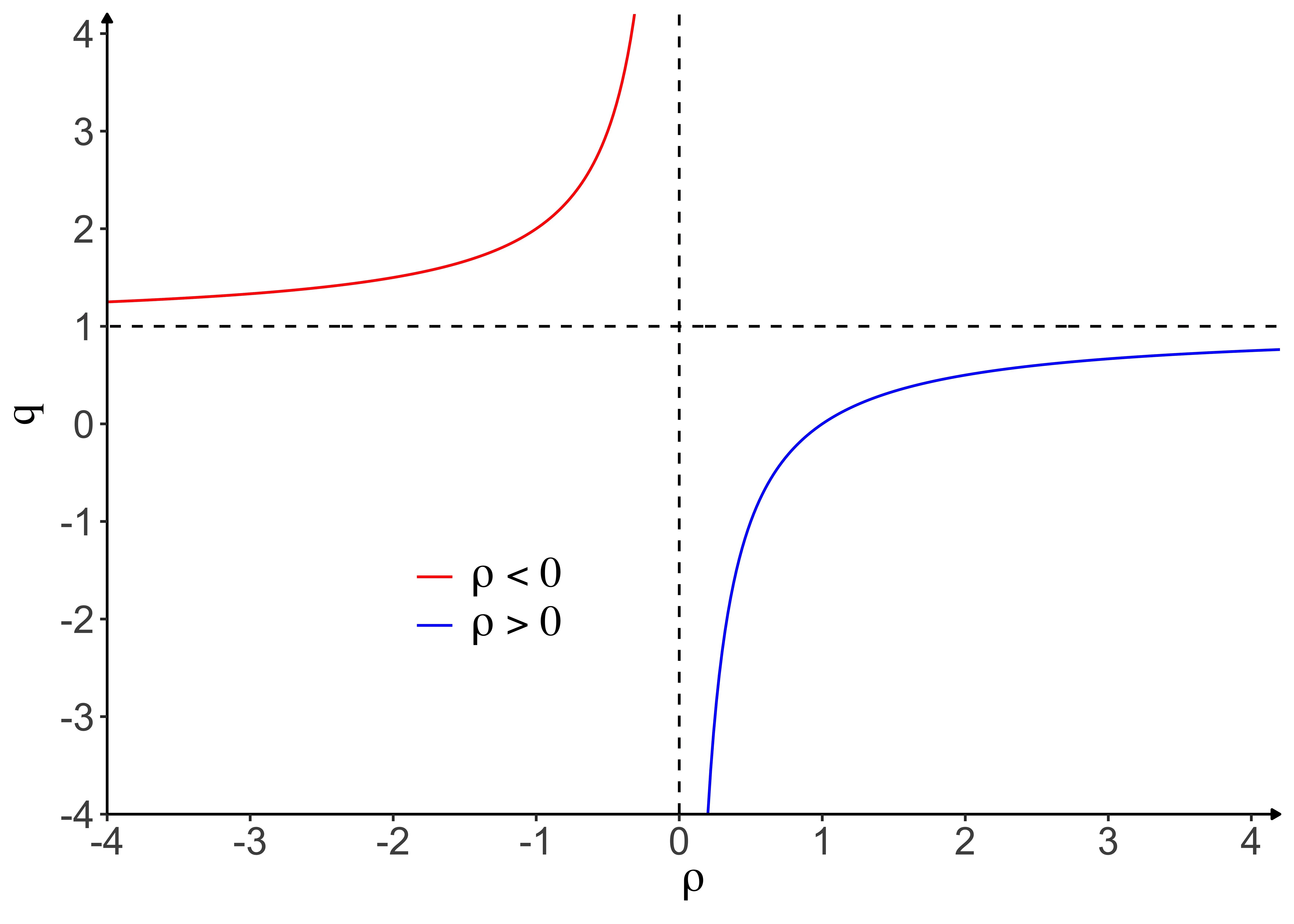
That's the problem the authors of the new work tackle. They take the familiar recipe for equilibrium (the Boltzmann–Gibbs–Shannon formula, which computes disorder (entropy) as a sum of independent contributions) and replace it with a more flexible one. In the new version, probabilities don't just add up; they sort of glue together: a parameter q controls the strength of the glue. If q=1, everything returns to the ordinary lottery. But if q is less than 1, particles start to feel each other, and the familiar equilibrium changes.
The authors didn't just rewrite old equations. They rigorously proved when a solution exists, when it's unique, and how to compute it explicitly. It turned out that out of many possible ways to account for the gluing, only two give an elegant result — a probability distribution resembling a power law. And there's a third way, previously unnoticed: it arises when the gluing parameter in the problem's condition is mirrored.
The most interesting conclusion concerns heat. The scientists introduced the concept of effective temperature — not the one a regular thermometer shows, but the one that dictates the rules of energy exchange in such a glued world. And they showed: if the gluing is strong enough (q between 0 and 1), then at absolute zero the entropy indeed goes to zero, as required by the third law of thermodynamics. So this peculiar statistics can be applied to real systems: from a swarm of gravitating particles to electronic circuits on the brink of chaos, where ordinary predictions stop working.
The parameter q in this statistics is sometimes called the 'nonextensivity parameter.' It appeared in 1988, when Brazilian physicist Constantino Tsallis tried to describe systems with long-range memory, and since then, his formula pops up in the most unexpected places: from turbulence to financial markets.