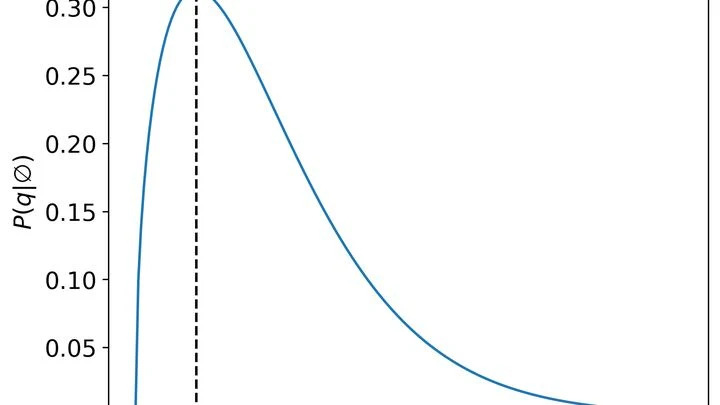
Imagine a crowd of people on an escalator in the subway: there are always fewer people at the top because it’s harder to get there. In the world of atoms and molecules, a similar principle applies: the greater the energy of a state, the fewer molecules “climb” to that “energy floor.” The Boltzmann distribution is a mathematical rule that says the chance of finding a particle in a state with a given energy drops exponentially as the energy increases. It’s like having a mountain, and with height, the number of tourists would decrease according to a strict exponential law, determined by the steepness of the slope (the temperature).
History
L. Boltzmann began his research by extending Maxwell's (James Clerk Maxwell) distribution for an ideal gas to systems with an external field. In 1871, he formulated the general principle: if a system can be in discrete states, then its equilibrium distribution is determined only by energy and temperature. In 1877, he linked entropy to the logarithm of the number of microstates (the famous Boltzmann formula), which led to a deep understanding of the statistical nature of the second law of thermodynamics. In the 20th century, quantum mechanics expanded the application of the distribution, and Erwin Schrödinger in his lectures 'What is Life?' used it to explain order and disorder in biological systems.
How it works
The Boltzmann distribution works for classical and quantum systems in thermal equilibrium, when quantum exchange effects can be neglected (i.e., for 'distinguishable' particles in the classical limit). It describes the populations of energy levels of atoms and molecules in spectroscopy, impurity distributions in semiconductors, thermal ionization, diffusion. Limits of applicability: the distribution fails when Fermi–Dirac statistics (for fermions, e.g., electrons in metals at low temperatures) or Bose–Einstein statistics (for bosons, like photons) are important, where the Pauli principle or Bose condensation must be accounted for. It is also valid only in equilibrium; in non-equilibrium systems, populations may be different.
Fun fact
It is precisely because of the Boltzmann distribution that water evaporates at room temperature: the fastest molecules at the surface, having energy above average, can overcome the attraction and fly away. Moreover, this law explains why it’s hard to breathe at high altitudes: the density of air (the number of molecules at a given height in the gravitational field) drops exponentially with height — exactly according to Boltzmann, where the role of energy is played by gravitational potential energy.
A fraction of a second after the big bang, the universe was a searing hot soup of particles and antiparticles. By all rights, they should have annihilated each other completely, leaving only emptiness. But for some unknown reason, one "extra" matter particle survived for every billion pairs. It was from these surviving scraps that galaxies, stars, and people eventually formed.
A fraction of a second after the big bang, the universe was a searing hot soup of particles and antiparticles. By all rights, they should have annihilated each other completely, leaving only emptiness. But for some unknown reason, one "extra" matter particle survived for every billion pairs. It was from these surviving scraps that galaxies, stars, and people eventually formed.
A sound signal is conveniently represented as a complex number: its modulus (amplitude) reflects loudness, while its argument (phase) indicates the wave's position in time: its instantaneous shift.
Machine learning has long ceased to be just a tool — it is becoming an investigator, independently fishing out the laws of nature from data. But how does a silicon mind come to understand?
Dark matter — the invisible architect of the universe, holding galaxies from flying apart. Thanks to the pioneering work of Fritz Zwicky and Vera Rubin we know: ordinary matter in the cosmos is just a negligible impurity. But what lies behind this dark matter?
In a world locked in a crystal lattice and cooled nearly to absolute zero, matter knows how to hide its deepest secrets. A quantum spin liquid is a state where electron spins never freeze, even at zero temperature, remaining in an eternally flickering superposition.
The search for new materials is like sailing across an uncharted archipelago: islands of stable crystals rise amid the raging ocean of possible combinations, and only a few survive the storm of thermodynamics. A true breakthrough came with entropy-stabilized oxides, where chaos, not order, binds the atoms.
The hunt for non-Abelian anyons is a quest for a quantum ghost that leaves only one clue: entropy. These particles live in two-dimensional systems at ultralow temperatures. Their exchange doesn't just flip the sign of the wavefunction — it entangles states, creating topological order.
A thousand particles enter a gradient dance. Each feels an attraction to regions of high probability and repulsion from neighbors — so they don't bunch up.
A billiard ball strikes another, and the sum of their velocities before and after the collision obeys strict rules. The same happens in the microscopic world: energy, momentum, and charge cannot simply vanish.
Biological complexity has long eluded us: you can count genes, cells too, but how do you grasp the organization of the proteome itself — a multi-thousand ensemble of proteins woven from carbon, oxygen, and hydrogen?
In a world striving for chaos, rhythm sometimes arises. The Belousov–Zhabotinsky reaction has amazed for decades: in a test tube, color waves run on their own, as if a living organism breathing matter. Something similar lurks in crystals where iron atoms balance between two magnetic states — high-spin and low-spin.
A solid electrolyte is not just a crystal lattice: it’s a bustling metropolis for ions. Each act of conduction resembles a trip through the city: there are wide highways with low energy barriers, gridlocks in bottlenecks, and tricky detours where an ion can get stuck.
Picture a pot of boiling soup, but every grain in it is not just a point but a tiny top spinning around its own axis. That's the world of spin-1 particles. For example, some short-lived mesons born in accelerator collisions.
The paradox of the young solar wind has long puzzled heliophysicists. Measurements showed that near the Sun, proton beams aren’t smeared out but sharply compressed, as if someone had neatly hammered them into the shape of a hammerhead.
A pot of soup forgotten on the stove cools to room temperature. It seems everything has come to rest. But if you look inside with a quantum magnifying glass, you'll find that water molecules haven't frozen: they continue their dance. It's just that now the dance is steady, not turbulent like when boiling.
A pot of water on the stove eventually settles down: the temperature evens out, the liquid stops boiling. Physicists call this thermal equilibrium — a state where energy is distributed in the most probable way.
If you pour sand into a glass, it settles in a flat layer. But instead of sand, take the tiniest particles of gas: in a gravitational field they don't just fall: each particle races along its own trajectory, collides with neighbors, and all this commotion creates pressure.
Hot tea cools down, and its temperature is the same throughout the cup. But in many systems (for example, in the rarefied gas between stars or in plasma) temperature is not uniform: in one place particles are faster, in another slower. Physicists call such systems "superstatistical": it's as if the tea consisted of many small regions, each with its own temperature.
A stream of electrons enters plasma like a jet of water hitting a calm pond. The jet disturbs the surface, giving rise to waves that grow quickly and mix the water. In plasma, this process is called the Buneman instability: the electron beam excites oscillations that then scatter its energy.
In a thin semiconductor channel, electrons behave not like lone runners but like a crowd at rush hour. They constantly bump into each other, and these collisions determine how easily heat and electric current pass through the material.
Toss a handful of sand on the floor: there are few large grains, many medium ones, and even more tiny ones. This skew, where small events are common and large ones are rare, is described by a power law. It shows up in city sizes, earthquake magnitudes, and citation counts of scientific papers.
In the 19th century, James Clerk Maxwell imagined a tiny demon. It knows the speed of every gas molecule and opens a door: fast ones to the left, slow ones to the right. This creates a temperature difference without expending energy, seemingly violating the laws of physics.
A hot coffee cools by radiating invisible light. To maintain temperature, it must receive exactly as much light back. This silent trade of photons is what we feel as steady warmth.
The universe is expanding, and the rate of that expansion is a hot topic in cosmology. Nearly a century ago, Edwin Hubble discovered that galaxies are flying apart, but modern measurements of the Hubble constant, which characterizes the expansion rate, give conflicting values.
The speedometer needle in a car shows how fast the wheels are spinning. The climate system also has rotation, but it is invisible: it happens in state space, where each point is a combination of ocean temperature, the depth of the warm layer, and other parameters.