An Alloy with Three Faces express
A metal bar suddenly becomes stiff when heated, and at the same time loses or gains magnetic properties. In alloys based on nickel and manganese, such transformations occur not smoothly but abruptly — atoms rearrange into a new order, and the material changes its behavior. In this work, researchers studied four very similar compositions of Ni-Mn-Cu-Ga, where the copper fraction differed by only fractions of a percent. That was enough to obtain three different scenarios: in one case, magnetism disappeared first, then the lattice changed; in another, the order was reversed; and in the third, both events occurred simultaneously.
The main trick is a new thermodynamic analysis. Usually, the magnetic transition temperature (Curie point) and the lattice rearrangement temperature are measured separately, but here they influence each other. The authors took into account how changes in the crystal structure alter the strength of interaction between electron spins — the so-called exchange parameter that determines whether a material is magnetic. It turned out that for the same alloy, the Curie point in the high-temperature phase (austenite) and in the low-temperature phase (martensite) differs by more than 50 degrees. The same piece of metal has two different "magnetic personalities" depending on how its atoms are arranged.
The practical benefit of the method is that it allows extracting hidden transition temperatures from standard magnetization measurements. Previously, this required complex experiments, but now it is enough to track how the magnetic response changes upon heating and apply the new calculation. This is important for fine-tuning ferromagnetic shape-memory alloys — materials that can bend and return to their original shape under a magnetic field. They are used in microactuators, sensors, and even medical instruments where silent movements without motors are needed.
Original abstract
as written by the authors arXiv:2605.08920
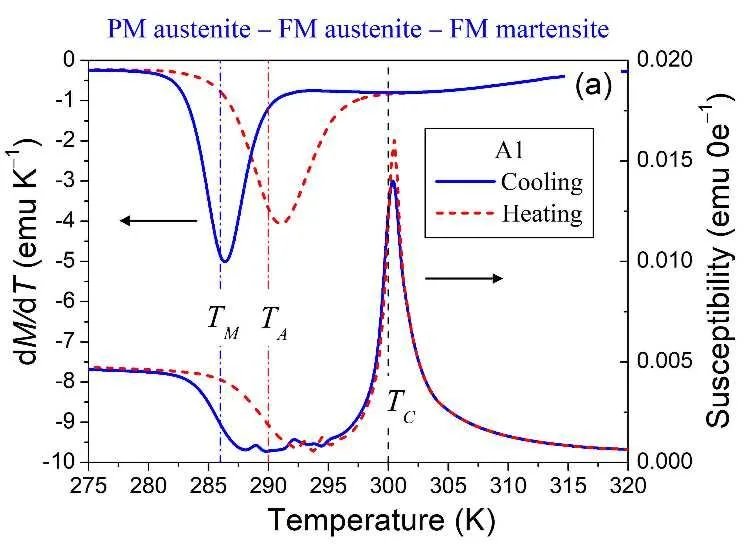
Ferromagnetic solids acquire nontrivial magnetic and caloric properties when the temperature of the structural phase transition approaches the Curie point. Deciphering magneto-structural transitions, i.e. determining their characteristic temperatures and elucidating the related properties, remains challenging. In the present paper, three types of transformational behaviour of Ni50Mn25-xCuxGa25 (x = 6.25, 6.5, 6.75, 7) and Ni50.5Mn18.5Cu6.5Ga24.5 alloys have been identified, arising from small variations in chemical composition: (i) structural martensitic transformation (MT) in the ferromagnetic phase; (ii) magneto-structural phase transition from paramagnetic austenite to ferromagnetic martensite; (iii) MT in paramagnetic phase. The temperature-dependent values of magnetization, M(T), and of magnetic susceptibility, $$\chi(T)$$, were measured for each alloy. A novel thermodynamic analysis was used to determine the Curie points and MT temperatures. The novelty lies in considering the interplay between structural and magnetic characteristics of the alloys through the impact of the structural transition on the spin-exchange parameter. The theoretical analysis of experimental data revealed that this impact results in a large difference ($$\geq$$ 50 K) between the Curie temperatures computed for the austenitic and martensitic states of each alloy. The characteristic temperatures, corresponding to the extrema of the dM(T)/dT and $$\chi(T)$$ functions, were calculated. The correlation of these temperatures with the Curie temperatures and the MT temperatures is not straightforward and depends strongly on the type of transformational behaviour (i) - (iii). The proposed approach provides a robust framework for extracting unmeasurable characteristic temperatures from standard magnetization data, applicable to ferromagnetic Heusler systems and other multiferroic ferromagnetic materials.
Ni-Mn-Ga alloys can elongate by 10% under a magnetic field — a giant deformation for a solid, comparable to stretching rubber, yet they remain as strong as steel.