Spotting the Elusive Boson with a Laser and a Point Cloud express
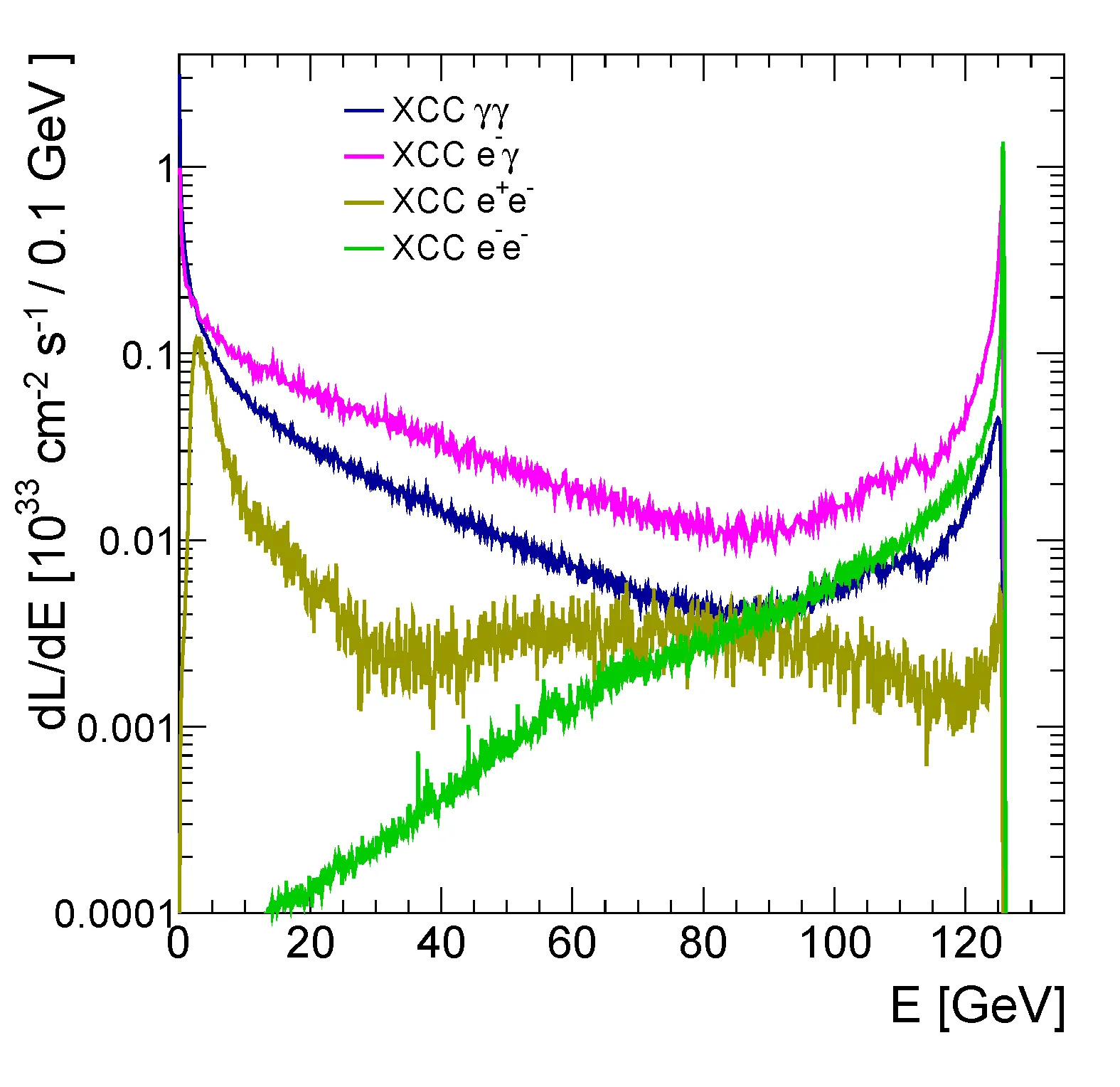
Two blindingly bright beams smash head-on. At the point of impact, a particle is born for an instant — the very one responsible for the mass of everything in the universe. That's the Higgs boson. Usually, it's produced by accelerating protons or electrons, but here the projectiles are particles of light themselves — photons. The idea isn't new, but now it's set to be realized on a facility where an X-ray free-electron laser (XFEL) strikes a target, generating a powerful stream of gamma-ray photons at the right energy — about 125 GeV, which matches the mass of the Higgs boson.
The main challenge is separating the rare Higgs production events from the background. Typically, physicists build complex chains of criteria based on individual particle signatures. The authors took a different route: they turned the detector readings into a point cloud, where each point is an energy cluster (a jet or a lepton), and its coordinates reflect direction and momentum. Then a neural network, similar to those that learn to recognize object shapes from pixel sets, takes over. It finds the pattern characteristic of Higgs boson decays within the cloud. To optimize it, they used a genetic algorithm, a method that mimics natural selection: hundreds of network variants are crossed and mutated until the most 'sharp-eyed' one emerges.
The result surpassed traditional methods: sensitivity to the signal increased severalfold. This means that even a compact collider of this new type could count Higgs bosons with exquisite precision and spot the slightest deviations from Standard Model predictions. And such deviations are a window into unknown forces and particles.
Thus, a laser beam tracing a point cloud becomes a tool not just for observation, but for hunting shadows of other worlds hidden in the deepest recesses of matter.
Original abstract
as written by the authors arXiv:2605.16756
We investigate single Higgs production in $$\sqrt{s}=125$$ GeV $$\gamma\gamma$$ collisions at the X-Ray Free Electron (XFEL) Compton Collider (XCC) concept and present an analysis targeting the major hadronic, semi-leptonic, and fully leptonic final states of the Higgs boson, including $$H\to s\overline{s}$$. In addition to studying Higgs production at a novel collider concept, our approach couples a novel set transformer-based deep learning framework that acts on particle-flow object point clouds with a genetic algorithm optimizer for signal-background discrimination, yielding significantly higher sensitivity than traditional methods. Our results demonstrate that an XFEL $$\gamma\gamma$$ collider can probe the Higgs sector with extremely high precision and enable new physics opportunities, complementary to proposed $$e^+e^-$$ machines.
The Higgs boson is sometimes called the 'God particle,' but physicists dislike that nickname. Its real role is humbler and more important: without it, electrons would have no mass, and atoms simply couldn't form.
In Liu Cixin's novel 'The Three-Body Problem,' aliens use protons unfolded in space as supercomputers — much like the neural network here 'unfolds' a point cloud in a high-dimensional space to find a hidden signal.