A collider is a type of particle accelerator designed to bring two beams of particles into head-on collision at extremely high energies. By smashing particles together, physicists can probe the fundamental structure of matter and discover new particles and forces. Colliders have been instrumental in major discoveries, such as the Higgs boson at the Large Hadron Collider (LHC). The high collision energies allow scientists to recreate conditions similar to those just after the Big Bang, providing insights into the early universe.
History
The first colliders were built in the 1960s, with the first proton-proton collider, the Intersecting Storage Rings (ISR) at CERN, operating in 1971. The concept of colliding beams was proposed earlier by Rolf Widerøe in the 1940s.
How it works
Particles such as protons or electrons are accelerated to near the speed of light using electromagnetic fields in a circular or linear accelerator. The beams are then focused and made to cross at specificinteraction points, where collisions occur. Detectors surrounding these points record the debris of particles produced in the collisions, allowing physicists to reconstruct what happened. The energy of the collision is determined by the kinetic energy of the particles, and higher energies require larger and more powerful accelerators.
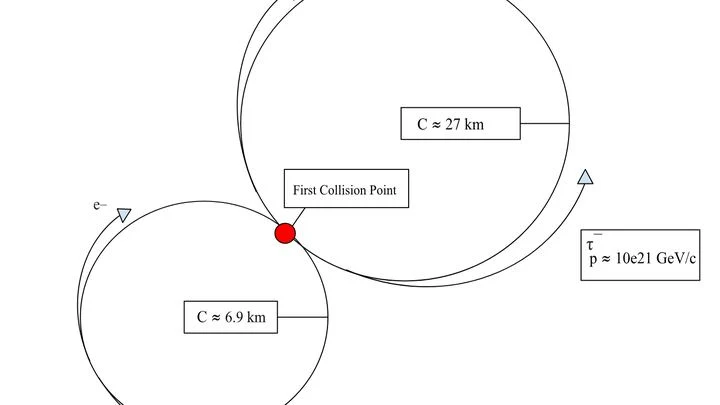
The Large Hadron Collider at CERN is the most powerful collider ever built, with a circumference of 27 kilometers, and it accelerates protons to energies of up to 6.5 TeV per beam.
To probe deeper into the workings of the universe, physicists accelerate electrons and smash them together. An ordinary electron is like a spinning top that wobbles randomly. For delicate experiments, you need particles whose spins all point in the same direction: this is called polarization.
In the first moments, the Universe expanded at an enormous rate. This process is called inflation, and its driving force is the inflaton field. Its energy pushed space apart, like yeast raising dough. But physicists suspect that the dough might have left 'bubbles'—superheavy particles born from the expansion itself.
The universe rang piercingly in its first moments. During the inflation epoch, when space expanded faster than light, energies were monstrous — trillions of times higher than in the Large Hadron Collider.
A speed of 7,5 kilometers per second is the threshold beyond which a cosmic collision turns dust grains into a chemical reactor. In the interstellar medium drift tiny cosmic dust grains — the legacy of dying stars.
2.1 × 10⁻⁹ — that's the temperature variation across the sky, about the same as measuring ripples a fraction of a millimeter high on the ocean surface. This microscopic non-uniformity is imprinted in the cosmic microwave background and tells the story of the very beginning of time.
The 21-kilometer ring near Protvino was once planned to accelerate protons. Today, the same tunnel could host a very different machine — a muon collider. The muon is a heavy cousin of the electron, and that's its strength. On a curve, an electron radiates like a searchlight, losing precious energy. A muon radiates a billion times less.
Deep inside a neutron star, matter is squeezed so tightly that familiar protons and neutrons give way to new players. Hyperons are born there — particles that harbor a strange quark.
In the late 1990s, the night sky delivered a surprise: Saul Perlmutter and Adam Riess found that the expansion of the Universe is accelerating. Ever since, the greatest riddle has been dark energy — a substance making up nearly 70% of the cosmos, yet evading laboratory study.
The story began almost a century ago, when Edwin Hubble showed that galaxies are receding, and Fritz Zwicky and Vera Rubin later realized: to explain their motions, invisible mass is needed — dark matter.
Atomic nuclei are not always like billiard balls. Some are elongated, like cigars, others are flattened. But xenon-129 resembles a potato — a bumpy triaxial ellipsoid.
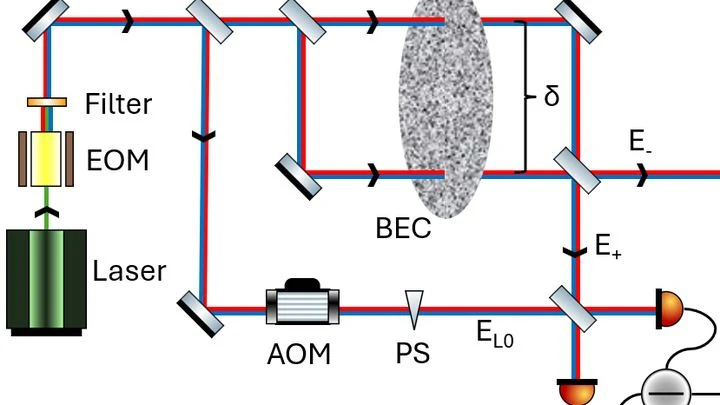
Physicists have proposed an experiment: a laser beam acts as a quantum detector and splits into two beam-ears. Each ear is directed through a tiny cloud of ultracold atoms — in this state, atoms merge into a single wave.
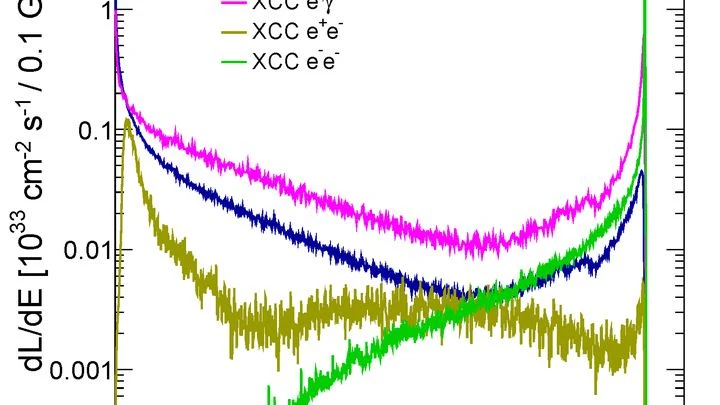
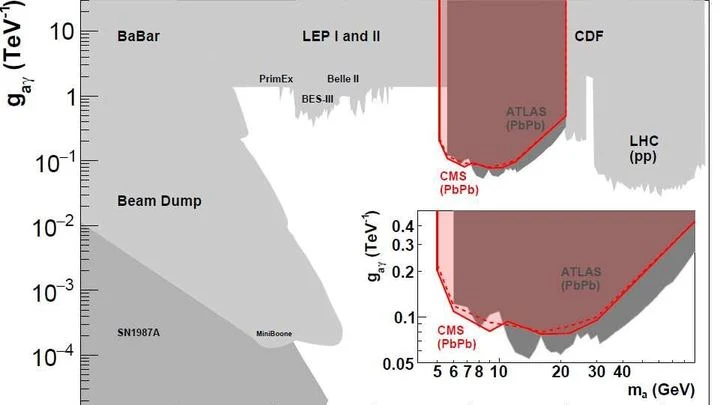
Two blindingly bright beams smash head-on. At the point of impact, a particle is born for an instant — the very one responsible for the mass of everything in the universe. That's the Higgs boson. Usually, it's produced by accelerating protons or electrons, but here the projectiles are particles of light themselves — photons.
The Standard Model is a set of rules for all known particles. But it says nothing about dark matter, which makes up a quarter of the Universe. To find it, you don't need to build city-sized colliders. Radioactive molecules act like sniffer dogs: their incredible 'scent' picks up the faintest traces of unknown forces that slip past giant machines.
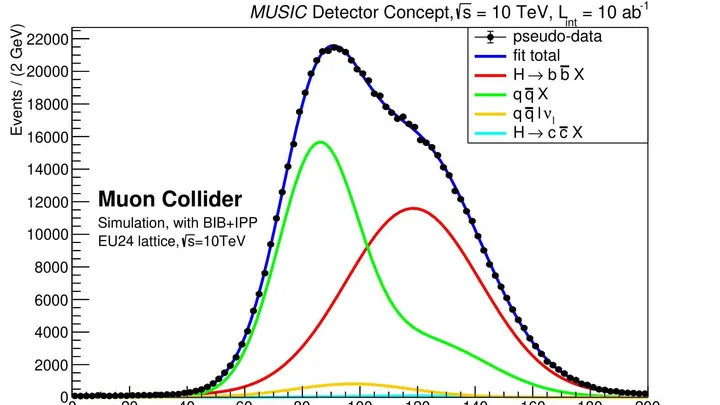
The Higgs boson is like a conductor that gives mass to all other particles. Without it, electrons would be massless and atoms would fall apart. But how does the conductor interact with itself? That is the key question a future muon collider aims to answer.
In a giant particle accelerator, particles smash into each other, and sometimes after the collision only two photons, particles of light, remain. Physicists can predict how often this happens, but their calculations have long disagreed with what detectors see. Each refinement of the theory changed the answer, and there was no consensus.
When two particles fly at almost the same speed in the same direction, their signals in the detector merge, like two voices in unison. Telling a duet from a soloist is an art in itself.
At the Large Hadron Collider, protons collide, and from the flash dozens of particles are born. Among them may be traces of rare processes — for example, the decay of a Standard Model Higgs boson into two W bosons. But these particles fly apart so quickly that their tracks merge into a single wide jet.
A ring road around the Sun, where the traffic is not cars but clumps of matter. The diameter of this road is measured in light-years: it encircles our planetary system at its outer edge, in the Oort Cloud, where the star's weak gravity still holds sway.
In the kitchen, two flashlight beams pass through each other without noticing. Light barely interacts with light. But if you accelerate particles to enormous energies, two photons can collide and give birth to something new.
A laser strikes a target, and a cloud of plasma, accelerated to hundreds of kilometers per second, shoots into the chamber. The chamber isn't empty: it's filled with a tenuous gas that plays the role of the cosmic medium. The plasma slams into this gas like a speedboat hitting still water, shoving it aside.
In giant particle accelerators, particles fly at nearly the speed of light and smash head-on. But sometimes one beam is slightly denser than the other, like someone stepping onto a packed escalator the wrong way. Then collisions become uneven, and detectors start 'flickering,' throwing off measurements.
In a collider detector, each proton collision leaves a trail of dozens of particles, like the splash from a stone thrown into water. Making sense of that splash and understanding what exactly happened at the moment of impact is a task that humans can no longer handle alone.
Fresh after the Big Bang, the Universe fizzed like a freshly poured soda. All of space was filled with bubbles — regions of new vacuum, the kind governed by the Standard Model, pushing out the old unstable state. The walls of these bubbles accelerated to near light speed, and in head-on collisions they crumpled and burst, unleashing monstrous energy.