A Laser That Doesn't Need a Perfect Cavity express
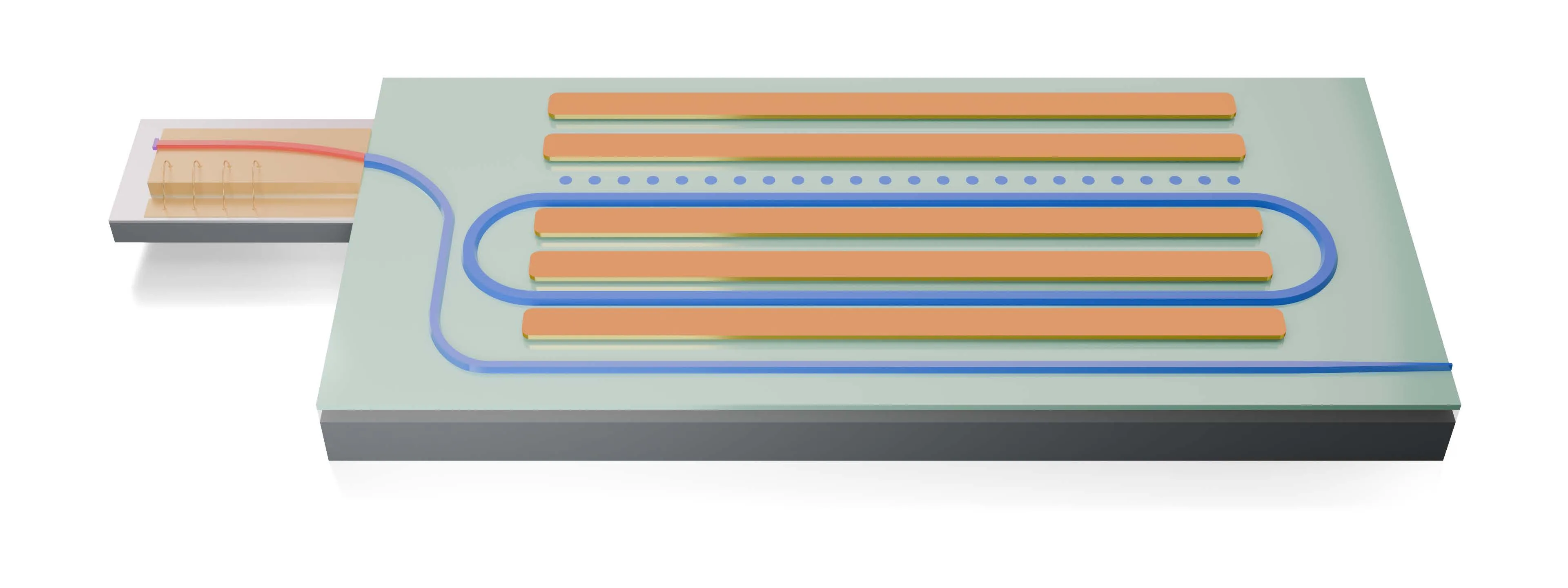
A tuning fork sounds incredibly pure, but touch it and the pitch changes almost instantly. Engineers faced a similar challenge: creating a laser that simultaneously possesses two seemingly incompatible properties — exceptional spectral purity (a very narrow emission line, like a tuning fork producing a single note without wobble) and the ability to rapidly tune that frequency. In conventional lasers, purity is achieved using a optical resonator with a very high quality factor — essentially a light trap where photons live long. But such a trap is inertial: like a heavy flywheel, it prevents quick changes in "pitch."
The authors took a different route. Instead of making the resonator ultra-high-Q, they applied strong synthetic feedback — an electronic loop that actively suppresses phase noise. Structurally, this is realized as a hybrid laser on a lithium niobate crystal: an external cavity with a built-in distributed Bragg reflector (a kind of "mirror" with a periodic structure) is tuned via the Pockels effect — a rapid change in refractive index under an applied electric field. The result is a laser with a short-term linewidth of just 29 Hz at a resonator Q-factor of only 0.62 million — orders of magnitude lower than typically required for such purity.
The modest Q-factor removes the limitation on tuning speed: the laser can change frequency at rates up to sub-exahertz per second (faster than $10^{17}$ Hz/s), and the chirp nonlinearity (deviation from an ideal linear frequency sweep) is only 0.14%. To assess practical utility, the researchers built a frequency-modulated continuous-wave lidar using this laser. Without complex chirp linearization algorithms, the system achieved a relative distance measurement accuracy of 1.7×10⁻⁴ at a data acquisition rate of 1 million measurements per second. Additionally, the laser was used for fiber-optic acoustic sensing: it reliably detects dynamic strain below one part per million (sub-με), comparable to stretching a kilometer of fiber by the thickness of a human hair.
Returning to the tuning fork analogy: the new laser not only sounds pure and easily changes pitch: it does so in unison with electronics that "sing along," removing excess noise. This approach promises inexpensive yet high-performance sensing systems for precision metrology, from mapping to monitoring the health of bridges and pipelines, where both speed and accuracy matter.
Original abstract
as written by the authors arXiv:2605.17491
Lasers that combine narrow linewidths with rapid tunability are critical for applications such as coherent optical ranging, distributed fiber-optic sensing, and precision spectroscopy. Despite significant progress in integrated laser technologies, the concurrent realization of low phase noise and frequency agility on a single integrated platform remains challenging owing to a fundamental architectural trade-off: conventional integrated laser designs typically suppress phase noise via high-$$Q$$ resonators, yet the extended photon lifetimes inherent to such resonators intrinsically constrain tuning speed. Here, we address this noise-agility trade-off by introducing a laser architecture that achieves ultralow phase noise and ultrafast tunability simultaneously. Rather than relying on ultrahigh-$$Q$$ resonators for self-injection locking, our design employs strong synthetic feedback within a Pockels-tunable, resonator-enhanced distributed Bragg reflector to suppress phase noise. As a proof of concept, we demonstrate a hybrid integrated laser with a short-term linewidth of 29 Hz, realized using a lithium niobate external cavity with a loaded $$Q$$ of only 0.62 million. The adoption of a moderate resonator $$Q$$ relaxes the photon-lifetime constraint on tuning speed, enabling sub-exahertz-per-second tuning rates and a chirp nonlinearity as low as 0.14%. Leveraging this laser, we implement a frequency-modulated continuous-wave LiDAR system that achieves a relative ranging precision of $$1.7 \times 10^{-4}$$ at a measurement rate of $$1\,\text{MSa s}^{-1}$$, without requiring complex chirp linearization techniques. We further demonstrate fiber-optic acoustic sensing capable of detecting sub-$$\mu\epsilon$$ dynamic strain, underscoring the platform's versatility for high-speed precision optical measurements. Our work provides a route toward cost-effective yet high-performance sensing and metrology systems.
A linewidth of 29 Hz is so narrow that if this laser were a radio transmitter, its signal could be picked up by an ordinary household receiver tuned to within fractions of a hertz.
The technology resembles the "light-scalpels" from "Dune," where lasers are used for ultra-precise measurements and real-time communication over vast distances.