How Motion Teaches a Detector to Distinguish Directions express
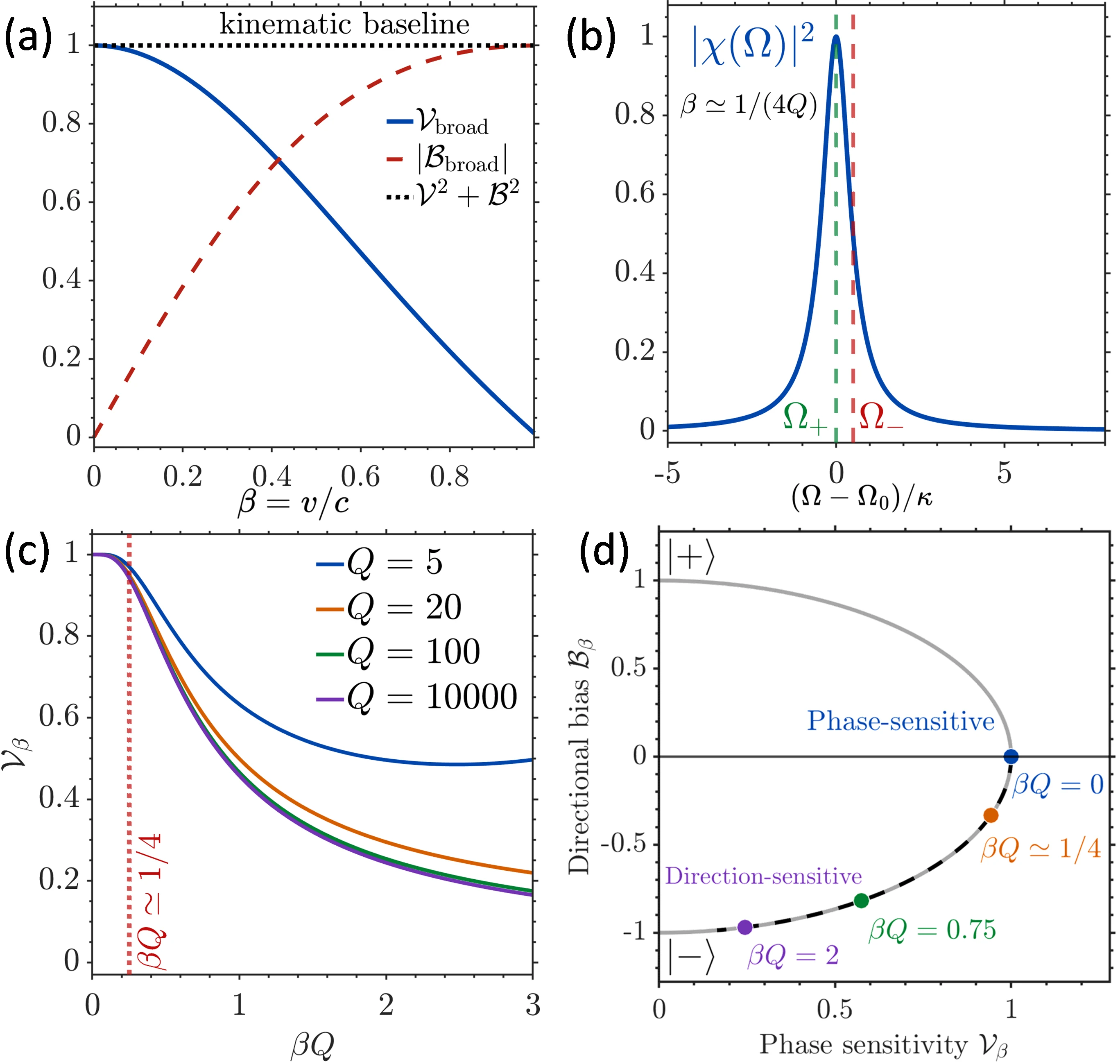
An ordinary photometry detector can't tell a left photon from a right one. But let it start moving, and everything changes. Imagine a rower moving between two flutists playing the same note. His ear is perfectly tuned to that note and ignores all others. As he moves, the pitch from the flutist ahead sounds higher, and from the one behind sounds lower. His ear picks out only the note whose Doppler shift hasn't pushed it outside his sweet spot. In the end, he hears only the flutist in front. The exact same principle applies to light. When a moving detector is sensitive only to a narrow frequency band, as in spectroscopy, oncoming photons 'blue-shift' for it, while receding photons 'red-shift' (the Doppler effect). If the shift caused by the finite speed of light falls within that narrow range, the detector favors one direction. That's how motion gives birth to directionality. The most surprising part: the photon itself doesn't pick a side — it remains in quantum uncertainty, as if walking two paths at once. The detector merely tilts the odds in favor of one.
Original abstract
as written by the authors arXiv:2605.21206
Photodetection is usually treated in the frame in which the detector is at rest relative to the optical apparatus. We show that uniform motion of an electric Glauber detector changes the single-click POVM realized on two counterpropagating single-photon modes. Motion Doppler-shifts the alternatives in the detector frame; finite bandwidth then converts propagation direction into a detection bias without decohering the photon. For a Lorentzian response near one Doppler branch, the readout crosses from phase-sensitive to direction-sensitive with a quality-factor-enhanced onset. Finite-time integration adds Doppler-beat visibility loss, separating passive covariance from measurement change.
Curiously, while the detector gains directionality, the photon stays in superposition — it doesn't 'choose' a path. Motion only increases the probability of registering it from one side, without violating quantum uncertainty.
In sci-fi, sensors often pick up signals from space — this effect could help tell which side an object is approaching from, without bulky antennas.