Spontaneous parametric down-conversion (SPDC) is a nonlinear optical process in which a single high-energy photon, called the pump, spontaneously splits into two lower-energy photons, conventionally labeled signal and idler. This process occurs inside a nonlinear crystal, where the electric field of the pump light is strong enough to alter the material's refractive index in a way that couples the three photons. The two emitted photons are perfectly correlated in energy and momentum, and they are entangled in various degrees of freedom, such as polarization or time of emission. SPDC is the most widely used source of entangled photon pairs in quantum optics experiments.
History
SPDC was first observed in 1970 by David Burnham and Donald Weinberg at the National Bureau of Standards in the US, using a nonlinear crystal and a laser. The theoretical framework was laid earlier by Louisell, Yariv, and Siegman in 1961. The process gained prominence in the 1980s when Alain Aspect used it to test Bell inequalities, and it has since become a cornerstone of quantum information science.
How it works
In a nonlinear crystal, the polarization response to an intense electric field is not perfectly linear; it contains a quadratic term that can mix frequencies. When a pump photon at frequency ω_p enters the crystal, there is a small probability that it is annihilated and two photons at frequencies ω_s and ω_i are created, such that ω_p = ω_s + ω_i (energy conservation) and k_p = k_s + k_i (momentum conservation, called phase matching). The process is 'spontaneous' because it is triggered by vacuum fluctuations — no external stimulus is needed. The crystal is typically cut at a specificangle to achieve phase matching, and the emitted photons emerge in cones of directions determined by the phase-matching condition.
In practice
SPDC is the standard source of entangled photon pairs for quantum key distribution, quantum teleportation, and tests of fundamental quantum mechanics. It is also used in quantum imaging and in generating heralded single photons for photonic quantum computing.
Fun fact
SPDC can even occur with sunlight as the pump source, as demonstrated in 2014 by researchers in Italy, who produced entangled photon pairs using solar radiation focused into a nonlinear crystal.
A courtroom interpreter must relay every word without being distracted by noise in the room. In the quantum world, a superconducting resonator plays that role, losing photons on schedule without straying into spurious effects.
Imagine a green beam that, passing through an ingenious optical setup, twists into a three-dimensional funnel of light — an optical vortex. At its heart, like in the eye of a hurricane, the intensity drops to zero. It is there that photons disappear.
An electron and its antiparticle — the positron, predicted by Дираком, — upon meeting, momentarily form позитроний: a tiny pair circling each other, like in an atom but without a nucleus. Almost instantly it decays, emitting two photons that turn out to be mysteriously linked.
A thin film of molybdenum disulfide, less than a micron thick, acts as a miniature photon-pair factory built right into a fiber-optic connector.
Ordinary optical fiber is not just a glass thread for the internet.
An ordinary photometry detector can't tell a left photon from a right one. But let it start moving, and everything changes.
Imagine a rower moving between two flutists playing the same note. His ear is perfectly tuned to that note and ignores all others. As he moves, the pitch from the flutist ahead sounds higher, and from the one behind sounds lower.
A quantum computer is like an orchestra where every musician-qubit must play in perfect silence. But when you have many such orchestras that want to perform together, they need a reliable conductor-communicator.
A flashlight beam in a dark room can hold a dust mote almost still: that's how optical tweezers work. But light doesn't just push the particle; it also jostles it with random kicks. Each absorbed photon strikes it like an invisible hammer. The authors of the new study have devised a light trap of a special shape.
Light isn't just straight rays; it's electromagnetic waves that can twist through space like a pair waltzing. Physicists call their total twist orbital angular momentum, and for a long time it was thought to obey the conservation law — a fundamental principle that follows from the symmetries of nature discovered by Emmy Noether.
Vacuum is not silent emptiness, but a boiling cauldron of quantum fluctuations, born from nothing and vanishing in billionths of a second. This invisible symphony acts like a constant wind, pressing an atom against a wall — as if a powerful bass note pushes a light ball.
A gamma-ray burst is a brief but extremely powerful flash of light, born from the merger of neutron stars or the collapse of a massive star. Inside such a flash, plasma flows race at enormous speeds and collide with each other.
In a molecule resembling chlorophyll and built from carbon, a metal atom at the center acts as a toggle. Shifting it by fractions of a nanometer can make the molecule glow, quench, or boost its brightness a hundredfold.
A factory smokestack releases carbon dioxide into the air, and nearby stands a unit that captures this gas and, under sunlight, assembles ethylene molecules from it — the feedstock for plastic bags and pipes. Materials scientists have brought this scenario closer by modifying a crystal of the semimetal PdSn4 with a small amount of platinum.
If you toss a stone into a pond, ripples spread across the water. Tiny magnetic crystals also host waves — except it's not water that oscillates but the direction of magnetization. These are called spin waves. They travel through the crystal like ripples on a surface and can carry information.
A light beam passing through a piece of glass usually just bends slightly. But if you engrave ultra-fine patterns inside the glass with a laser, you can make the light split into separate beams, much like white light fans out into a rainbow after rain.
Quantum communication via satellite is like a roll call between two distant lighthouses: the beam must hit the detector exactly, or the message can't be read. But in space, everything shakes — sunlight heats the hull, thrusters cause vibrations, and delicate optics drift off-axis.
Light from an ordinary lamp is chaos: photons scatter in all directions with no order. But if you make many atoms emit light simultaneously and in sync, you get a short, powerful flash, like applause that turns individual claps into a single burst. Such coordinated emission is called superradiance.
An ordinary laser emits photons one by one, like a faucet dripping water. But what if you need several particles of light born at the same instant? Physicists have made a cloud of cold rubidium atoms emit quadruples of photons — as if the faucet suddenly released four drops at once, each falling into its own test tube.
At a temperature of 4.3 degrees above absolute zero, a crystal of palladium telluride stops resisting electric current. Electrons pair up and move without loss, like a crowd holding hands. But this superconductor seems to have not one but two different ways of pairing.
Entangled photons are like twins: what affects one instantly affects the other, even if they are separated by kilometers. Until recently, observing such a connection required detectors that counted each photon individually in pitch darkness. Physicists simplified the task by swapping them out for a regular scientific camera.
Physicists have for the first time created a trio of photons entangled as a single whole, not just pairwise. To achieve this, a special chip was cooled to a temperature hundreds of times lower than that of deep space — any noise threatened to destroy the fragile link.
A laser on a lithium niobate crystal comes to life with a current of 40 milliamps. Its light splits into two streams, each passing through a six-millimeter waveguide, where twin photon pairs are born. One stream rotates the polarization of its twins, after which both flows merge into a common channel.
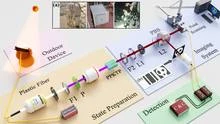
Sunlight collected by a Fresnel lens and passed through 20 meters of plastic fiber had a power of just 3 microwatts, a million times less than a typical laser pointer. That was enough to generate photon pairs correlated in position inside a nonlinear crystal. One photon from each pair passed through the object, the second was scanned by a detector, and coincidences built up the image.