Gamma-Ray Candle Markarian 421 Trims Its Own Flame express
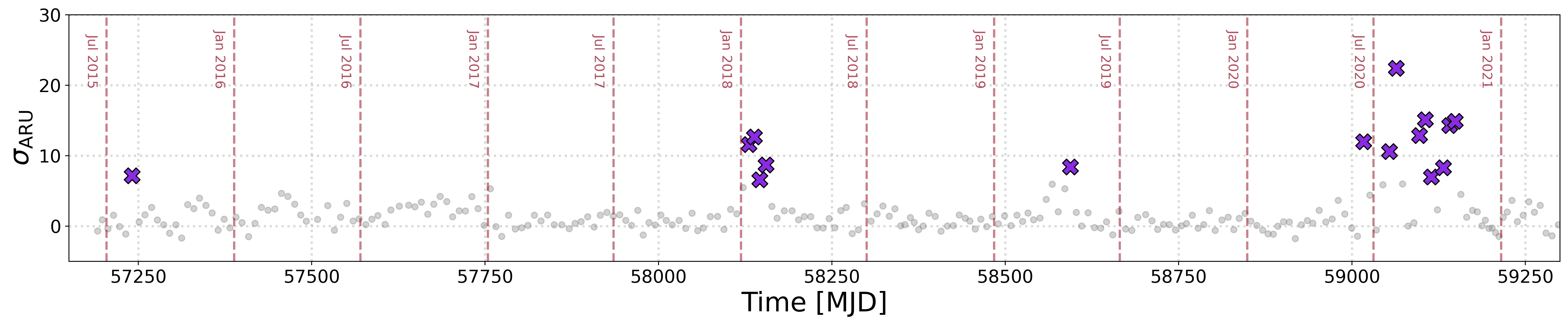
A spotlight shines ever brighter, but at some limit the bulb suddenly burns out, and no more light comes through. Astrophysicists have seen something similar in the distant blazar Markarian 421. This is an active galaxy whose jet of superheated plasma points almost straight at Earth, like the beam of a cosmic lighthouse. The HAWC telescope, perched high in the mountains of Mexico, has kept a continuous watch on this object, accumulating observations over 2460 transits through its field of view.
During quiet periods, the gamma-ray emission from Mrk 421 resembles steady noise. But when the source enters a high-activity state, the picture changes dramatically. Instead of a smooth spectrum stretching on without end, a sharp cutoff appears at an energy of about 13 TeV (tera-electronvolts). It is as if a sound suddenly stops on a single note, and then silence. The researchers checked: a model with an exponential cutoff fits the data at a significance level of 3.8 sigma, far more convincing than a simple power law without a break.
The most intriguing part is the nature of this cutoff. Normally, gamma rays on their way to us can lose energy by colliding with photons of the extragalactic background light (the faint glow of all stars and galaxies over the universe's history). But calculations show that the observed cutoff does not match what would be expected from such absorption. This means the source itself stops emitting particles above a certain energy: its internal "fuse" blows before the intergalactic medium can interfere. This allows scientists to place upper limits on the brightness of the background light itself — a fundamental property of the cosmos that is difficult to measure directly.
So the blazar, like a burning-out lightbulb, not only reveals its own inner workings but also helps us see the invisible web of light that permeates the entire universe.
Blazars are the same as quasars, except their jets are aimed straight at us. If such a beam passed through our galaxy, it could sterilize planets hundreds of light-years away.