Popular

Ghosts of the Universe: Neutrinos as Dark Matter ⚡ экспресс

Original: "Particle Physics in Curved Spacetime and Dark Matter"
arXiv:2605.26134 · 2026-05-21 · CC BY 4.0 · ⏱ 1 min · General Relativity HEP Theory
Ghostly neutrinos, constantly shifting their identity, create hidden mass and keep galaxies from flying apart.
Abstract

Using quantum field theory in curved spacetime, it is shown that the 'flavor vacuum' of neutrinos (a special quantum state of mixing particles) behaves like dust and cold dark matter. In a weak gravitational field, such a vacuum creates a correction to the Newtonian potential, resembling the Yukawa potential. This correction naturally explains the puzzlingly flat rotation curves of spiral galaxies — a key piece of evidence for the existence of dark matter. Thus, neutrino mixing, well-known to physicists, becomes an unexpected contributor to the dark mass of the Universe.

Links in the knowledge graph 1

📄 Showing the "Simple" version — "Popular" is not ready yet. Add it to favorites to help prioritize it.

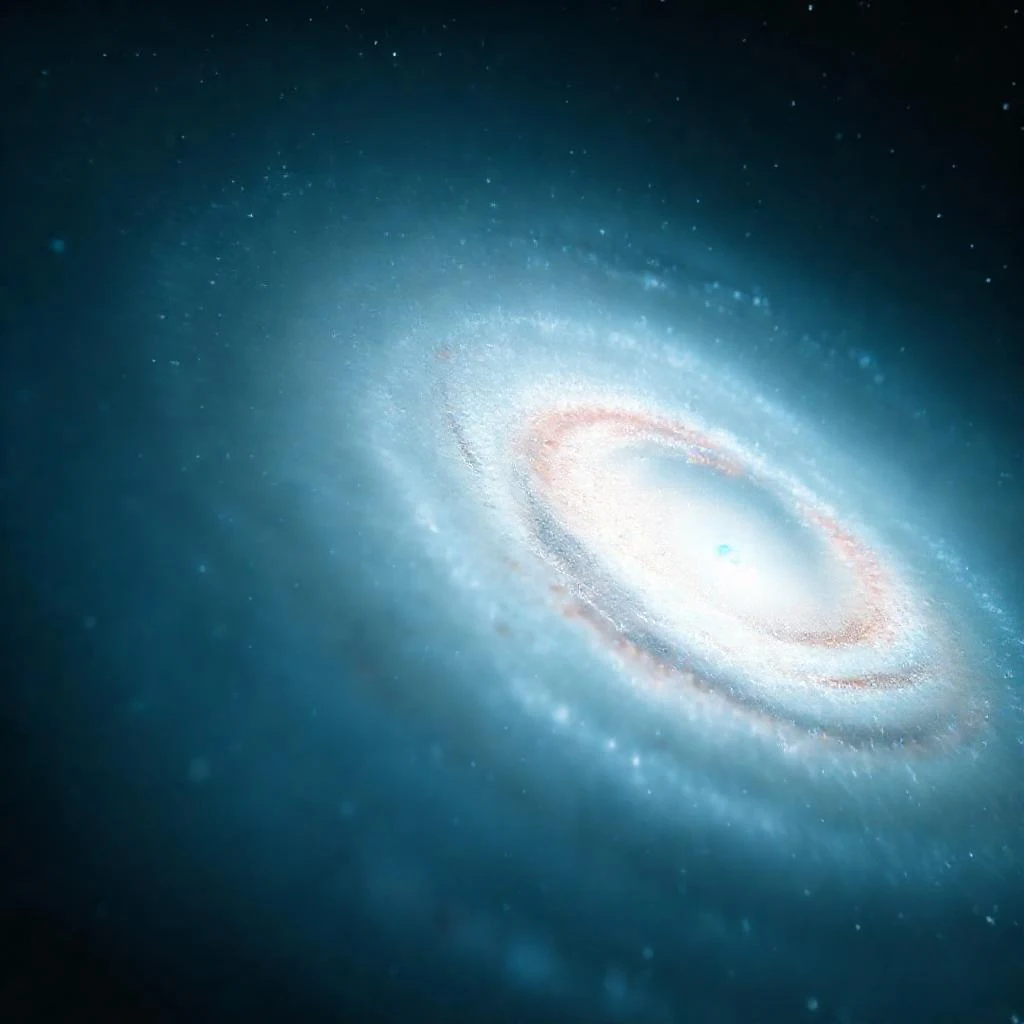
For nearly a century, astronomers have watched galaxies spin as if held together by invisible mass. Fritz Zwicky first noticed it, and Vera Rubin precisely measured the speeds of stars at the edges. The explanation — dark matter, a mysterious substance whose gravity stops stars from flying apart.

Trillions of neutrinos pass through us every second — almost intangible, like ghosts.

A new hypothesis: the ghostly nature of neutrinos itself creates the missing mass. In curved spacetime, different types of neutrinos continuously morph into each other, like ghosts changing guises. These transformations generate energy, which on galactic scales amplifies the gravitational pull. So silent ghosts become the invisible glue holding galaxies together.

🎯 Every second, about 100 billion neutrinos from the Sun pass through your pinky fingernail.

Scientists
Albert EinsteinFritz ZwickyVera RubinEmmy NoetherRobert H. DickeWolfgang Pauli
Tags
dark matter galaxy spacetime curvature Standard Model
Laws
gravitational lensingNoether's theoremequivalence principlespin–statistics theoremFermi's golden rulevirial theorem
Original: arXiv:2605.26134 · CC BY 4.0 · bridge42worlds