Salvatore Capozziello

9 articles · 22 co-authors · latest: 2026-07-28
90 citations · h-index 5 · 14 papersData: Semantic Scholar

We have retold 9 papers by this author. 3 of them with a full read. most often about: dark energy, redshift, cosmological constant. 22 co-authors across our retellings.

Links in the knowledge graph
Cosmology2025-08-142 minarXiv:2508.10514
The Universe's Rhythm: Dark Energy May Be Falling Out of Step
The universe is expanding, and the pace of that expansion is set by dark energy, the mysterious force accelerating the recession of galaxies. In the standard cosmological model, its density is constant: a cosmological constant, an unwavering metronome since the birth of the cosmos.
Dark Energy: The Actor Changes Its Mask
The universe is putting on a show, and the lead role goes to dark energy. For a long time, the actor seemed unchanging: the cosmological constant (the vacuum energy that accelerates cosmic expansion) set the same tone throughout.
Cosmology2025-10-241 minarXiv:2510.21976express
General Relativity2026-01-151 minarXiv:2601.10806express
A Black Hole with an Icy Surface
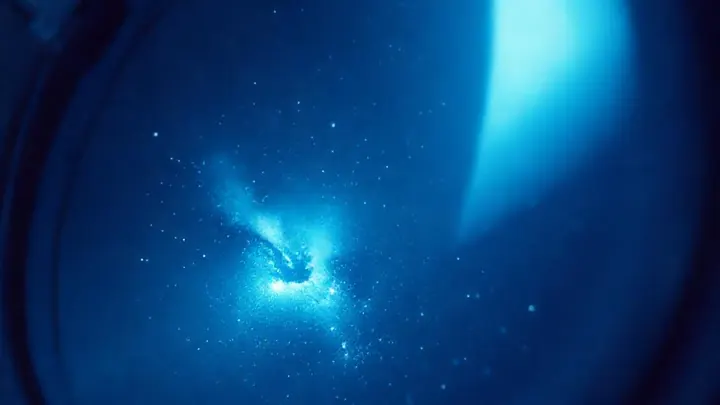
An ordinary black hole is an abyss into which everything falls irretrievably. But a new model paints a different picture: at its edge, time freezes, and the hole becomes a frozen whirlpool. Light and matter don't fall in but stick fast to the surface — causing a bright spot to appear within the shadow.
General Relativity2026-05-211 minarXiv:2605.26134express
Ghosts of the Universe: Neutrinos as Dark Matter
For nearly a century, astronomers have watched galaxies spin as if held together by invisible mass. Fritz Zwicky first noticed it, and Vera Rubin precisely measured the speeds of stars at the edges.
General Relativity2026-06-162 minarXiv:2606.17580express
Gravity Without Spacetime
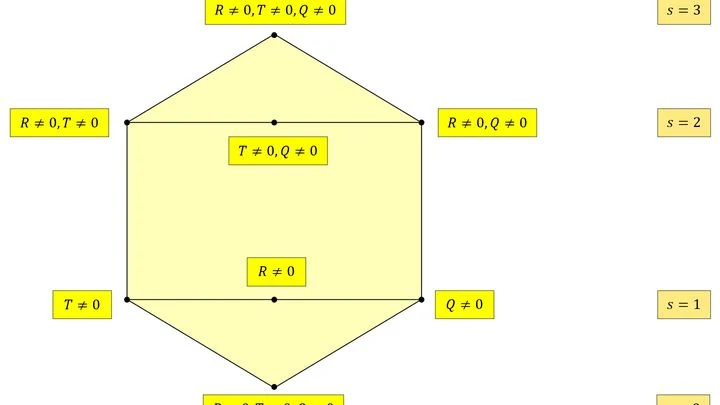
Gravity is usually explained through the curvature of spacetime. Massive bodies press it down like a bowling ball on a stretched rubber sheet. But this approach has two lesser-known twins. In one, gravity arises from torsion (twisting) of spacetime; in the other, from its non-metricity (when lengths and angles change during transport).
General Relativity2026-06-271 minarXiv:2606.28956express
Vacuum by the Book
A ball sits in a pit. It won't roll out on its own: it needs a push. But in the quantum world, a particle can leak through a barrier without extra energy. This trick is called tunneling.
Cosmology2026-07-123 minarXiv:2607.10607
General Relativity2026-07-281 minarXiv:2607.25311express
How Black Holes Ring After a Strike
A stone falls into still water — ripples spread across the surface. A black hole behaves similarly when something falls into it or when it merges with another black hole. The hole begins to oscillate, and these oscillations propagate through space as gravitational waves.