Neutrino flavor changes on schedule express
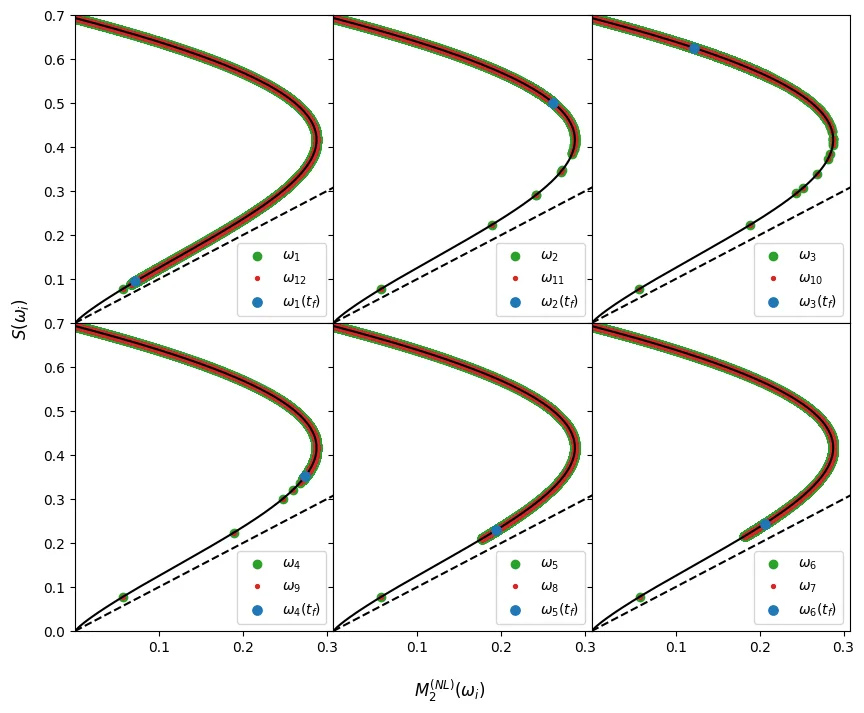
Neutrinos are nearly elusive particles that permeate everything around us. In a dense cloud, such as during a star explosion, they begin to collectively change their type, or 'flavor.' This process is like a crowd of people synchronously changing the color of their clothes, but not all at once — rather in waves. For a long time, it was unclear why the transitions happen abruptly, as if someone were flipping a switch.
The authors of the study looked inside the quantum 'orchestra' of neutrinos using a computer model. They measured two resources: entanglement (how much particles are linked to each other) and nonlocal magic (a measure of how hard it is to predict the system's state). It turned out that exactly at the moment of a sharp flavor change, entanglement peaks, while magic drops. This is like musicians in an orchestra suddenly playing in tune and predictably, although before that each was improvising on their own.
This picture is not just beautiful. It offers a practical recipe: if we know where entanglement is maximal, we can build more efficient computer simulations. Instead of calculating every particle, it's enough to track these special points. This could help understand how neutrinos affect supernova explosions and the formation of elements that make up ourselves.
In a dense neutrino cloud, particles interact so strongly that their collective behavior resembles a single organism. One particle cannot 'decide' to change flavor: it's always the result of a collective dance of billions.
In Stanislaw Lem's novel 'Solaris,' the ocean manifested itself through complex, inexplicable structures. The behavior of a neutrino cloud is somewhat similar: an outwardly chaotic medium is internally organized by strict quantum rules that we are only beginning to understand.