Black Holes Wrapped in a Gas Cocoon express
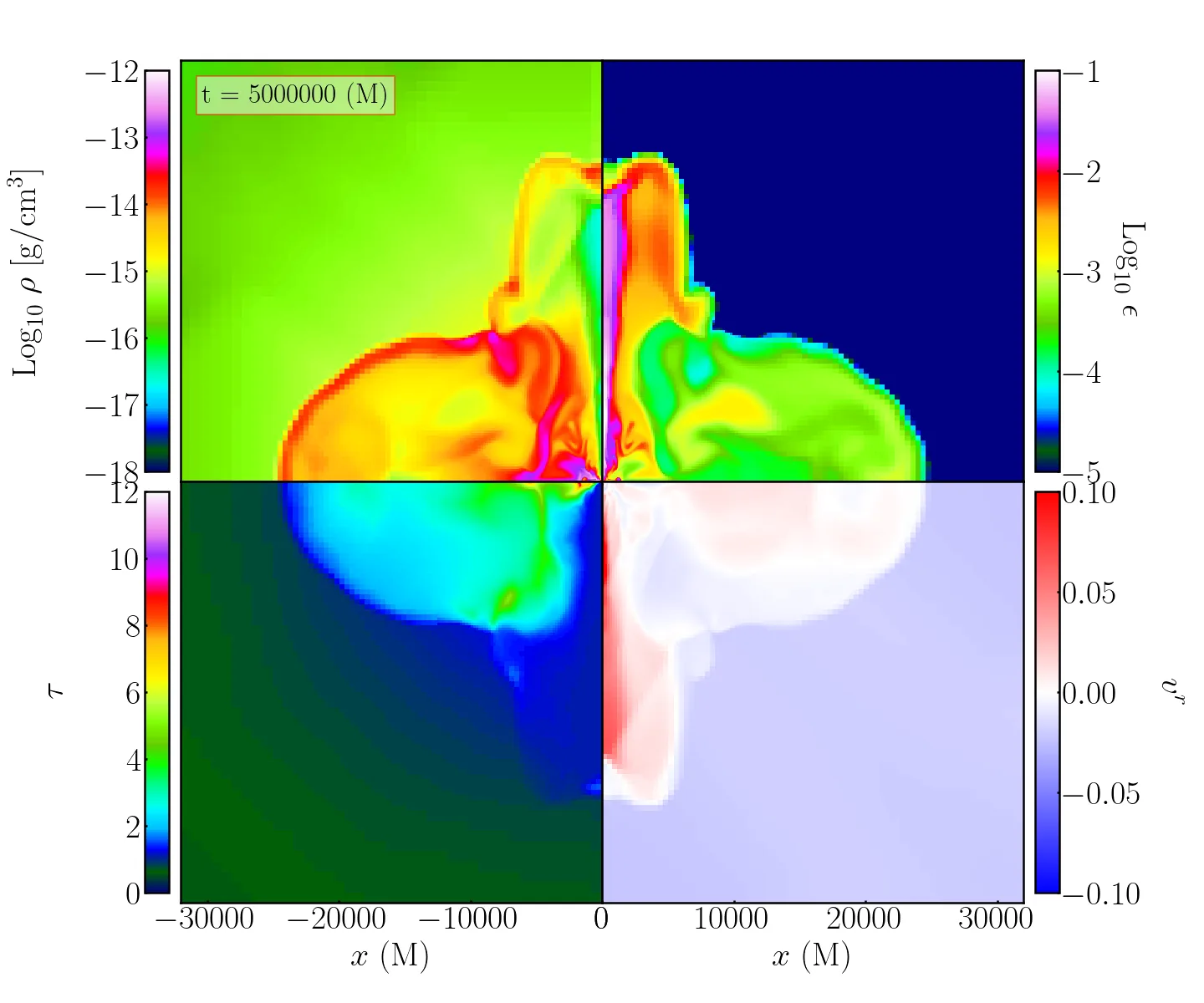
Water plunges into an abyss, but part of it shoots back up — churning and foaming at the very edge. That's roughly how gas behaves as it flows onto a supermassive black hole when its stream becomes too dense. In a new study, scientists traced this picture using computer simulations. They accounted for the effects of general relativity — how a black hole warps space and time around itself.
The calculations considered black holes with masses from 100,000 to 10 million solar masses. Gas fell onto them at a rate close to the Eddington limit — the threshold beyond which the pressure of light should push matter away. The fate of this gas depends on how heavy the central black hole is. If it's not too massive, up to a million solar masses, radiation trapped in the inner region accelerates some of the gas and ejects it through the poles in narrow jets. This creates a layered structure: streams of matter flow both inward and outward.
For more massive black holes, over three million solar masses, the picture is different. Radiation can no longer punch through the thick infalling gas, and no outflows occur. Instead, an extended shell gradually forms around the hole. It's like a boiling pot with a tight lid: the gas inside constantly churns but barely reaches the event horizon. In both cases, only about ten percent of what would fall in under free-fall actually reaches the black hole itself. The rest is either carried away or gets stuck in the shell.
This result is important for understanding how supermassive black holes grow in the centers of galaxies. If a massive shell accumulates around a black hole, it could hide it from our telescopes for a long time. Then, when heating exceeds a critical threshold, it might flare up and eject the accumulated material. Such processes may explain the mysterious synchronization of growth between black holes and their host galaxies.
Original abstract
as written by the authors arXiv:2605.24087
By performing a viscous hydrodynamics simulation in general relativity for super-Eddington accretion flows onto massive black holes of mass $$M=10^5$$--$$10^7M_\odot$$, we discuss a formation scenario for black hole-envelope systems. We consider the mass accretion rate of $$a^3/G \approx 1.5 \times 10^{25} (a/10\,\mathrm{km\,s^{-1}})^3$$\,g/s, comparable to the Eddington mass accretion rate of a $$10^7M_\odot$$ black hole, assuming that the gas temperature of the infalling matter is $$\lesssim 10^4$$\,K. Here, $$a$$ and $$G$$ denote the sound speed and gravitational constant. For the accretion flow, we set up a quasi-spherical Bondi-type flow in which radial inflow dominates over angular momentum in the distant region. It is found that (i) for low-mass black holes with $$M \lesssim 10^6M_\odot$$, a photon-trapped region forms in the inner region, and a significant viscous outflow driven near the polar region overcomes the ram pressure of the mass inflow, leading to an inflow-outflow structure; (ii) for massive black holes of $$M \gtrsim 3 \times 10^6M_\odot$$, the outflow is not launched, and a convective envelope around the black hole gradually develops; and (iii) irrespective of the black-hole mass, the mass accretion rate onto the black hole is of order 10\% of the Eddington accretion rate for reasonable values of the viscous coefficient. As the mass accretion rate onto the black holes is much lower than the mass growth rate of the envelope for low-mass black holes with $$M\lesssim 10^6M_\odot$$, the envelope mass is likely to increase until the total viscous heating rate exceeds the Eddington luminosity of the system, if the mass accretion rate is preserved to be high for $$\gtrsim 10^8 (M/10^7M_\odot)$$\,yrs.
The shell around a black hole can weigh several times more than the black hole itself before it begins to dissipate, like a snowball that grows faster than it melts.
In Greg Bear's novel "The Light of Distant Stars," intelligent clouds around black holes use their radiation to sustain life — an idea that echoes the convective cocoon from this work.