Kenta Hotokezaka

6 articles · 23 co-authors · latest: 2026-07-11
11,622 citations · h-index 45 · 146 papersData: Semantic Scholar

We have retold 6 papers by this author. 3 of them with a full read. most often about: binary star, Accretion disk, black hole merger. 23 co-authors across our retellings.

Links in the knowledge graph
Stellar2026-04-081 minarXiv:2604.06904express
Magnetic Brake for Binary Stars
Two stars orbit a common center, accreting gas from a surrounding cloud. Rotating disks of gas form around each star and around the pair as a whole. From these disks, jets shoot out like hoses. Inside the disks, gas is constantly churned — that's the magnetorotational instability at work.
High Energy2026-05-222 minarXiv:2605.24087express
Black Holes Wrapped in a Gas Cocoon
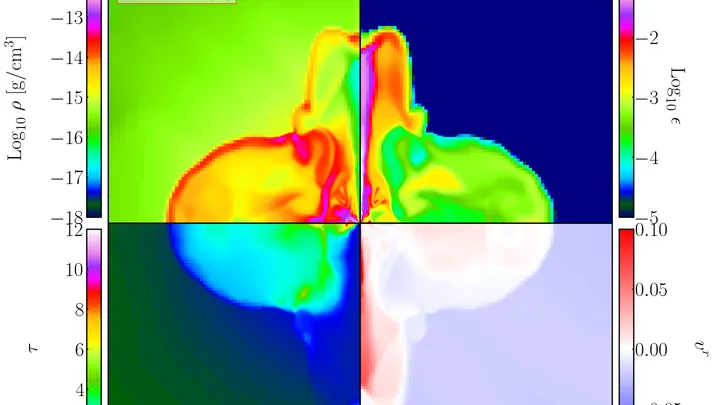
Water plunges into an abyss, but part of it shoots back up — churning and foaming at the very edge. That's roughly how gas behaves as it flows onto a supermassive black hole when its stream becomes too dense. In a new study, scientists traced this picture using computer simulations.
Precious Metal Dust: How Kilonovae Conceal and Reveal Secrets
In August 2017, the LIGO gravitational antennas, built with the decisive involvement of Rainer Weiss, caught a shudder in spacetime from gravitational waves — the merger of two neutron stars.
The Universe's Foundry: Kilonova Dust and the Birth of Gold
When two neutron stars, the ultra-dense cores of dead stars, collide, a kilonova is born: an explosion a thousand times brighter than a typical nova. This is the universe's true smelting works. In the scorching cloud racing outward at near-light speeds, a furious flux of neutrons transmutes atomic nuclei into gold, platinum, osmium.
High Energy2026-07-081 minarXiv:2607.07668express
Strange Stars vs. Neutron Stars: A Duel in Gravitational Waves
Two ultradense spheres, each the size of a city, whirl in a dance. Their masses are less than the Sun's, but inside them is matter compressed to unimaginable limits. One sphere is a neutron star; the other is a strange star, made entirely of quarks — the elementary particles that build up protons and neutrons.
The Spotlight That Turned Away: The Mystery of Transient AT 2019ijn
The cosmos is full of screams we can't hear. Every time a black hole tears a star apart, a blinding flash is born, and often — a narrow relativistic jet, shooting out thousands of light-years. But if that searchlight is aimed away from Earth, we see only a faint afterglow — a radio echo arriving with a delay.