Dark Energy That Changed Its Mind express
An inflating balloon starts out slowly, then suddenly expands faster and faster, as if someone is pumping it up from inside. That's roughly how our universe behaves: galaxies are receding with acceleration. The culprit behind this acceleration is called dark energy. In the simplest picture, it's like a steady hum — a cosmological constant that doesn't change over time. But what if that hum sometimes breaks into a wail and then quiets down again?
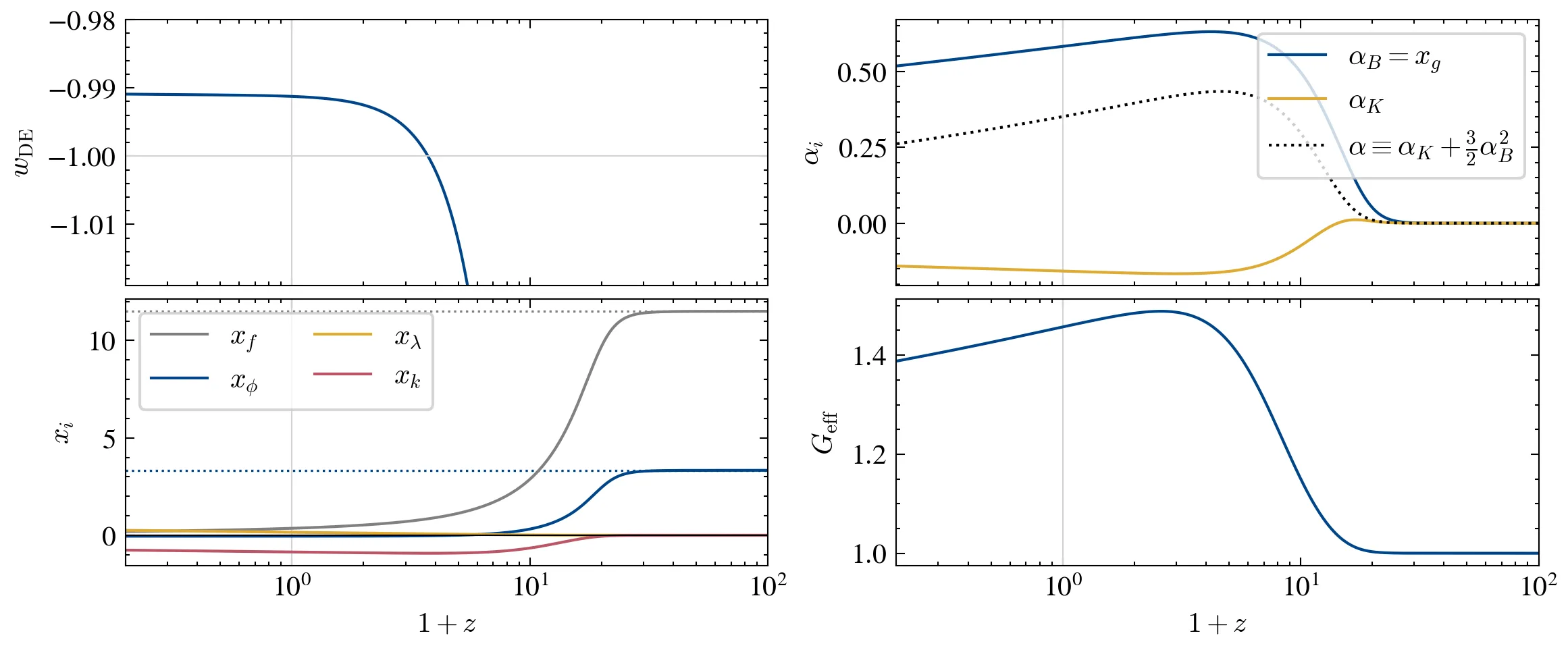
In a new paper, physicists explored exactly this scenario within Horndeski gravity — a framework that adds extra gears and levers to Einstein's gravity, allowing spacetime to stretch in more intricate ways. The key player here is an almost conserved scalar charge — something like a wound-up spring that slowly unwinds, nudging the expansion along. The theory predicts that dark energy can cross the w = −1 boundary. The parameter w is like the 'stiffness' of dark energy: if w is exactly −1, the energy resembles a perfectly uniform mist; if w drops below −1, the mist starts to thicken, and expansion speeds up even more: this is called phantom behavior.
The authors identified three possible ways dark energy could cross this boundary. Each scenario was tested against current data, and none fit. It turns out that simple models, where the transition happens only once and the field's potential lacks a cosmological constant, don't mesh well with what telescopes see. It's like trying to describe a melody with a single note: technically possible, but grating to the ear.
To back up their claims, the scientists released an interactive web app. There, anyone can tweak the parameters and watch how the universe's evolution changes. Perhaps more complex versions of the theory, with multiple transitions or a different potential, might still explain the observed acceleration. But for now, the conclusion is sobering: capricious dark energy refuses to fit into simple frameworks. So the balloon of our universe keeps inflating, and we're still searching for whoever is squeezing the pump.
The parameter w for dark energy has been measured to about 5% precision, and so far it's nearly indistinguishable from −1—but even a tiny deviation would mean the universe's expansion ends in a Big Rip.
In Asimov's novel 'The Last Question,' humanity confronts the inevitable decline of the universe, but there, dark energy behaves meekly, without phantom tricks.