The phantom divide is a critical boundary in cosmology at the equation-of-state parameter w = -1, separating two classes of dark energy models. For w > -1, dark energy is 'quintessence,' a dynamic field whose energy density decreases over time. For w < -1, it is 'phantom' energy, which has the bizarre property that its density increases as the universe expands, potentially leading to a future singularity called the Big Rip. The value w = -1 corresponds to a cosmological constant, the simplest and most widely accepted form of dark energy.
History
The term 'phantom divide' was coined in the early 2000s as observational data from supernovae and cosmic microwave background suggested that w might be less than -1. The concept gained prominence in 2003-2004 with papers by Robert Caldwell and others discussing phantom energy and its implications.
How it works
The equation-of-state parameter w relates pressure p to energy density ρ via p = wρc². For quintessence, w lies between -1 and -1/3, causing accelerated expansion that slows over time. For phantom energy, w < -1, which implies negative kinetic energy in the simplest field models, leading to instabilities. Crossing the phantom divide (w transitioning from above to below -1) is impossible in many single-field models but can occur in more complex theories with multiple fields or modified gravity.
In practice
The phantom divide is a key target for observational cosmology: precise measurements of the expansion history using supernovae, baryon acoustic oscillations, and weak lensing aim to determine whether w crosses -1, which would rule out the cosmological constant and point to more exotic physics.
Fun fact
If phantom energy is real, the universe could end in a 'Big Rip' where all matter, from galaxies to atoms, is torn apart in a finite time — a scenario that has been used in science fiction as a dramatic end-of-the-world plot device.
The cosmological standard model is like a recipe for a cake where everything is strictly measured: dark matter is like flour without a single lump (zero pressure), and dark energy is like the perfect leavening agent (equation of state exactly minus one). But what if the flour is a bit damp and the leavening agent has lost its oomph?
The standard cosmological model ΛCDM (which includes dark energy and cold dark matter) is the score of a cosmic symphony. It describes how space expanded after the big bang. How dark matter clumped together. How galaxies ignited. For a long time, everything played flawlessly.
A climber on a ridge notices something strange: the horizon around them seems to freeze. No forward, no backward — only emptiness and silence. This is roughly the picture painted by new calculations for our Universe. At some point in its expansion, the invisible boundary, the future event horizon, stopped growing.
Cosmic ripples begin with tiny clumps. 380,000 years after the Big Bang, the universe was nearly homogeneous — density fluctuations were only one part in 100,000. But gravity turned these weak ripples into galaxies, clusters, and giant voids.
In the first moments after the Big Bang, cosmic symmetry breaking divided the hot plasma into regions with different vacuums — the lowest energy states of a field.
A cold, black mirror — that's what the sea of dark energy, the invisible substance driving the expansion of the universe, looked like for billions of years. But the DESI spectrograph has caught a faint ripple.
A black hole is not just an abyss where everything falls. Right at its horizon, in the so-called quantum atmosphere, a faint glow is born — Hawking radiation. This is not calm light but a churning stream of particles that can influence the most delicate quantum connections.
The quantum world is often compared to a musical instrument. Each system, whether an atom or a chain of particles, sounds at its own frequencies, which physicists call energy levels. In chaotic systems, like an orchestra without a conductor, these frequencies usually fill the entire available range without gaps.
Since Saul Perlmutter and his colleagues discovered the accelerated expansion of the universe, physicists have been scratching their heads over the nature of dark energy.
Einstein’s cosmological constant — a blunder or a boomerang insight? The universe’s acceleration caught physicists off guard: ΛCDM works, but why is the vacuum energy so absurdly tiny? Imagine an ocean heaving with quantum fluctuations, yet on the surface only a microscopic ripple.
The cosmological kitchen is full of invisible ingredients. Dark matter, like an invisible scaffold, keeps galaxies from flying apart, while dark energy, like yeast in dough, makes space expand ever faster.
The universe is expanding at an accelerating rate, like dough that keeps rising faster even though the yeast ran out long ago. For twenty years, astronomers have been searching for the cause and call it dark energy. But what it is remains a mystery.
New work proposes an unexpected source: the vacuum inside the atomic nucleus.
A translator hears not just words, but intonation, pauses, the tremor in a voice. Ordinary entropy analysis of cosmic perturbations is like meeting minutes: it records facts but loses the nuances. Pseudoentropy entropy is a new tool that captures the hidden "music" of the early universe.
The Universe grows like a metropolis: galaxies skyscrapers are erected on an invisible scaffold of dark matter: its gravity pulling in construction material. Meanwhile, dark energy makes the city itself continuously expand.
The universe is expanding faster and faster thanks to dark energy. But measurements of the rate give contradictory results. A new explanation: in the past, dark energy acted as a brake, slowing the galaxies' recession, and then switched to acceleration. Like a car that first rolls backward and then lunges forward.
In the late 1990s, astronomers including Saul Perlmutter discovered that the universe is expanding at an accelerating rate. The cause was dubbed dark energy — an invisible force stretching the cosmos.
Our universe isn't just expanding: it's doing so faster and faster. It's like raisin bread dough in the oven: the raisins move apart, and the farther they've already separated, the faster they continue to recede. The strange force pushing the cosmos apart is called dark energy. Most scientists think it's constant, like a permanent spring built into the very fabric of space.
An inflating balloon starts out slowly, then suddenly expands faster and faster, as if someone is pumping it up from inside. That's roughly how our universe behaves: galaxies are receding with acceleration. The culprit behind this acceleration is called dark energy.
Imagine a huge layered cake, where the layers of dough are space and the filling is a special region resembling an invisible wall. This wall is not made of bricks but of energy, and it could be as thick as the entire universe. If such a wall exists, it should stretch the dough layers differently: those lying along it spread apart faster, while those across it spread slower.
When a car on cruise control hits a bump, the speed jumps for a moment, but the engine runs smoothly. Something similar was recently noticed with dark energy — the force that makes the Universe expand faster and faster.
Our Solar System isn't an island in the void: it's a sensitive web stretched in a dark cosmic corner. Planets circle their orbits like dewdrops on threads, and we are the spider sensing the faintest tremor. That tremor betrays the approach of the catastrophe astronomers call the Big Rip.
Imagine inflating a balloon. It expands quickly at first, then slows down, and then suddenly speeds up again, as if someone gave the pump another squeeze. That's what seems to be happening to our universe.
Spread a handful of coins on the table. Each coin is a possible outcome: heads, tails, or something else. If we know how chaotic this set is (its entropy), which combinations of probabilities will we encounter more often? It turns out the answer depends on how much chaos we allow.
Sometimes an unwelcome guest sneaks into the equations, like a creaky floorboard that unsettles the whole house. In gravity theories, if you add curvature-squared terms to the equations (which you need to describe very strong fields), a ghost particle appears — heavy but with negative energy.
The universe keeps a tally of every newborn star. Over 13.8 billion years, galaxies have ignited so many stars that their 'census' can reveal the nature of the cosmos itself, just as tree rings reveal past climates.
The universe is expanding faster and faster, and scientists blame it on dark energy. Its origin is explained in a new way: dark energy isn't eternal, but appears only after dark matter clumps together into lumps — future galaxies.
The mechanism works like a pump that turns on when pressure drops.
Dark energy is usually seen as an innate property of the cosmos, at work from the very first moments. But a new model suggests it behaved like water on the verge of boiling: long unnoticed, then suddenly kicking in at a critical moment. This scenario is called 'late activation': around 5–7 billion years ago, a shift occurred, and the universe’s expansion began to accelerate.
Galaxies are flying apart, but the expansion rate measured from the afterglow of the Big Bang and from supernova explosions doesn't match: this problem has been called the Hubble tension. It's like two dancers losing their rhythm because they can't feel each other.
The universe is expanding faster and faster, like yeast dough in the kitchen. This expansion is helped by dark energy — the cosmic sugar. Ever since astronomers like Adam Riess noticed the acceleration in the late 1990s, they've been searching for the cause.
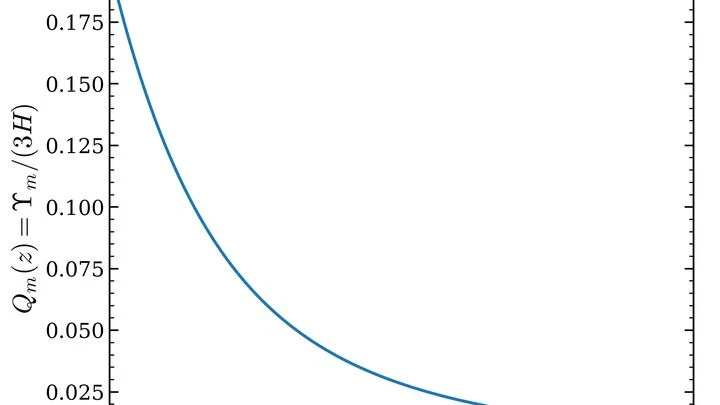
Dark energy and dark matter are the invisible conductors of the cosmos. Usually considered independent, new research proposes seeing them as dance partners. The lead — dark energy — changes the mass of dark matter particles. Like a dancer who lifts and lowers their partner, dark energy increases or decreases the weight of dark matter.
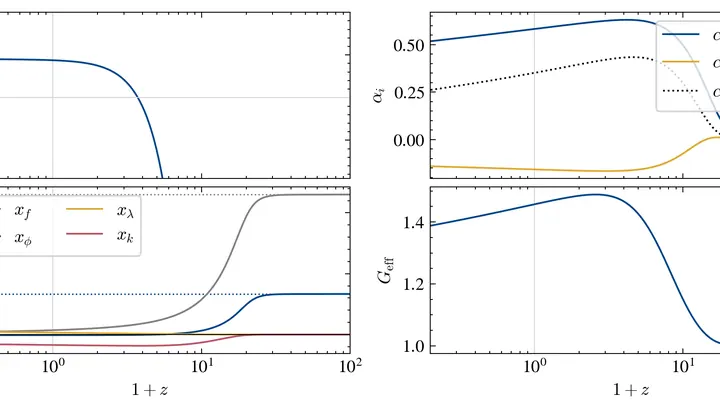
Data from the DESI galaxy survey hint: dark energy was more powerful in the past than today. This 'phantom' behavior threatens the Universe with a Big Rip — a finale where even atoms disintegrate. But the KMIX model explains this as an illusion. Two fundamental fields — like a distorting mirror — warp our picture: constant energy appears variable.
The universe is putting on a show, and the lead role goes to dark energy. For a long time, the actor seemed unchanging: the cosmological constant (the vacuum energy that accelerates cosmic expansion) set the same tone throughout.
The universe is expanding, and the pace of that expansion is set by dark energy, the mysterious force accelerating the recession of galaxies. In the standard cosmological model, its density is constant: a cosmological constant, an unwavering metronome since the birth of the cosmos.
Two telescopes look at the same Universe and see different expansion rates. Local measurements from supernovae give 73.04 ± 1.04 km/s/Mpc, while cosmic microwave background data within the standard model predict 67.36 ± 0.54.
A crowd in a square. At first, everyone spins to their own rhythm, but suddenly the music changes, and they all start moving in sync, as one. That's roughly how electrons behave in some metals: they either cling to magnetic impurities or break away and form a collective order.