Magnetic charge is a hypothetical property that would be the magnetic analog of electric charge. If it existed, it would be carried by particles called magnetic monopoles — isolated north or south poles without their opposite counterpart. In the provided research, magnetic charge appears in the context of monopoles on cosmic strings, which could generate gravitational waves, and in condensed matter systems where emergent monopoles arise in spin ices. The concept is crucial for testing the symmetry of Maxwell's equations and for understanding the early universe.
History
The concept was first proposed by Pierre Curie in 1894, but it was Paul Dirac who in 1931 showed that the existence of a magnetic monopole would naturally explain the quantization of electric charge. No fundamental monopoles have been observed to date.
How it works
In classical electromagnetism, magnetic fields are always produced by moving electric charges or by changing electric fields, and magnetic field lines form closed loops. A magnetic charge would create a radial magnetic field, similar to how an electric charge creates a radial electric field. In quantum theory, the existence of a single magnetic monopole would explain the quantization of electric charge, as shown by Dirac in 1931. In condensed matter, 'magnetic charges' are quasiparticles that emerge from the collective behavior of spins, not fundamental particles, but they obey similar Coulomb-like interactions.
In practice
In condensed matter physics, emergent magnetic charges in spin ice materials are studied for potential applications in magnetic data storage and thermal management devices.
Fun fact
If a magnetic monopole existed, it would be the only known particle with a magnetic charge, and its existence would force the electric charge of all particles to be integer multiples of a fundamental unit.
Units by system: SI: am · CGS: statc · Planck: c · natural: e
A superconductor pushes out a magnetic field like a sponge squeezing out water. This Meissner effect has been known for nearly a century, but it's usually calculated in a flat world — without gravity. In the strong field of a black hole or at enormous speeds, the picture changes.
A black hole is not a vacuum cleaner. By itself, it doesn't pull everything in more strongly than an ordinary star of the same mass. But if there's a magnetic field nearby and charged particles flying around, an interesting game begins.
In the first moments, the Universe expanded at an enormous rate. This process is called inflation, and its driving force is the inflaton field. Its energy pushed space apart, like yeast raising dough. But physicists suspect that the dough might have left 'bubbles'—superheavy particles born from the expansion itself.
Light from the very beginning of the cosmos has been traveling toward us for 13.8 billion years. During that time, its polarization, the direction of its oscillations, might have been twisted, like a compass needle that someone quietly nudged. Physicists call this phenomenon cosmic birefringence.
The early Universe was like a rapidly cooling ocean. At colossal temperatures, everything was one — quarks, electrons, forces all blended into a symmetric 'steam.' But as it expanded and cooled, this steam condensed, phase transitions cascading one after another like water turning to ice.
In a world locked in a crystal lattice and cooled nearly to absolute zero, matter knows how to hide its deepest secrets. A quantum spin liquid is a state where electron spins never freeze, even at zero temperature, remaining in an eternally flickering superposition.
Light from a distant blazar, an active galactic nucleus whose jet points our way, travels for billions of years. Along the way, it triggers cascades of charged particles that the intergalactic magnetic field deflects sideways. This creates a blurred gamma-ray glow around the blazar: a secondary halo.
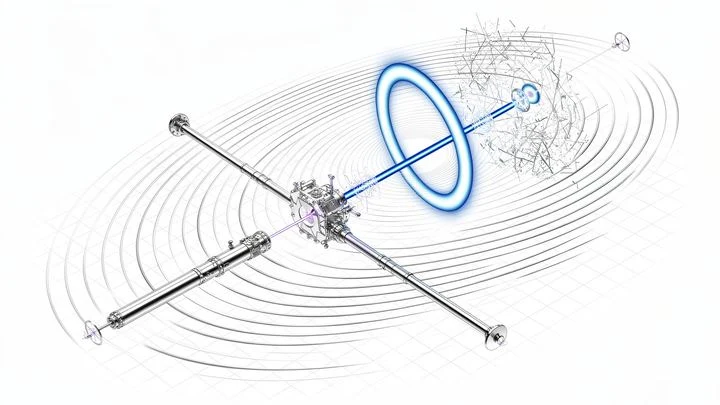
When massive bodies accelerate (say, two stars orbiting each other) the space around them doesn't stay calm. It trembles like the surface of a pond after a stone is thrown. These tremors are called gravitational waves. They carry energy away, and the source gradually loses mass.
A neat stack of atomic layers lies on a substrate. An invisible beam of terahertz light shines down on it, with a magnetic field applied from the side. After reflection, the beam's polarization rotates slightly.
Immediately after the Big Bang, in the seething cauldron of the cooling Universe, much like in unevenly hardening glass, stresses appeared — hairline cracks in reality, cosmic strings. Picture a tightrope walker balancing on an invisible cable stretched across the abyss of warped spacetime.
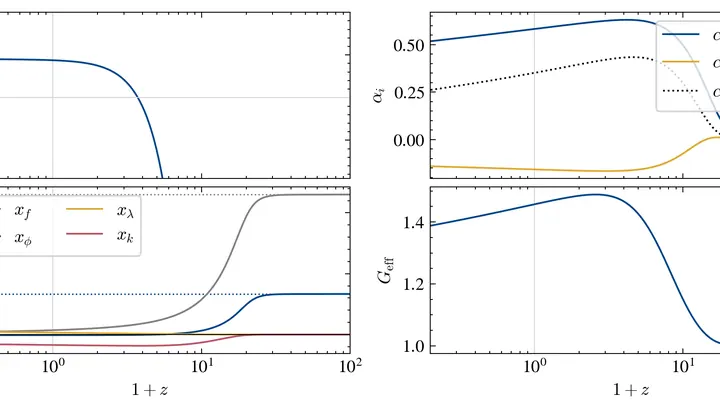
An inflating balloon starts out slowly, then suddenly expands faster and faster, as if someone is pumping it up from inside. That's roughly how our universe behaves: galaxies are receding with acceleration. The culprit behind this acceleration is called dark energy.
Ancient light, traveling 14 billion years, reaches us from all directions. At first glance, it looks perfectly smooth, but if you look closely, tiny fluctuations appear, like ripples on a still pond. Those ripples aren't random noise; they're an encoded history of the universe.
Two electrically charged spheres attract each other with a certain force. If you replace their charges with magnetic poles, a spring scale shows exactly the same force. Black holes, it turns out, behave the same way — except instead of springs, the fabric of spacetime itself does the work.
Deep inside Earth lies a solid iron core about the size of the Moon. It floats in liquid metal and sways slightly, like a pit in a peach when you shake the fruit. Such oscillations are called Slichter modes: the core shifts both along the planet's axis and perpendicular to it.
Three forces act together to damp this motion.
Water boils at 100 degrees Celsius, but if you squeeze it hard enough, it behaves differently. Similarly, quarks and gluons, the building blocks of protons and neutrons, change their properties in a strong magnetic field.
According to theories beyond the Standard Model, our best description of elementary particles and their interactions, pairs of magnetic monopoles were born in the first instants after the Big Bang. These hypothetical particles carry only one magnetic pole—'north' or 'south'—unlike familiar magnets where poles are inseparable.
A rotating black hole is a cosmic whirlpool that sucks in everything around it. Some of these holes have invisible threads that stretch from the event horizon like spokes from a wheel. Scientists have long debated what these threads are and whether they can be observed.
In a new study, physicists have shown that these threads are not just a mathematical artifact.