A Spiral of Electrons Creates a Magnetic Filter express
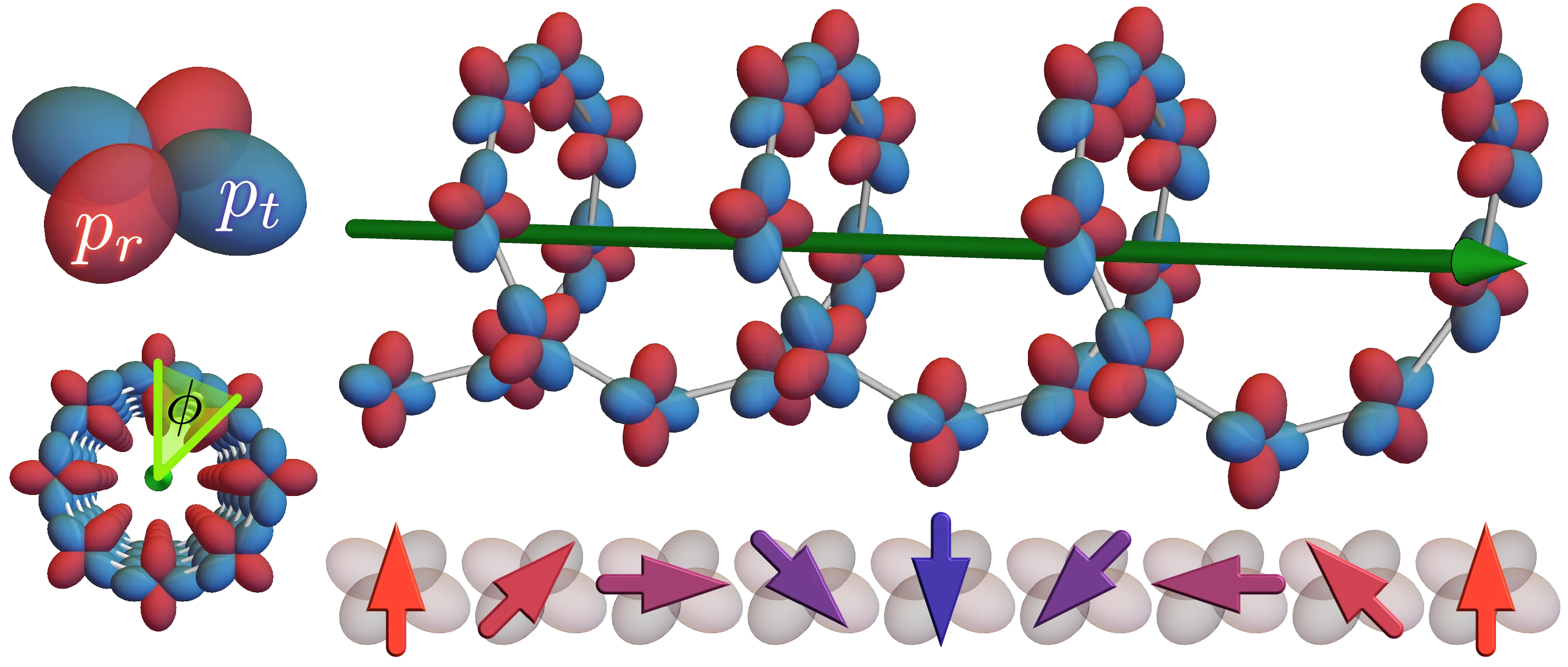
Run a current through a spring of organic molecules, and the electrons that come out are almost all spinning the same way. This trick is called chiral spin selectivity, and it has long puzzled physicists. In light atoms, spin (the particle's intrinsic rotation) is too weakly coupled to charge motion to achieve nearly perfect sorting.
The authors built a model where electrons don't fly solo but constantly jostle each other. In the cramped helical structure, their mutual repulsion gives rise to a complex magnetic pattern — spins align not in a line but at an angle, like needles on a curved branch. Calculations showed that even a tiny spin-orbit interaction (the coupling between spin and motion) gets amplified by the collective effect. A whisper in a quiet room becomes audible to everyone.
To verify, they used three computational methods. One tracked the quantum states of the entire chain. The second broke it into clusters. The third modeled thermal fluctuations. All confirmed that the magnetic texture holds without long-range order. Local correlations suffice — neighboring spins remember each other even if distant ones have already "forgotten." This is like a crowd where everyone orients to the nearest neighbor, and a wave passes without a central commander.
Such a mechanism paves the way for spin filters based on cheap carbon materials — no rare metals or ultra-low temperatures needed. It also hints at why nature chose chiral molecules for fine-tuning chemical reactions: perhaps electron spin acts as an invisible conductor.
In an experiment with double-stranded DNA deposited on a gold substrate, electron spin polarization reached 60% at room temperature, and that's without any magnetic materials.
In Robert Charles Wilson's novel Spin, a hypothetical spintronics technology allows manipulating consciousness through quantum states of electrons.