Helium Droplets and Hidden Symmetry express
Three floats on water bob chaotically. But three helium atoms cooled to near absolute zero behave differently, as if obeying an invisible law of similarity. Their mutual attraction is so weak that the atoms form a loose cloud. Its size can be changed, but its shape always remains the same, like a matryoshka doll that is scaled up or down without altering the painted pattern.
This property is discrete scale invariance (the system looks the same when magnified by a certain factor). In the human world, you rarely encounter this: a snowflake under a magnifying glass doesn't look like itself under a microscope. But for three helium atoms, this is almost an exact law. The authors calculated how much real droplets deviate from the ideal. The deviations turned out to be tiny, as if a matryoshka doll had swollen from humidity by the thickness of a hair.
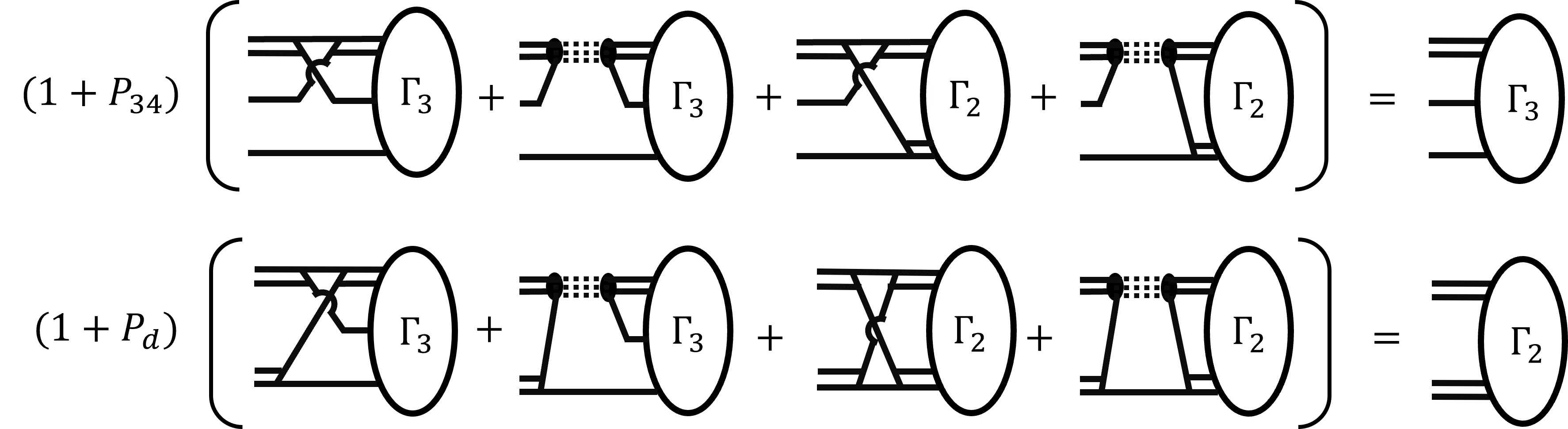
When a fourth atom is added to the trio, the picture becomes more complex but doesn't break. Two stable states emerge — the ground state and an excited state, like two floors in a house. Calculations showed that the energies of these states and the radii of the droplets match the results of more sophisticated models with high precision. And those models account for all the details of the interaction. This means that the hidden symmetry plays the main role, not the subtle nuances of forces between atoms.
The study reminds us that even in the simplest systems, nature hides elegant mathematical structures. Three or four helium atoms are not just a tiny droplet, but an almost perfect fractal living by the laws of similarity. And just as a fully nested matryoshka doll reveals the smallest figure, calculating these systems reveals fundamental rules governing the microworld.
Helium is the only substance that remains liquid at absolute zero unless high pressure is applied. This makes its droplets an ideal laboratory for studying quantum effects.
In Greg Egan's novel "Schild's Ladder," quantum systems with scale invariance serve as the key to creating a new physics that changes our understanding of space.