Imagine a stove: the stronger you heat it, the more heat it radiates — that's intuitive. But the Stefan–Boltzmann law says that the radiated power increases not just a lot, but as the fourth power of temperature! That is, if you heat an iron from 300°C to 600°C (twice as hot on the absolute scale), it will radiate 16 times more heat. Analogy: it's like having a garden hose — you turn the tap slightly, and the water pressure increases dramatically. So it is with light and heat from a heated body.
History
Irish physicist John Tyndall conducted measurements of thermal radiation in the 1860s, which led Stefan to analyze the data of Dulong and Petit. Josef Stefan, an Austrian physicist of Slovenian origin, published a note in 1879 in which he claimed that the radiation from a platinum wire is proportional to the fourth power of its absolute temperature. Ludwig Boltzmann, impressed by the insight, undertook a rigorous proof: in 1884, he considered radiation as a working substance in a Carnot cycle and derived the law from the second law of thermodynamics, using the light pressure discovered by James Clerk Maxwell. Later, in 1900, Max Planck, in deriving his famous formula, confirmed and generalized this law, showing that σ can be expressed through Planck's constant, the speed of light, and Boltzmann's constant.
How it works
The Stefan–Boltzmann law is widely applied in astrophysics to determine the luminosities of stars, as well as to calculate the energy balance of planets, including Earth: knowing the solar constant and albedo, one can estimate the planet's equilibrium temperature. In engineering, the law is used in designing furnaces, steam boilers, as well as in infrared sensors and thermal imagers. Limits of applicability: the law holds strictly only for black bodies or gray bodies with a constant emissivity; for real bodies, a correction factor (emissivity) is introduced. At very high temperatures, when effects of general relativity become noticeable (e.g., near black holes), the calculation of energy release requires modifications.
Fun fact
Thanks to this law, we understand why the Sun, while not so large by cosmic standards, shines more than 400 times brighter than its entire surface would if it had the temperature of a human body! If the Sun cooled to 4000°C instead of the current 5500°C, we would receive half as much light — life on Earth would be different. And an incandescent light bulb shines dimly precisely because its filament only heats up to 2500°C — if it were like the Sun, it would instantly evaporate.
A numerical factor that depends on the frequency integration limits and the specific definition of 'average' (e.g., over the full spectrum). — proportionality constant = 2.701
k_B
constant
Fundamental constant converting temperature to energy scale — boltzmann constant= 1.380649e-23joule per kelvin
⟨ ⟩
operator
Statistical average over the photon distribution — ensemble average
Effective temperature of the surface — temperaturekelvin
\sigma
constant
Proportionality constant relating blackbody radiated power to temperature — stefan boltzmann constant= 5.670374419e-8watt per metre squared per kelvin to the fourth
total radiative flux emitted per unit area — radiative flux watt per square metre
T
variable
absolute temperature of the radiating body — temperaturekelvin
\sigma
constant
Stefan-Boltzmann constant relating temperature to radiated power — stefan boltzmann constant= 5.670374419e-8watt per square metre per kelvin to the fourth
A black hole isn't just a cosmic vacuum cleaner. If it rotates, it can amplify waves around it, much like a mountain echo repeats sound. For ultralight dark matter (particles billions of times lighter than an electron), this effect, called superradiance, can create a huge cloud.
A black hole is not an absolutely black bag. In 1974, Stephen Hawking showed that it glows — faintly, but continuously. This radiation is born not inside, but outside, right at the boundary from which even light cannot escape.
A new study sharpens the picture.
On March 26, 2026, the Chinese-European Einstein Probe observatory caught an X-ray flash that lasted a little over a quarter of an hour. A thousand seconds. The onboard WXT telescope registered a sharp rise in radiation, then a smooth decline, as if someone had screamed into silence, and the echo slowly faded.
14 seconds. That’s all it takes for a new code to weave the full spectrum of a star, from ultraviolet to near-infrared. This spectrum is not just a rainbow but a detailed tapestry of thousands of dark absorption lines, each left by a specific atom in the star's atmosphere.
Cosmic ripples begin with tiny clumps. 380,000 years after the Big Bang, the universe was nearly homogeneous — density fluctuations were only one part in 100,000. But gravity turned these weak ripples into galaxies, clusters, and giant voids.
In the early universe, just a few hundred million years after the Big Bang, astronomers see strange objects — little red dots. They are compact, red, and in their spectra, broad Balmer lines scream the presence of supermassive black holes. But how did the hole manage to accumulate millions of solar masses in such a short time?
Ten billion years ago, the universe was speckled with strange crimson sparks. The JWST spotted them in images at distant redshifts — compact sources blazing like entire galaxies yet no larger than a tiny central region. Astronomers nicknamed them “little red dots.” Their nature long defied explanation.
Dark matter is invisible to telescopes, but its gravity was revealed half a century ago by Vera Rubin. Since then, physicists have explored dozens of hypotheses, and one of the most elegant is primordial black holes, formed in the first moments after the Big Bang.
Seventeen minutes: that’s the heartbeat frequency of AM Canum Venaticorum, setting the rhythm for the entire class of ultracompact binaries. In these systems, two white dwarfs whirl in a death dance, tightening their orbit to the still-inaudible whisper of gravitational waves.
The light of a distant star carries within it the silent hum of the atmospheres of planets orbiting it. For a long time, capturing it was like trying to make out a whisper over a roaring waterfall. But with the advent of the 39-meter Extremely Large Telescope (ELT) and the ANDES spectrograph with a resolution of 100,000, this task is no longer hopeless.
The cosmos is full of screams we can't hear. Every time a black hole tears a star apart, a blinding flash is born, and often — a narrow relativistic jet, shooting out thousands of light-years. But if that searchlight is aimed away from Earth, we see only a faint afterglow — a radio echo arriving with a delay.
A quarter-century ago, Michel Mayor and Didier Queloz discovered the first hot Jupiter, and shattered all the rules of planet formation. A gas giant on a days-long orbit couldn't have formed next to the star: it's far too hot and lacks building material. So, it must have been born far away and then migrated.
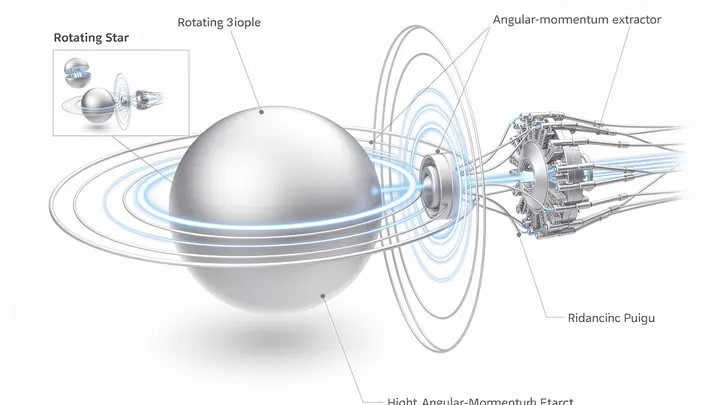
For decades, SETI has hunted for Dyson spheres — hypothetical shells that capture a star's light stars and re-radiate it in the infrared. But the cosmos remains silent. Perhaps an alien intelligence operates more elegantly: instead of collecting light, it tames the rotation of a sun, like a giant flywheel.
Around some young stars where star formation has recently ended, there swirl not just dust rings but actual planetary battlefields — extreme debris disks.
When JWST peered into the young universe at redshifts of 6–10, it revealed a scattering of mysterious 'little red dots' (LRDs). These objects combined features of galaxies and active nuclei, but their spectra refused to fit into familiar patterns.
Right after the Big Bang, the Universe was a chemical desert — only hydrogen and helium, not a hint of metals. But moments passed (by cosmic standards), and the birth of the first stars — Population III — began.
Imagine a forest planted in a single day. At first glance, all trees look alike, but their cross sections tell different stories: some grew on clean soil, others on the ashes of ancient fires.
Long-period radio transients (LPTs) are a mysterious class discovered only recently. Their pulses last minutes or hours, and their nature was completely unknown. ASKAP J1745-5051, caught by the Australian telescope ASKAP, became the first to get a full explanation.
A black hole is a place where gravity is so strong that even light cannot escape. But around it there is a glowing ring of gas, and in the center a dark void known as the shadow. The size of this shadow depends on how spacetime is curved.
Three floats on water bob chaotically. But three helium atoms cooled to near absolute zero behave differently, as if obeying an invisible law of similarity. Their mutual attraction is so weak that the atoms form a loose cloud.
A light ray skims along the horizon of a black hole: that invisible boundary from which nothing can escape. The closer the ray gets to the horizon, the slower its own 'time' stretches — a special measure of path called the affine parameter.
If you shrank an ordinary black hole to the size of a grain of sand, it would shine like a tiny star and quickly vanish in a flash. That's Stephen Hawking's prediction: the event horizon acts like a hot surface emitting particles.
Black holes aren't faceless devourers. Sometimes they behave like water: they can 'freeze' or 'boil', changing their internal state. Scientists described this by modeling light near a black hole as a gas.
A black hole is like a whirlpool in a river: anything that falls in can never escape. But it also has an outer zone, the ergosphere, where space itself moves faster than light and drags any object along. Usually, the size of this zone is tightly linked to the hole's mass and spin rate.
If you pour sand into a glass, it settles in a flat layer. But instead of sand, take the tiniest particles of gas: in a gravitational field they don't just fall: each particle races along its own trajectory, collides with neighbors, and all this commotion creates pressure.
A drop of water stretches in a strong electric field. The deuterium nucleus, a bound pair of a proton and a neutron, behaves the same way, except here the field comes from a passing gamma ray, and instead of just stretching, the nucleus can simply fall apart.
A stream of electrons enters plasma like a jet of water hitting a calm pond. The jet disturbs the surface, giving rise to waves that grow quickly and mix the water. In plasma, this process is called the Buneman instability: the electron beam excites oscillations that then scatter its energy.
A black hole is not just a void but a massive object that warps the space around it. If it finds itself in a cloud of invisible dark matter, matter that emits no light but makes itself known through gravity, its behavior changes.
In the 19th century, James Clerk Maxwell imagined a tiny demon. It knows the speed of every gas molecule and opens a door: fast ones to the left, slow ones to the right. This creates a temperature difference without expending energy, seemingly violating the laws of physics.
When a bright spot flares up on a star, astronomers want to know how much energy was released into space. They used to picture a flare as a growing campfire: the area of the fire increases, but the heat remains the same. That made calculations simpler, but reality turned out to be different.
Atoms, like a swarm of fireflies, shine in unison. When they flash together, the light multiplies — a hundred atoms shine ten thousand times brighter than one. Physicists have turned this trick into a heat engine. A typical motor needs both a hot and a cold source, but here the atoms operate with just a cold one.