Molecular Rope in the Cradle of Planets ✛ ✎ ✦
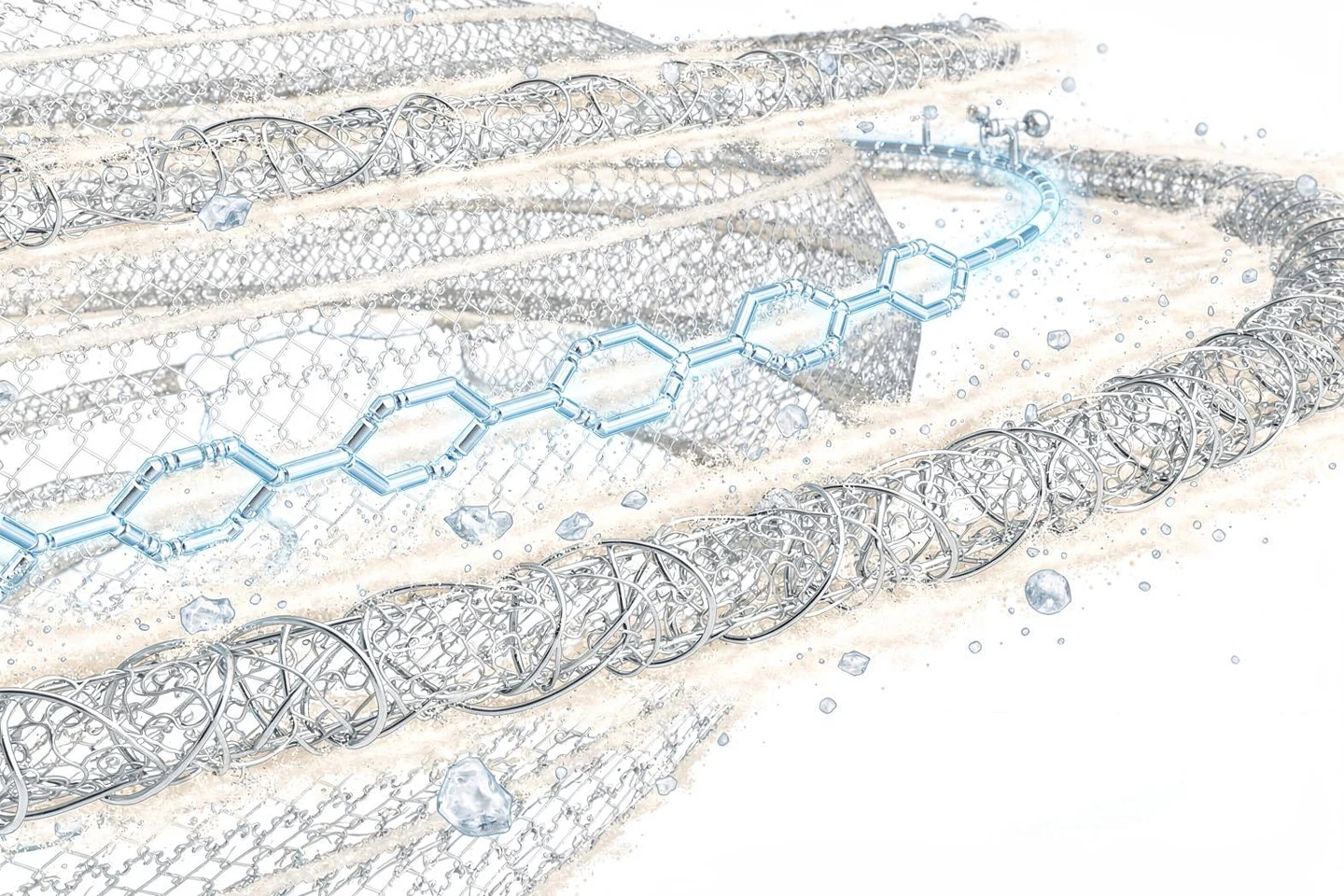
The birth of planets is a cosmic forge: gas and dust compress, shock waves and harsh radiation burn away all complexity. It was thought that fragile organic threads like cyanopolyynes couldn't survive this hell. But when ALMA's radio spectroscopy antennas targeted the disk of TW Hydrae, a young Solar System just 60 parsecs away, a faint but unmistakable radio voice cut through the noise. It was HC5N, a chain of five carbon atoms with hydrogen and a nitrogen group at the end — a molecular rope that passed through the fire unscathed.
The metaphor is no accident: cyanopolyynes are nearly linear, and their huge dipole moment turns them into natural antennas, emitting in the millimeter band. Their signal is a vibrating string that tells of temperature, turbulence, and the chemistry of the environment. To pull it from the noise, astronomers used an elegant trick: they took a template from the brighter line of HC3N, like copying the rhythm of a familiar melody to hear a faint echo. By shifting and stacking the spectra according to the disk's Keplerian rotation, they reached a combined significance of 5.3σ — enough to say, “yes, this is real.”
Finding HC5N in a class II disk, where planets are already actively forming from cosmic dust, connects epochs. Chemical models show that building such a chain requires an elevated ratio of carbon to oxygen (C/O > 1)—exactly what was suspected for TW Hydrae and now confirmed. Comparison with the TMC-1 cloud hints that these molecules are not new but inherited from the parent cloud, surviving collapse and heating. That means in our Solar System, comets, asteroids, and the early Earth received a starter kit of prebiotics, where such threads already existed, capable of weaving into larger structures. Perhaps we are seeing just the first knot of a vast chemical web stretching from stellar cradles to the threshold of life.
A new chapter lies ahead. More sensitive instruments, like the future ngVLA, will be able to detect even longer chains (HC7N, HC9N) and map their distribution in disks of different masses and ages. By measuring isotopic ratios of hydrogen and carbon, we will learn how chemical evolution depends on environment. And including reactions with water and ammonia, the main reservoirs of hydrogen and nitrogen in ices, into models will more precisely show how carbon ropes are woven into planetesimals. Then we will trace the path of prebiotic molecules from the cloud to the atmospheres of exoplanets, and perhaps to the first sparks of life.
Cyanopolyynes are molecular “threads” with a large dipole moment, which causes them to emit in the radio range like natural antennas. The longest known, HC11N, was found in the dark cloud TMC-1.