HC5N in TW Hydrae's disk: first detection of long cyanopolyynes in a protoplanetary disk ✛ ✎ ✦
Context
Around young stars swirl protoplanetary disks — the cradles of future planets. Their chemical makeup determines which molecules will end up in the atmospheres of exoplanet and the nuclei of comets. However, detecting complex organics in Class II disks (where planets are already actively forming) long remained a rarity, especially for molecules with long carbon chains. This limited our grasp of the link between interstellar cloud chemistry and mature planetary systems. Studying TW Hydrae's disk — one of the closest analogs to the early Solar System — opens a new chapter, allowing us to test whether протопланетные диски can inherit complex molecules from their parent cloud.
Methods
Observations were carried out with the spectroscopy at 3 mm. Scientists searched for spectral lines of cyanopolyyne HC5N (a molecule with a chain of five carbon atoms and a nitrogen group) in TW Hydrae's disk. Due to the weak signal, special techniques were employed: matched filtering using a template from a brighter line of the related molecule HC3N, as well as shifting and stacking spectra with correction for Keplerian rotation of the disk. This made it possible to pick out the target signal above the noise. Additionally, chemical modeling varying the carbon to oxygen ratio helped assess where in the disk HC5N might exist.
Results
The analysis yielded robust detections of two HC5N lines (J=37-36 and J=41-40) with significances of 3.4σ and 4.2σ individually, and 5.3σ when combined. Integrated fluxes were 3.7±3.5 and 8.3±6.3 mJy km/s. Based on these data and an assumed rotational temperature of 20–50 K, the disk-averaged column density of HC5N was determined to be about $10^{12}$ cm⁻². This is one to two orders of magnitude lower than HC3N, consistent with a rapid decline in abundance as the carbon chain lengthens. HC5N most likely resides in the warm molecular layer above the cosmic dust midplane. Chemical models show that reproducing the observed HC5N amount requires an elevated C/O ratio (>1), which had previously been suggested for TW Hydrae from other data. The main contribution to the emission comes from the inner disk region within 90 AU, where reactions involving the CN radical are active.
Implications
The detection of HC5N in TW Hydrae marks the first time such a long carbon chain has been found in a Class II disk. This proves that the chemical complexity seen in cold molecular clouds can survive the transition to a mature disk stage. The similarity in the relative abundances of HC5N and HC3N with data from the TMC-1 cloud argues for common synthesis pathways, despite differing physical conditions. For exoplanet, this means that prebiotic molecules — or their fragments — can be incorporated into planetesimals and, potentially, delivered to the surfaces of forming planets. Moreover, thanks to their large dipole moments, cyanopolyynes serve as excellent probes of temperature, turbulence, and isotopic composition in disks.
Future development
In the future, more sensitive observations with ALMA and possibly with next-generation telescopes under construction (such as ngVLA) will not only confirm the presence of HC5N in other disks but also map its distribution, measure isotopic ratios of carbon and hydrogen, and check how chemistry changes at different evolutionary stages of disks. Chemical models will be refined by incorporating more comprehensive reaction networks for carbon chains, as well as accounting for the effects of magnetic fields and turbulence on mixing. It is not unlikely that even longer chains, up to HC7N and HC9N, will be found.
Impact
The results will impact exoplanet and the chemistry of Solar System comets, linking the observed composition to prebiotic evolution in protoplanetary disks. They will also provide new benchmarks for laboratory astrochemistry and star formation models.
Next steps
Immediate next steps include deeper time integration on ALMA to boost the signal-to-noise ratio, and conducting surveys of other Class II disks, including around stars of different masses, to assess the universality of the phenomenon.
Key open problems
The discovery is directly tied to a key problem in astrochemistry: how and how efficiently complex organic molecules survive the collapse of a molecular cloud, the protostar stage, and incorporation into planetesimals. It also sheds light on the mystery of the low abundance of complex organics in Solar System comets compared to interstellar cloud gas, and may help us understand the chemical pathways to the origin of life on early Earth.
The knowledge machine's view
This section is addressed to the author of the paper and their colleagues. Neighbouring works were found by meaning-based search across our archive, not by word overlap. We do not review: we show the field around the work.
What the work does
The study reports the first detection of HC5N in a protoplanetary disk (TW Hydrae) using ALMA. The authors extracted weak HC5N lines using a template from HC3N and Keplerian stacking, and determined a column density of ~10^12 cm^-2. Chemical modeling indicates formation in a warm molecular layer with an elevated C/O ratio.
Where its strength is
A strong point is the successful application of a weak-signal extraction method using a template from a related molecule and Keplerian stacking. This opens the door to systematic searches for other long-chain molecules in disks.
Where it could go next
- It might be interesting to compare the HC5N distribution with recent infrared maps of dust and ices in TW Hydrae to clarify how carbon-chain chemistry relates to dust evolution and planetesimal formation.based on: Shadow Theater at TW Hydrae: Webb Catches the Hidden Drama of Planet Birth arXiv:2607.23992v1
- A related study shows how cosmic rays may contribute to the synthesis of complex organics in disks; it might be worth estimating their contribution to HC5N formation alongside gas-phase reactions with CN.based on: Cosmic Rays as Chefs of Complex Organic Chemistry arXiv:2605.06767
- To test the generality of the conclusions, one could compare with observations of other disks, for example, data on the chemical composition of young stars where infalling gas may affect disk chemistry.based on: Chemical Portrait of a Young Star: When Infalling Gas Paints Patterns arXiv:2607.18683
Worth trying
- Apply the same template extraction method to search for HC7N and other cyanopolyynes in the ALMA archive for TW Hydrae.
- Check whether HC5N emission correlates with the distribution of heavy water to understand the role of ices in preserving carbon chains.
- Compare the relative abundances of HC5N/HC3N in TW Hydrae and in Solar System comets to assess a possible link.
Why this may matter
The detection of HC5N in a Class II disk strengthens the link between interstellar chemistry and the composition of forming planetary systems. It may help us understand which organic molecules were available during planet formation and possibly influenced the origin of life.
Nearby works in our archive
- Heavy water ice found in planet-forming disksimilarity 0.62
- Shadow Theater at TW Hydrae: Webb Catches the Hidden Drama of Planet Birthsimilarity 0.58
- First Light from a Tiny Buildersimilarity 0.57
- Cosmic Oven: How Heat Baked the Building Blocks of Life on Jupiter's Moonssimilarity 0.56
- Chemical Portrait of a Young Star: When Infalling Gas Paints Patternssimilarity 0.56
- Cosmic Rays as Chefs of Complex Organic Chemistrysimilarity 0.56
The closest work in the archive sits at 0.62 by meaning — the usual level for our corpus.
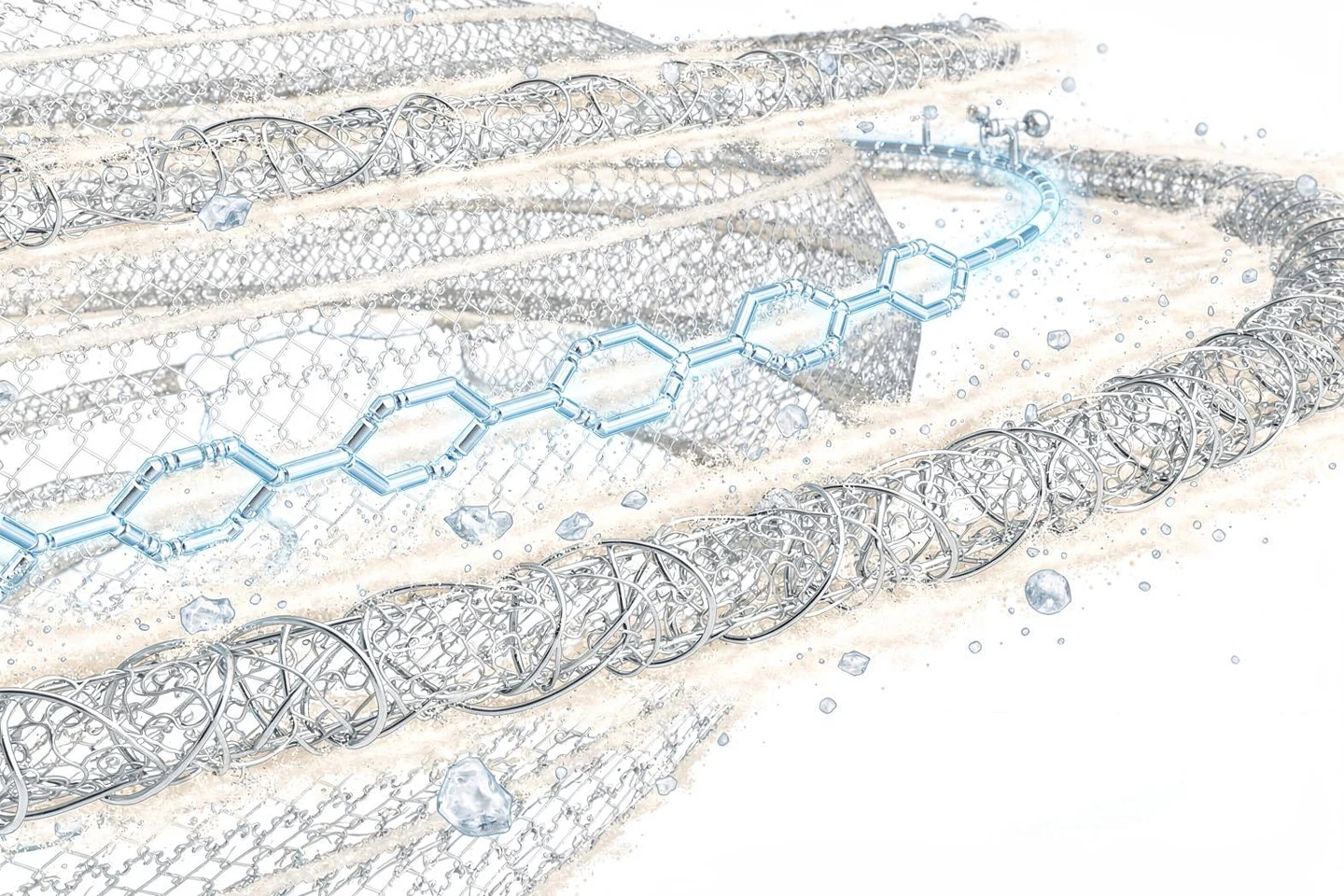
HC5N is a member of the cyanopolyyne class — carbon chains with a nitrogen group at the end. The longest one found in space is HC11N, detected in the cold molecular cloud TMC-1. Interestingly, such molecules can be thought of as 'molecular ropes' — they're almost linear and have a large dipole moment, making them handy 'antennas' for radio emission.
Key numbers
- significance of combined signal: 5.3σ
- HC5N column density: ∼1012 cm⁻²
- distance to TW Hydrae: 60 pc
- rotational temperature (assumed): 20–50 K
- C/O ratio in disk: >1 (from models)