Bees of Dark Clouds: How Ions Weave Carbon Rings in Space ✛ ✦
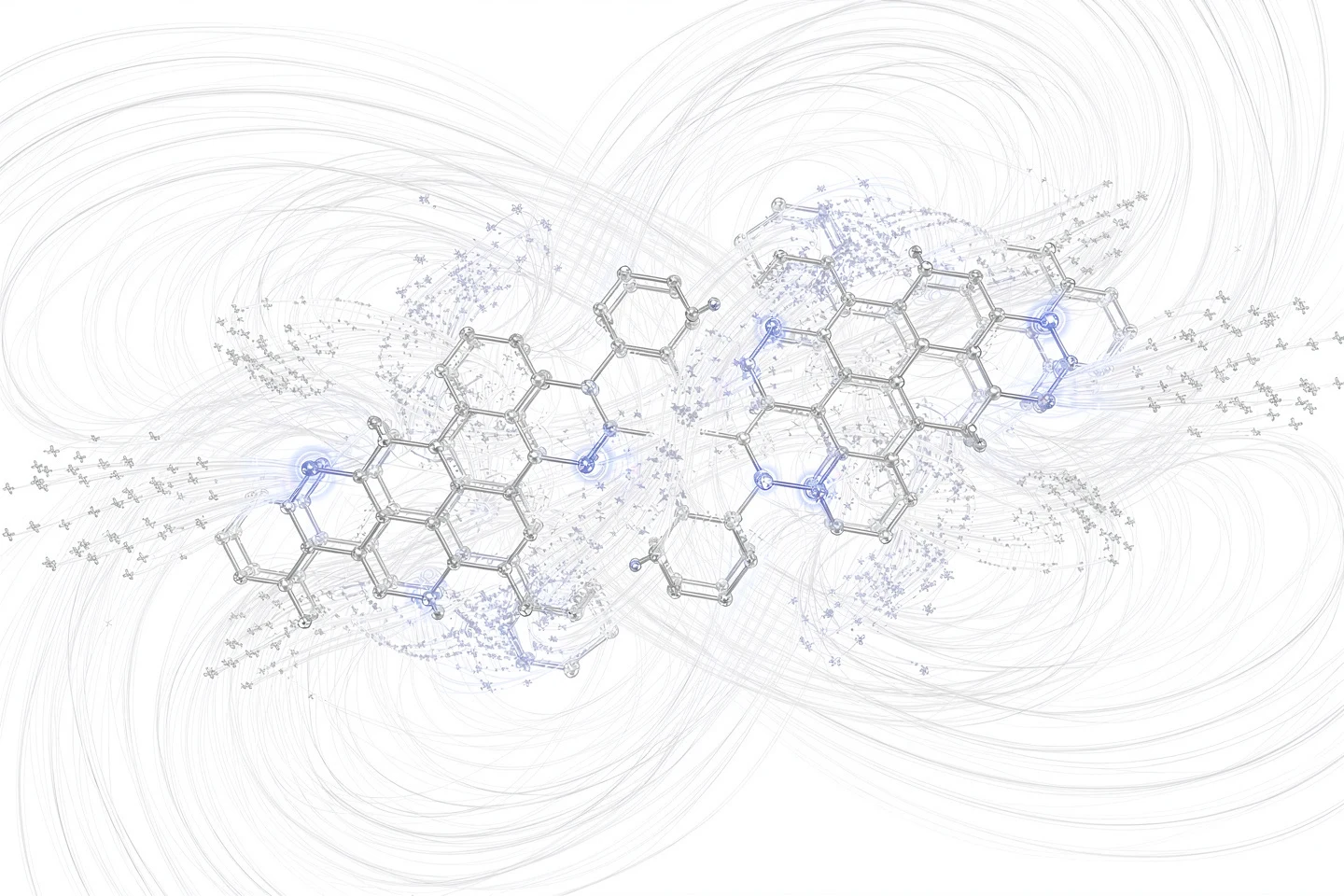
In cold molecular clouds, where temperatures drop to 10 K, chemistry does not freeze. It turns into a slow, error-free dance. Invisible ions, like nocturnal bees, carry carbon 'pollen grains' from molecule to molecule. They stitch aromatic rings into intricate polycyclic structures. It is this process, recreated in terrestrial laboratories, that finally clarified the birth of carbon skeletons in cosmic dust.
For a long time, it was believed that five-membered rings, a hallmark of molecules like acenaphthylene, could only form in hot, energy-rich environments. But recent discoveries by radio telescopes and the eye of James Webb challenged that: in the swirling darkness of the protostellar nebula TMC-1, cyanoacenaphthylene was detected — a derivative of acenaphthylene, stable at far more modest temperatures.
Experiments at the PIRENEA facility in France provided the key. Ions C₁₁H₉⁺—benzyl-type isomers of naphthalene — were mixed with methylnaphthalenes in high vacuum and then irradiated with visible light. The reaction proceeded via two channels: in one, an entire naphthalene block was lost; in the other, only a methyl group. The product ratio depended on the methyl group's position — much like a bee choosing a flower by its scent. Under light, both products lost hydrogen or methyl groups, and only the acenaphthylene cation survived — a particle remarkably resistant to photodestruction. Its stabilization energy (7.6 eV) is so high that the cation could cross an entire galaxy without breaking apart.
This low-temperature mechanism is a true revolution for astrochemistry. Previously, the growth of complex polycyclic aromatic hydrocarbons (PAHs) was pictured as a frantic assembly near stars; now we see that even in the icy cores of clouds, a delicate web of carbon lace is being woven. Moreover, the presence of water ices on dust grains can accelerate these reactions, turning dust into an ideal incubator for organics. By some estimates, up to a quarter of all carbon in the Milky Way is locked in PAHs — vast carbon oceans drifting between the stars. Against this backdrop, the work of Edwin Hubble, who showed that such dust pervades distant worlds, and of Cecilia Payne-Gaposchkin, who proved that stars are mostly hydrogen and helium while carbon complexity is born in the interstellar medium, comes to mind.
On the horizon are experiments at cryogenic temperatures and direct detection of intermediate complexes via infrared spectroscopy. We stand on the threshold of assembling a complete molecular genealogy of PAHs. This is not just deciphering chemical pathways; it is reading a cosmic bee saga where carbon rings are arranged into intricate honeycombs — possible cradles of life.
Acenaphthene from coal tar served for centuries as a raw material for dyes. Now its 'cosmic relatives' help us understand how carbon complexity is born in interstellar darkness.
Remarkably, PAHs as building blocks of prebiotic chemistry echo Fred Hoyle’s novel ‘The Black Cloud’—where an interstellar cloud itself was alive. Reality is no less fantastical: clouds are teeming with complex organics.