How Cosmic Carbon Rings are Born: Ion Chemistry in Cold Clouds ✛ ✦
Context
Polycyclic aromatic hydrocarbons (PAHs) are among the most common organic molecules in the universe. They make up a significant portion of cosmic dust, influence the thermal balance of clouds, and serve as raw material for prebiotic chemistry. However, the pathways of their formation in cold conditions (about 10 K) remained a mystery. Recent discoveries with radio telescopes and the James Webb Space Telescope showed that even in the darkest corners of space, complex PAHs exist, including cyano-substituted forms. This requires a revision of chemical evolution models.
Methods
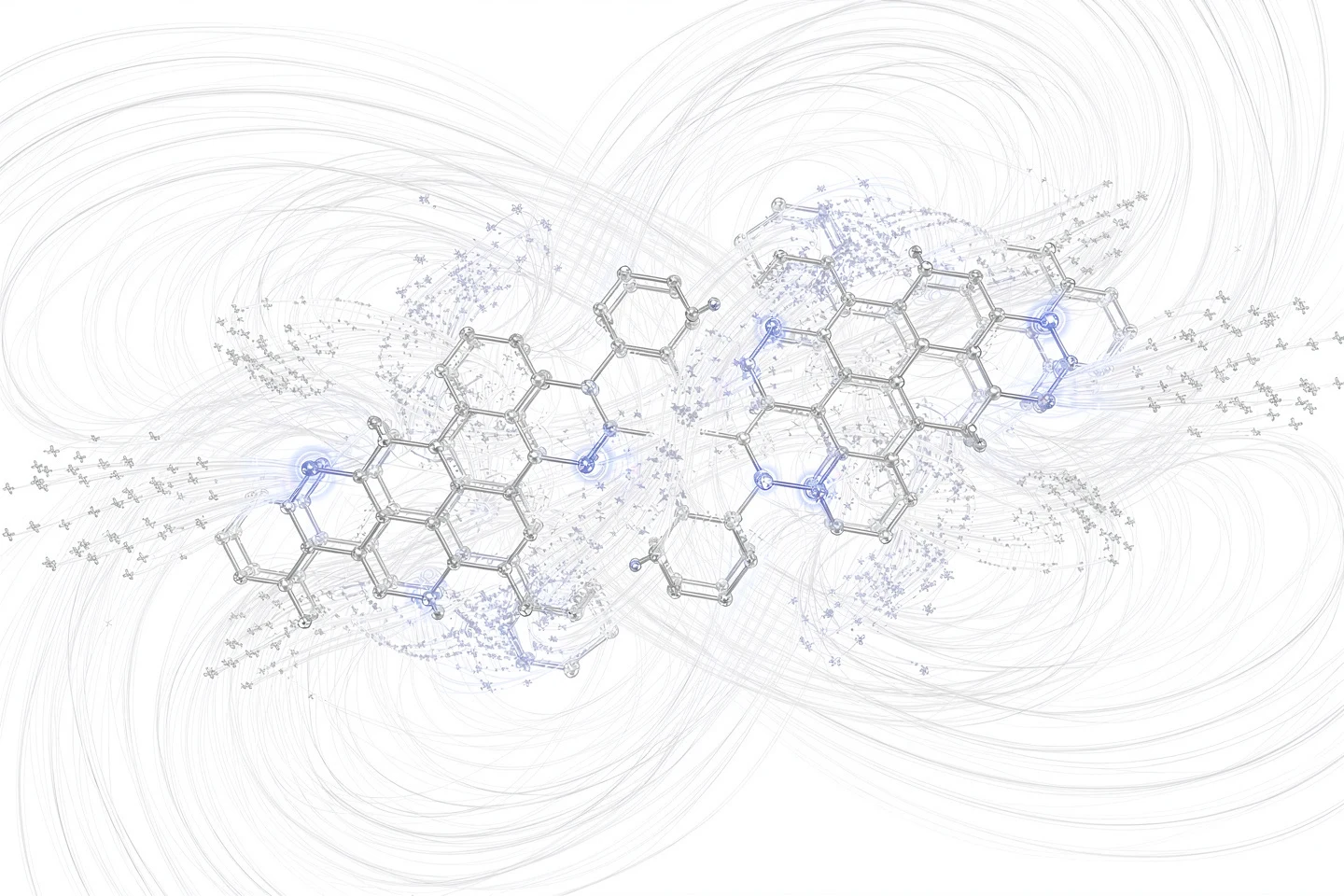
The researchers used a Fourier transform ion cyclotron resonance mass spectrometer (FT-ICR MS) as part of the PIRENEA setup. C₁₁H₉⁺ ions were produced by photodissociation of dimethylnaphthalenes and isolated in high vacuum. They were then mixed with neutral molecules at room temperature, simulating radiative association processes — the main mechanism for molecular growth in rarefied environments. The reaction products were irradiated with visible light, and their structure was investigated using time-of-flight mass spectrometry and multiphoton dissociation spectroscopy. Quantum chemical calculations by density functional theory and molecular dynamics (DFTB) allowed modeling the dynamics of ion-molecule complexes and confirming the formation of five-membered rings.
Results
Main result: C₁₁H₉⁺ ions (benzylic isomers of naphthalene) react with dimethylnaphthalene, yielding two products: C₁₂H₁₁⁺ and C₁₃H₁₃⁺. Their ratio depends on the position of methyl groups. For example, for 2,3-dimethylnaphthalene the fraction of C₁₃H₁₃⁺ was 79%, while for 1,4- and 1,5-isomers C₁₂H₁₁⁺ dominates (70% and 83%). Upon subsequent irradiation with visible light, both products lose hydrogen or methyl groups, ultimately forming the acenaphthylene cation (C₁₂H₈⁺) — an exceptionally photostable species. This is confirmed by comparison with literature data: the acenaphthylene cation withstands heating up to an energy of 7.6 eV, which is comparable to anthracene and much higher than that of naphthalene (5.8 eV).
Implications
The discovery points to a new pathway for the formation of five-membered carbon rings in the interstellar medium. Previously it was thought that such structures only arise at high temperatures, but these experiments demonstrate an efficient low-temperature mechanism via long-lived ion-molecule complexes. This directly explains the presence of cyanoacenaphthylene in the cold cloud TMC-1 — previously no synthesis pathway was known for it.
Future development
In the future, similar experiments are planned at cryogenic temperatures to closely approach the conditions of molecular clouds. It is also important to investigate reactions with other alkyl-PAHs and radicals like CN to build a complete picture of aromatic system growth. Joint use of data from James Webb and ground-based radio telescopes will allow testing the predicted PAH formation pathways in various astrophysical environments — from cold cores to photodissociation regions.
Impact
The results will impact astrochemistry, interstellar medium astrophysics, and planetary science — especially in understanding the chemistry of Titan's atmosphere, where similar ions were detected by the Cassini probe.
Next steps
The next step will be experimental study of C₁₁H₉⁺ reactions with other neutral partners, including benzene and naphthalene, as well as direct detection of intermediate complexes using infrared spectroscopy in traps.
Key open problems
The work connects two fundamental problems: the growth of complex organic molecules at low temperatures and the origin of unidentified infrared bands (UIR), attributed to PAHs. Understanding the formation pathways of pentacycles is key to unraveling the composition of cosmic dust.
The knowledge machine's view
This section is addressed to the author of the paper and their colleagues. Neighbouring works were found by meaning-based search across our archive, not by word overlap. We do not review: we show the field around the work.
What the work does
The study reproduces a low-temperature pathway for the formation of five-membered carbon rings: C₁₁H₉⁺ ions react with dimethylnaphthalene under radiative association conditions, yielding C₁₂H₁₁⁺ and C₁₃H₁₃⁺ products, which after photodissociation convert into the photostable acenaphthylene cation. This explains the presence of cyanoacenaphthylene in the cold cloud TMC-1.
Where its strength is
The strength of the work lies in demonstrating a concrete mechanism for PAH growth through long-lived ion-molecular complexes, which operates at molecular cloud temperatures and links laboratory data with astronomical observations.
Where it could go next
- It might be interesting to see how the found mechanism fits into the overall picture of TMC-1 chemistry: in our archive, there is an analysis of observations of this cloud, listing the detected molecules and discussing their synthesis pathways.based on: Record-Breaking Cloud: How TMC-1 Doubled Our Chemical Inventory arXiv:2604.26439
- Nearby is a work on the role of cosmic rays in the formation of complex organics: it might be worth comparing the proposed pathway with alternative mechanisms involving ionization and excitation by high-energy particles.based on: Cosmic Rays as Chefs of Complex Organic Chemistry arXiv:2605.06767
- The archive contains an analysis of benzene ring formation in hot regions; comparing it with your low-temperature pathway could help outline the range of conditions under which aromatic structures form.based on: The Scent of the Universe: Benzene Rings in Hot Clouds arXiv:2604.24510
Worth trying
- Test whether similar five-membered rings form in reactions of C₁₁H₉⁺ with other methyl-substituted aromatic compounds to assess the generality of the mechanism.
- Compare predicted reaction rates with chemical evolution models of TMC-1 to quantitatively verify the contribution of this pathway to the observed abundance of cyanoacenaphthylene.
- Investigate the possibility of forming six-membered rings via analogous complexes to extend the mechanism's applicability to other classes of PAHs.
Why this may matter
Understanding the low-temperature synthesis of five-membered rings is important for interpreting JWST and radio telescope observations, as well as for refining models of chemical evolution in the interstellar medium and prebiotic chemistry.
Nearby works in our archive
- First Light from a Tiny Buildersimilarity 0.63
- Proteins from Cosmic Icesimilarity 0.61
- Record-Breaking Cloud: How TMC-1 Doubled Our Chemical Inventorysimilarity 0.61
- Cosmic Rays as Chefs of Complex Organic Chemistrysimilarity 0.61
- A Nearby Supernova: Recipe for Rocky Planetssimilarity 0.60
- The Scent of the Universe: Benzene Rings in Hot Cloudssimilarity 0.60
The closest work in the archive sits at 0.63 by meaning — the usual level for our corpus.
Original abstract
as written by the authors arXiv:2606.03575v1
C$$_{11}$$H$$_9^+$$ ion is the dominant fragment cation formed from methyl-naphthalene (MeNp) and dimethyl-naphthalene (diMeNp). Using the multiplex capabilities of PIRENEA, a setup dedicated to laboratory astrophysics, we studied the reactivity of the benzylium-like isomers of C$$_{11}$$H$$_9^+$$ with diMeNp under isolated conditions relevant to radiative association. Two reaction products are observed, C$$_{12}$$H$$_{11}^+$$ -- also formed in the reaction with MeNp -- and C$$_{13}$$H$$_{13}^+$$, with branching ratios that depend on the specific diMeNp isomer. The reaction products were subsequently exposed to UV-visible irradiation to gain insight into their structures. The acenaphthylene radical cation, C$$_{12}$$H$$_{8}^{\bullet +}$$, was identified as the most stable photofragment. We show that this experimental approach, supported by density functional theory calculations and molecular dynamics simulations, provides new constraints on the chemistry of benzylium-type species. We highlight the role that long-lived ion-molecule complexes can have in promoting C-C coupling and the formation of a pentagonal cycle. Moreover, the chemistry uncovered here highlights new pathways for the formation of pentagonal rings during PAH growth under low-pressure and cold conditions. In particular, it can lead to efficient formation of acenaphthylene-like species, recently detected in the TMC-1 cold cloud.
Interestingly, acenaphthene is a component of coal tar, which in the 19th century was used for dye production. Now its 'cosmic relatives' help us understand the chemistry of star birth.
The role of PAHs as building blocks of prebiotic chemistry recalls Fred Hoyle's novel 'The Black Cloud', where an interstellar gas-dust cloud turns out to be a living organism. Today's science shows that clouds are indeed full of complex organics.
Key numbers
- fraction of C₁₃H₁₃⁺ from 2,3-dimethylnaphthalene: 79%
- fraction of C₁₂H₁₁⁺ from 1,4-dimethylnaphthalene: 70%
- photostability energy of acenaphthylene cation: 7.6 eV
- temperature of cold molecular clouds: ~10 K