Wormholes Without Exotic Matter express
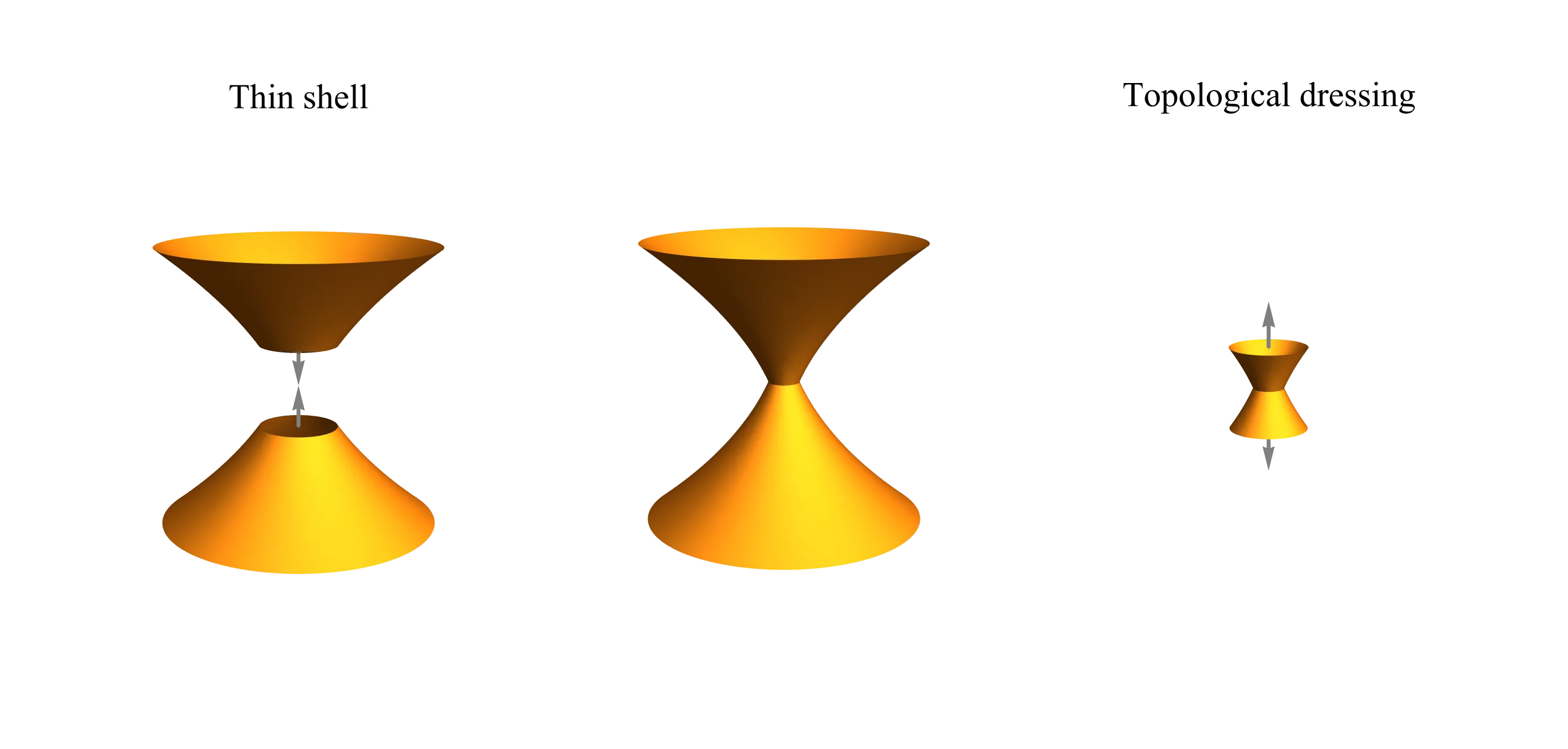
Usually, a wormhole is imagined as a tunnel in space, whose walls are held open by something unusual — matter with negative energy. Like the supports in a mine that keep the ceiling from collapsing. But in this work, the physicists did without supports. They took three different empty spaces (what remains if you remove all stars and planets) and reshaped their coordinates, like a tailor altering a suit without adding new fabric. The result was three wormholes: one with a flat throat, like a straight corridor, and two with a spherical throat, like a round arch.
These wormholes are not just geometric tricks. One of them behaves like a purely topological construction, like a Möbius strip, which has no distinguished side. The other two create real gravity, even though they contain no matter. But the most surprising thing is that you cannot smoothly transform an ordinary wormhole with exotic matter into such an empty one. It's like trying to convert an arch bridge into a suspension bridge without dismantling the structure: they are fundamentally different.
It turns out that empty wormholes are not a simplified version of ordinary ones but a separate class of objects. They live in a distinct sector of 'configuration space'—an imaginary catalog of all possible geometries of the universe. And they open a new perspective on how space can connect distant regions without any magic.
Original abstract
as written by the authors arXiv:2606.08022
We examine three degenerate spacetime configurations with wormhole topology, obtained via branching coordinate transformations of the Rindler, Minkowski, and Schwarzschild vacuum metrics.These configurations are, respectively, a Rindler wormhole with a planar throat, and the Klinkhamer and Schwarzschild Klinkhamer wormholes with spherical throats. Within the framework of the Einstein Palatini Cartan formulation, we demonstrate that these degenerate configurations are matter free. In this regard, they differ fundamentally from their nondegenerate wormhole counterparts in the thin shell model, which require exotic matter. Nevertheless, the degenerate configurations considered here exhibit distinct physical manifestations, ranging from purely topological structures to genuine gravitational effects. Furthermore, in all three examples, we demonstrate the absence of a limiting transition from the non-degenerate spacetime to the matter free degenerate configuration. This suggests that degenerate geometries constitute an independent sector of the configuration space of general relativity.
The term 'wormhole' was coined by physicist John Wheeler in 1957, drawing an analogy with the tunnels dug by worms, which connect two points on the surface by the shortest path through the earth.
In the movie 'Interstellar,' a wormhole near Saturn allows the protagonists to reach another galaxy, and, unlike many science fiction plots, its visualization is based on real equations of general relativity.