Are you one of the authors of this paper? Email us from your institutional or work email address mentioning this article's arXiv ID and we'll verify you and give you edit access to this page.
Are you an author who sees something we missed or got wrong? Write to us — the subject line already carries the paper id. We read every note and correct the write-up.
The XRISM X-ray telescope peered into the heart of the Perseus cluster and found no mysterious iron dip.
📄 Showing the "Simple" version — "Popular" is not ready yet. Add it to favorites to help prioritize it.
The Perseus galaxy cluster is a giant metropolis of thousands of star islands, bathed in an invisible ocean of scorching gas. Like urban smog, this gas preserves traces of all the chemical factories that have operated in galaxies for billions of years: supernova explosions that scatter freshly forged atoms across the surroundings. Astronomers were especially interested in iron: it should be abundant at the center, but old instruments stubbornly showed a strange dip there, as if someone had scraped the middle of a frying pan clean, leaving the edges untouched.
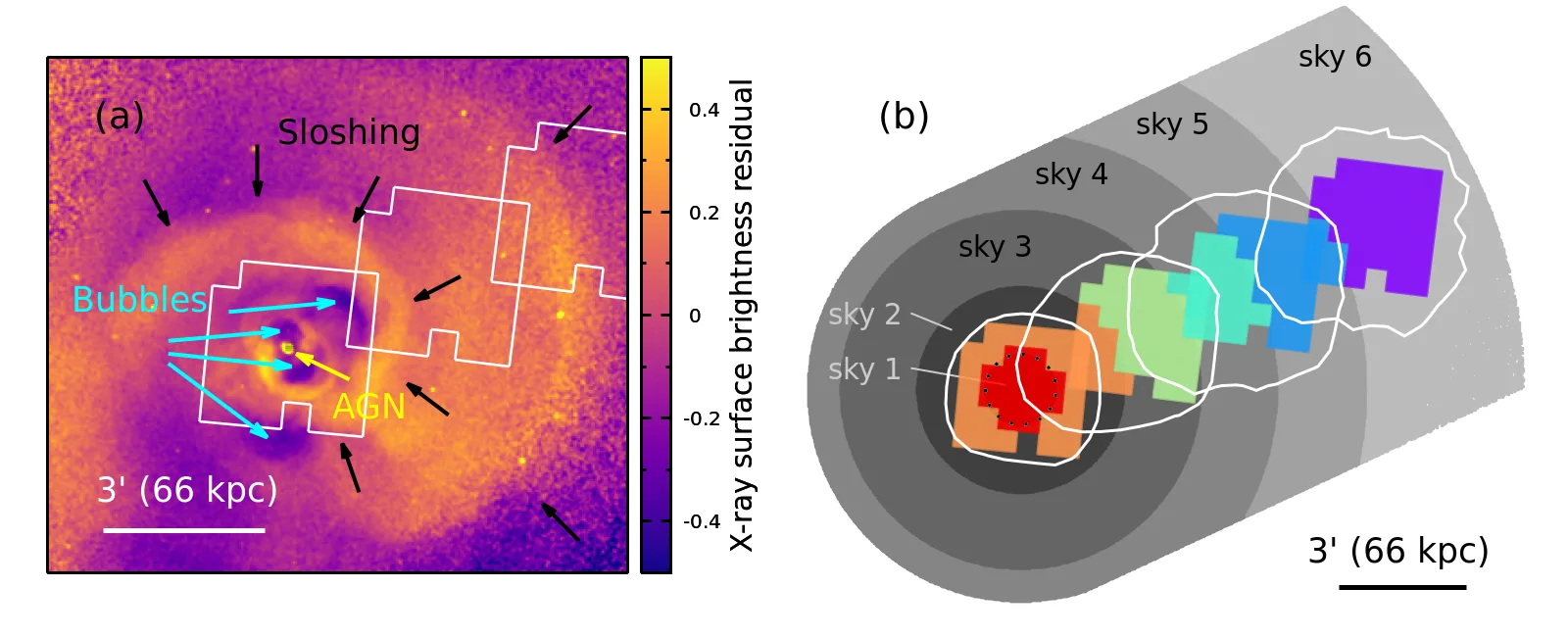
The new Japanese XRISM telescope, with its Resolve instrument that distinguishes colors of X-ray light forty times more precisely than its predecessors, set out to test this mystery. It aimed its microscopic gaze at four points in the cluster — from the very center to the outskirts at a distance of a quarter of a million light-years. And the iron dip vanished. It turned out that the old CCD cameras were simply confused by the faint signal due to the bright active galactic nucleus NGC 1275 at the center. No mysticism, just a technical mirage.
The Resolve instrument's resolution is about 5 electronvolts. That's like hearing a pin drop at a rock concert: before, we only heard the crash of drums, but now we can distinguish the whisper of strings.
But the real surprise was in the chemical composition. The ratio of silicon, sulfur, argon, and other elements to iron remained nearly constant from the edge to the center. This means that the central giant galaxy NGC 1275 barely added its own 'signature' recipe to the common pot. The entire gas was mixed and enriched before the cluster even assembled, as if all the soup ingredients were thrown into the pot at once, and then it just simmered slowly.
Type Ia supernovae, exploding white dwarfs, are considered the main suppliers of iron. But in Perseus, their contribution at the center turned out to be modest — otherwise the composition would have differed sharply.
So the XRISM telescope not only settled the long-standing debate about the 'dip' but also showed that the cluster's chemical history was surprisingly simple. No need for two different types of Type Ia supernovae to explain the element abundances. As it turns out, the Universe sometimes cooks by a basic recipe, and that makes the result even more elegant.
The hot gas in the Perseus cluster weighs more than all its galaxies combined, yet it is so tenuous that it would be considered a vacuum in an Earth laboratory.
In Peter Watts's novel Blindsight, alien ships disguise themselves as ordinary astrophysical objects, just the kind where precise chemical analysis of gas could reveal foreign interference.