Matteo Guainazzi

5 articles · 30 co-authors · latest: 2026-07-06
414 citations · h-index 12 · 57 papersData: Semantic Scholar

We have retold 5 papers by this author. 3 of them with a full read. most often about: Solar wind, accretion_disc_wind, active galactic nucleus. 30 co-authors across our retellings.

Links in the knowledge graph
A Veil over the Beacon: The Slow Wind of GX 13+1
About 25,000 light-years from Earth, in the constellation Sagittarius, a dense veil wraps around the neutron star GX 13+1. It scatters X-ray photons the way fog scatters streetlight, and for a long time it hid the source's true power from astronomers.
High Energy2026-04-241 minarXiv:2604.22922express
Winds from Black Holes
At the center of many galaxies sits a supermassive black hole. When gas falls onto it, the gas heats up and shines brighter than an entire galaxy: this is an active galactic nucleus. Sometimes a true hurricane erupts from there: a stream of ionized gas racing at tens of percent of the speed of light.
Galaxies2026-06-152 minarXiv:2606.17141express
Cosmic Cocktail Without the Secret Ingredient
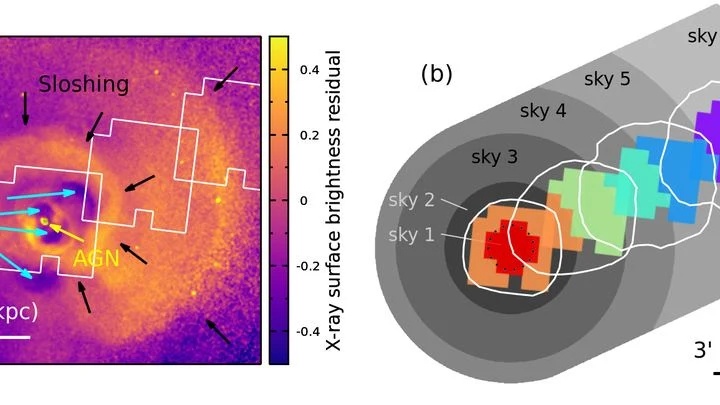
The Perseus galaxy cluster is a giant metropolis of thousands of star islands, bathed in an invisible ocean of scorching gas. Like urban smog, this gas preserves traces of all the chemical factories that have operated in galaxies for billions of years: supernova explosions that scatter freshly forged atoms across the surroundings.
Lightning over a black hole: the first Neupert effect beyond our Galaxy
Active galactic nuclei (AGN) are the universe’s powerhouses: their X-ray coronae blaze millions of times hotter than stellar atmospheres. But what strikes the spark? A ten-day X-ray campaign by the XRISM and XMM-Newton satellites, aimed at NGC 3783, provided the answer: it’s actual thunderstorms.
The Pulse of a Black Hole: Birth of a Jet in X-ray Echo
For years, silence reigned in the heart of galaxy 1ES 1927+654: the accreting gas merely whispered in X-rays, leaking slow winds. But in 2022–2025, the picture changed dramatically. Spectra taken by XMM-Newton and Swift lit up with emission lines — a narrow peak at 0.56 keV, likely from OVII oxygen, a broader feature near 1 keV, and a powerful iron band in the 6–7 keV region.