Silicone Imprint of Ancient Stars express
The galaxy NGC 1277 is like an old book that no one has opened for billions of years. It formed quickly at the dawn of the Universe and has barely changed since — no collisions with neighbors, no new layers added. Astronomers call such systems 'relics': they preserve the chemical composition of the first stars, much like amber preserves prehistoric insects.
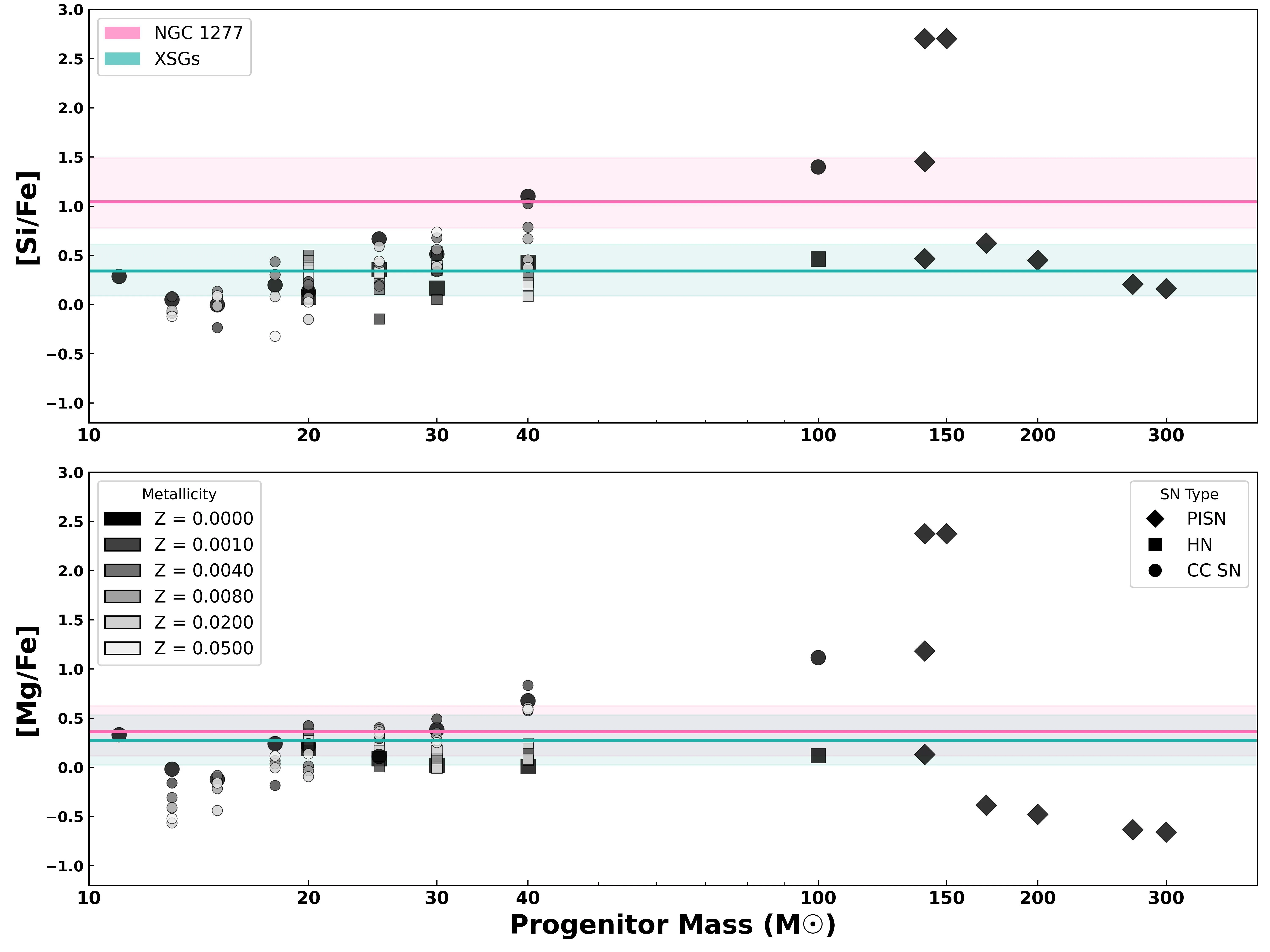
Using deep infrared spectroscopy, scientists peered into the galaxy's chemical record. They were in for a surprise: silicon absorption lines turned out to be unusually strong. The silicon-to-iron ratio exceeded the solar value by dozens of times, and crucially, silicon was far more abundant than magnesium. Current stellar population models and typical core-collapse supernovae cannot produce such an excess.
Such supernovae, called pair-instability, could only occur in an environment nearly devoid of heavy elements: that is, among the very first generation of stars. In massive galaxies that grew slowly, this signal has long been diluted by subsequent generations. But NGC 1277 formed rapidly and then froze, preserving this rare chemical autograph. This discovery opens a window into the era when the Universe was just learning to create complex atoms, and hints at what its first stellar giants were like.
Original abstract
as written by the authors arXiv:2606.17153
The formation of massive galaxies remains a fundamental question in astrophysics, with recent JWST observations suggesting that intense star formation occurred earlier than previously expected. We used the prototypical massive relic galaxy NGC 1277 as a fossil record to probe the chemical signatures of early star formation. With a stellar mass of $$1.2 \pm 0.4 \times 10^{11}M_\odot$$ and a compact structure (half-light radius of 1.2 kpc), NGC 1277 is representative of massive relic galaxies-systems that formed rapidly at high redshifts ("red nuggets" at $$z>2$$) and have since undergone largely passive evolution, preserving the imprint of their earliest stellar populations. Using deep near-infrared spectroscopy, we identified unusually strong silicon (Si) absorption features in this galaxy. We measure $$[\mathrm{Si}/\mathrm{Fe}]=1.05^{+0.45}_{-0.27}$$ and $$[\mathrm{Mg}/\mathrm{Fe}]=0.36^{+0.27}_{-0.24}$$, corresponding to a significantly enhanced silicon-to-magnesium ratio ($$[\mathrm{Si}/\mathrm{Mg}]=0.67^{+0.45}_{-0.27}$$) which cannot be reproduced by current stellar population models or typical core-collapse supernova yields. This enhancement suggests a contribution from very massive, metal-poor progenitors during the earliest phases of star formation. Such conditions are consistent with nucleosynthetic yields from pair-instability supernovae or other enrichment channels associated with extremely massive stars, whose chemical signatures are expected to remain less diluted in systems like NGC 1277 due to their rapid formation timescales and minimal late-time accretion. This result provides rare chemical evidence of early massive-star enrichment preserved in a local relic galaxy and opens a new observational window into the chemical evolution of the Universe.
Pair-instability supernovae leave behind neither a neutron star nor a black hole — the star is completely destroyed, scattering all its matter, including a huge amount of silicon.