Radio Signals from the Depths: Why Magnetars Muffle Their Bursts express
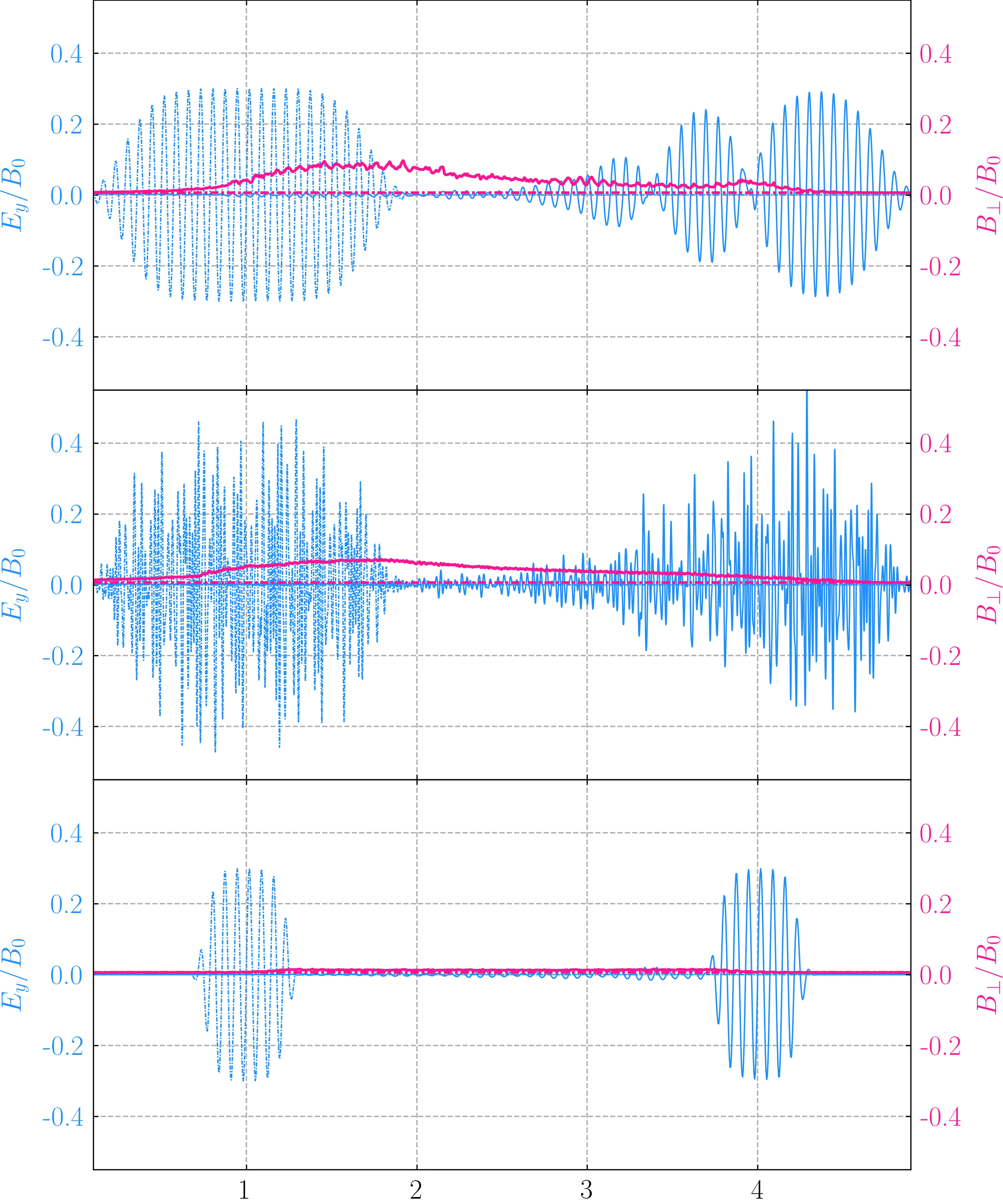
A lighthouse sends its beam through a storm of its own mirrors: that's roughly how fast radio bursts behave when trying to leave a magnetar's vicinity. A magnetar is a neutron star with a magnetic field a quadrillion times stronger than Earth's. In its inner magnetosphere, gigahertz radio waves transform into special magnetosonic waves and immediately enter a triple resonance. Energy is pumped into closed Alfvén oscillations — the trembling of magnetic field lines.
Using three-dimensional simulations, the authors showed that the radio signal rapidly decays as it excites these oscillations. In a quiet dipole field, damping is effective within 10–100 stellar radii. Beyond that, Alfvén waves suffer 'charge starvation'—they lack particles to grow, and the process halts. But if the burst occurs during an eruption, when the star ejects a relativistic magnetic outflow, the resonance works at greater distances. The signal may only fade at 100–1000 radii from the surface. This sets a hard limit: the most powerful bursts must die out before reaching outer space.
Thus, the magnetic storm around the star acts as a natural filter. Only those radio cries that manage to slip through narrow gaps or are carried out with the plasma flow reach our telescopes. This explains why fast radio bursts are so rare and unpredictable.
Original abstract
as written by the authors arXiv:2606.19448
We investigate the propagation of fast radio bursts (FRBs) through magnetar magnetospheres. Previous work showed that, in the inner magnetosphere, GHz radio waves propagate as fast magnetosonic waves and undergo resonant three-wave interactions that transfer their energy into trapped Alfv\'en waves. Using three-dimensional force-free electrodynamics simulations, we demonstrate that FRBs would excite Alfv\'enic fluctuations, leading to strong nonlinear attenuation of the radio signal. In quiescent dipolar magnetospheres, the nonlinear decay stays efficient within $$\sim10$$--$$100$$ magnetar radii; charge starvation of the excited Alfv\'en waves stops the decay at larger radii. For FRBs propagating within relativistic magnetic outflows launched during magnetospheric eruptions, three-wave interactions remain efficient and constrain the escape radius to $$\gtrsim10^2$$--$$10^3$$ magnetar radii for luminous bursts. Our results confirm that nonlinear plasma processes strongly limit the escape of FRBs from the inner magnetospheres of magnetars.
A city-sized magnetar generates a magnetic field that could erase the data on a credit card from hundreds of thousands of kilometers away.
In Vernor Vinge's novel 'A Fire Upon the Deep', ultra-powerful radio pulses from the Galactic core turn out to be signals from an ancient artificial intelligence — what a twisted echo of magnetar bursts!