An Entropic Clamp for El Niño ✛
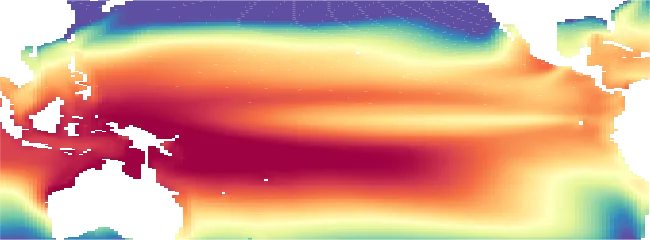
Every winter, the tropical Pacific Ocean seems to replay the same script: sea surface temperatures off the coast of Peru rise, trade winds weaken, and a wave of droughts and floods spreads across the planet. This is El Niño, and its peak almost always falls in December. Why winter in particular? There is enough energy to warm the water in summer too, but the ocean seems to wait for a permission that only arrives at the end of the year.
Climate scientists have long suspected that it is not just about the amount of heat. Imagine trying to fill a bathtub, but the tap opens and closes on a seasonal schedule. If water comes in faster than it can drain, the level rises. But to know when the tub will overflow, you need to know not only the flow from the tap, but also how irreversibly the water goes down the drain. In the new study, the authors applied exactly this perspective to El Niño: they calculated how irreversible the transitions of ocean temperature are across seasons.
To do this, they used a simplified model of El Niño, the so-called recharge oscillator. In this model, sea surface temperature is linked to the heat stored in the deeper ocean, like a float on a spring. The spring compresses and expands, while random wind gusts add noise. It turns out that the irreversibility of transitions, that is, how strongly the system 'forgets' its past, varies over the year. It is maximal in September and February, and minimal in November.
This result echoes a known principle: if a process is irreversible, it produces entropy, and entropy production limits how strongly observable quantities can fluctuate. The authors derived an exact inequality for ocean temperature, linking the rate of change of its variance to entropy production. They found that in November, entropy production is minimal, so the variance can grow fastest. Thus, the entropic clamp explains why El Niño is tied to winter.
Now that we have an entropic measure of phase locking, it can be used as a diagnostic tool for climate models. If a model fails to reproduce the seasonality of El Niño, it may be underestimating the irreversibility of transitions in the tropical ocean. This is no longer just an energy balance, but a subtler property of the climate system: its ability to 'forget' the past at the right time of year.
The peak of entropy production in September and February means that in these months ocean temperature transitions are most irreversible: the system 'forgets' the past faster than in other seasons.