Current Runs Along Secret Paths express
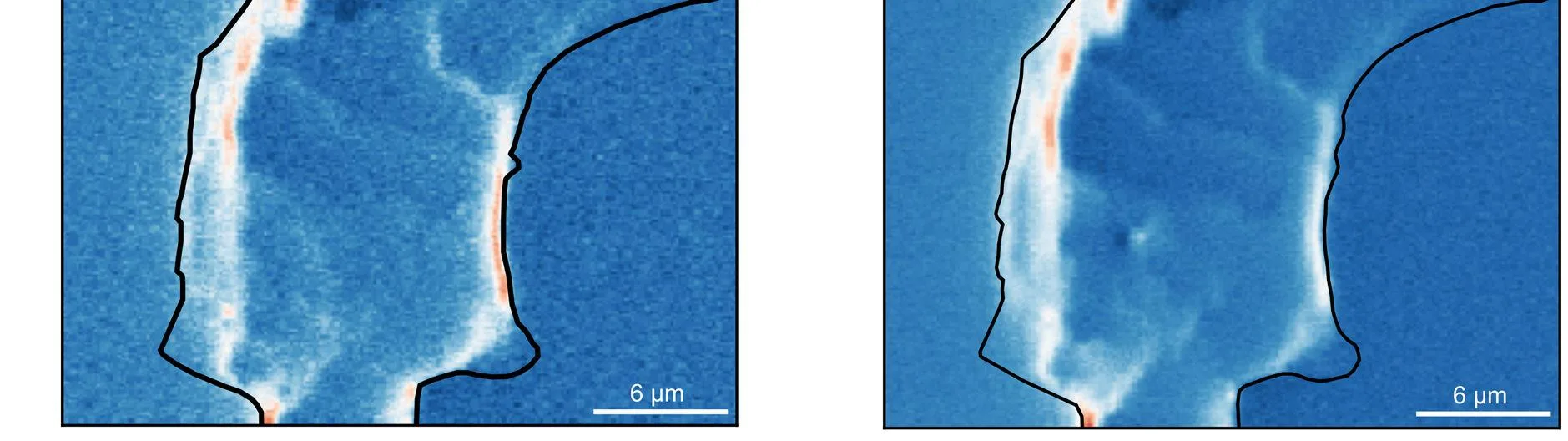
In the crystal CsV3Sb5-xSnx, which becomes a superconductor at low temperatures, current does not flow as a uniform stream but along narrow, winding paths. A scanning microscope with a sensitive magnetic field sensor helped reveal these paths: it picks up the faintest currents, much like a sonar probes the seafloor. The picture resembles a network of streams cutting through rock: some regions carry current, others remain blocked.
These current channels emerge exactly at the temperature where the material loses its resistance. From then on, they lead their own life: they do not vanish upon warming, nor do they blur even when the current is increased. Their behavior is nonlinear — current grows not smoothly but in jumps. This reveals that the channels act as a chain of Josephson junctions (places where supercurrent leaks through a thin barrier). Such 'streamlet' transport naturally explains long-standing puzzles: why the material exhibits a spontaneous diode effect (current flows more easily in one direction) and where the internal Josephson junctions come from.
The experiment provides the first spatial map of how supercurrent flows in kagome superconductors. Previously, the internal structure could only be inferred from bulk electrical measurements, like guessing the bottom topography from ripples on the water. Now it is clear that the material spontaneously fragments into conducting filaments, and this fragmentation is enhanced by impurities. This approach paves the way for local studies of other systems where different types of order coexist and compete.
Original abstract
as written by the authors arXiv:2606.20157
Superconductors are many-body quantum states in which current flows without dissipation. Theory predicts that supercurrents follow a relatively simple spatial pattern in both conventional and unconventional superconductors. Recent studies into the AV3Sb5 (A = Cs, K, Rb) family of Kagome superconductors indicate that CsV3Sb5 has unconventional transport properties that cannot be accounted for with these simple theories, including reports of intrinsic Josephson junctions, higher order Cooper pairing and the zero field diode effect. Attempts to interpret these findings have focused on the interplay of superconductivity with the unconventional charge density wave (CDW) order in these materials, with which superconductivity competes. A current roadblock to understanding how these kagome superconductors give rise to their intriguing properties is the lack of spatially resolved information about transport. Here we show, using a recently developed superconducting quantum interference device (SQUID) microscope, that flakes of CsV3Sb5-xSnx host a network of narrow supercurrent channels. These supercurrent channels emerge at the critical temperature and remain stable for all temperatures and currents. Their non-linear behaviour is consistent with a network of Josephson junctions linked by narrow supercurrent filaments, which naturally leads to the observed transport anomalies. Intriguingly, these observations are much weaker in undoped samples, which suggests links to the physics of charge density waves, disorder, and electronic correlations, all of which are greatly influenced by the doping strength. These results establish new frontiers for the local investigation of charge transport and competing orders in strongly correlated electron systems, and shine a new light on the anomalous transport properties of the AV3Sb5 kagome superconductors.
Kagome is a woven basket pattern made of interlaced triangles. In crystals with such a lattice, electrons behave particularly strangely due to geometric frustration.