Stochastic differential equations (SDEs) are equations that describe how a quantity changes over time when its evolution is influenced by random fluctuations, or noise, in addition to deterministic forces. Think of a pollen grain jiggling in water (Brownian motion) or a stock price fluctuating under market whims: the underlying trend is there, but randomness constantly perturbs it. SDEs formalize this by combining ordinary differential equations with a term that injects randomness, typically modeled as a Wiener process (a continuous-time random walk). They are essential in fields where noise is not a nuisance but a core feature of the system, such as biology (population dynamics, gene regulation), finance (option pricing), and physics (turbulence, thermal fluctuations).
History
The mathematical foundations were laid by Kiyosi Itô in the 1940s, who developed the stochastic integral and calculus that bear his name. Earlier, Albert Einstein and Marian Smoluchowski had used heuristic stochastic models for Brownian motion, but Itô provided the rigorous framework. Ruslan Stratonovich introduced an alternative integral in the 1960s, and the theory has since expanded into a rich field with applications across sciences.
How it works
An SDE is written like dX_t = a(X_t, t) dt + b(X_t, t) dW_t, where X_t is the state, a is the drift (deterministic trend), b is the diffusion (noise strength), and dW_t is an infinitesimal increment of a Wiener process. The key subtlety is that the noise term is not a smooth function; it has infinite variation, so the integral of b dW_t must be defined carefully. Two main interpretations exist: Itô (where the integrand is evaluated at the left endpoint of each time step) and Stratonovich (evaluated at the midpoint). The choice affects the calculus rules and the physical meaning. Solutions are stochastic processes, and instead of a single trajectory, one obtains a probability distribution over possible paths.
In practice
SDEs are used to model option prices in quantitative finance (e.g., the Black-Scholes equation is a partial differential equation derived from an SDE), to simulate neural activity in computational neuroscience, and to describe turbulent flows in physics.
Fun fact
The path of a Wiener process, the fundamental noise in SDEs, is continuous everywhere but differentiable nowhere — it is so jagged that its length over any finite interval is infinite.
A clot grows like a snowball rolling down a mountain: small at first, it picks up new layers, and predicting when it will turn into an avalanche is tricky. In the blood, a long chain of reactions, the coagulation cascade, unfolds, where one substance activates another, and the clot gains mass.
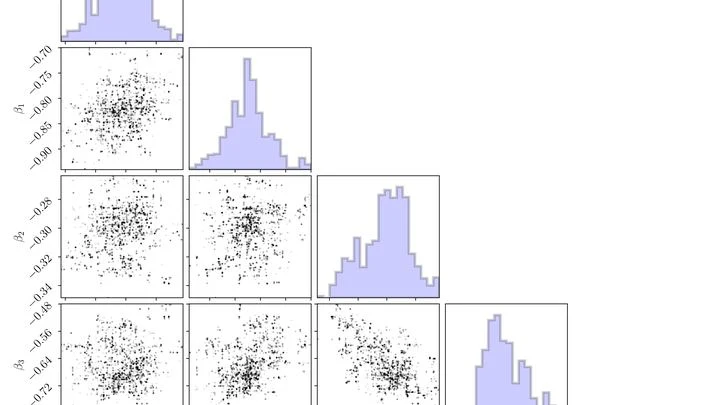
Many natural processes are described by differential equations, but scientists often have only fragmentary data — a sort of torn map. The new computational method works like a cartographer who reconstructs a complete map of the terrain from a few landmarks.
The early universe expanded at an unimaginable rate — faster than light could cross it. In this boiling cauldron, any region of space resembled an open can of paint: its boundaries continuously captured new 'vapor' from outside, while some of its own contents irrevocably escaped.
A candle flame in a draft dances: now it flares up, now it almost goes out. Quasars behave much the same way — supermassive black holes in the centers of distant galaxies, surrounded by a scorching disk of infalling matter. Only they flicker not over seconds, but over months and years.
Three twins on the run constantly change clothes. That's roughly how neutrinos behave — nearly elusive particles that pass through us by the trillions every second.
Two musicians play a duet. In a perfect hall, they hear each other perfectly and gradually fall into resonance. But try playing in a room where someone keeps slamming the door. You'd think the rhythm would be thrown off. But no: sometimes that very random slam makes both of them sync up instantly.
A drop of ink in a glass of water spreads evenly, but in a cup with chunks of fruit jelly, the ink will take winding paths — sometimes getting stuck, sometimes slipping through. Similarly, molecules in living cells or porous materials don't move on a smooth field but through a disordered medium: denser in some places, thinner in others.
When a massive star dies and collapses into a supernova, a neutron star is born — a city-sized sphere with the Sun's mass. Its matter is so compressed that a teaspoon weighs more than Mount Everest. Physicists are trying to learn the "recipe" of this matter — the equation of state that explains how matter behaves under extreme pressure.
There's a lot hidden underground: water, ore, sand, clay. To figure out what's there, you don't have to dig. Just run a weak alternating current through the ground and listen to how the rock 'responds' at different frequencies. This technique is called spectral induced polarization.
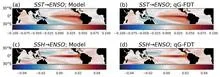
Every few years, the warm current off the coast of Peru shifts, and fishermen come home empty-handed. This is El Niño, the breath of the tropical Pacific, which affects weather from Indonesia to California. Predicting its arrival is as hard as predicting where a stone thrown into a raging river will roll.
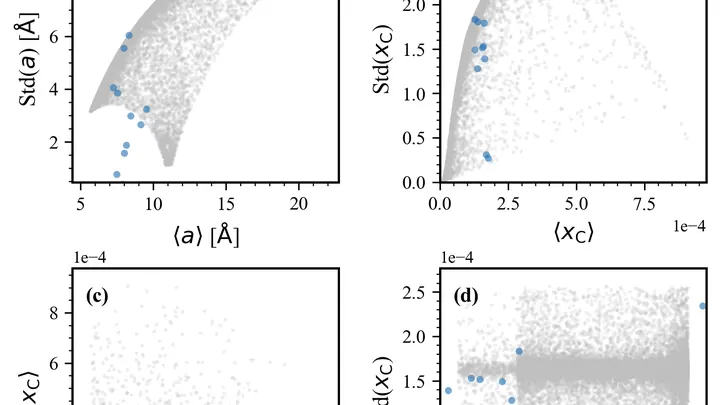
Cosmic dust isn't dirt: it's tiny grains, like soot from a campfire, scattered between the stars. Some of them spin at breakneck speeds, millions of times per second, emitting faint radio waves. Astronomers call this anomalous microwave emission: it interferes with studies of the early universe, but it's also a mystery in its own right.
A quantum state under continuous measurement is not a frozen picture but a random dance. Each measurement outcome nudges the state one way or another, and to predict the future you have to track the entire trajectory.
In a large concert hall, sound bounces off the walls, and even if you stand in a corner, the echo can reveal the shape of the room. That is essentially the problem the authors tackle: how to recover a system's hidden rhythms from the 'echo' in data collected from only part of the system.