Quantum Spins on Indium Impurities in Germanium express
A quantum computer is like an orchestra where every musician must play their part without missing a beat. The musicians are qubits — carriers of quantum information. For the orchestra to sound harmonious, you need qubits that are reliable, controllable, and not too sensitive to noise. One promising platform is the spins of holes trapped on impurity atoms in a semiconductor.
The research group proposed using indium atoms embedded in ultra-pure germanium. Unlike conventional donor qubits, where the information carrier is an electron, here a hole does the job — a positively charged carrier that appears when an acceptor impurity captures an electron. The spin of such a hole is sensitive to an electric field, allowing control without magnetic fields, just by applying voltage to a gate. The authors calculated that at an indium concentration of about 2×10¹⁴ atoms per cubic centimeter, the distance between neighboring acceptors would be roughly 170 nanometers. In an active region 1 micrometer long, there would be on average five atoms — enough to pick out the desired chain after fabrication, rather than trying to place atoms one by one.
Coupling between neighboring qubits can be dipolar or via phonons — quanta of crystal lattice vibrations. The direct exchange mechanism only kicks in when atoms are very close or with the help of an additional gate. In a second stage, after basic operations are refined, one could add a phononic crystal — a structure that suppresses unwanted acoustic vibrations and enhances desired interactions. This approach is reminiscent of tuning the acoustics of a concert hall: first you get a clean sound from each instrument, then you add resonators for ensemble playing.
Original abstract
as written by the authors arXiv:2606.22067
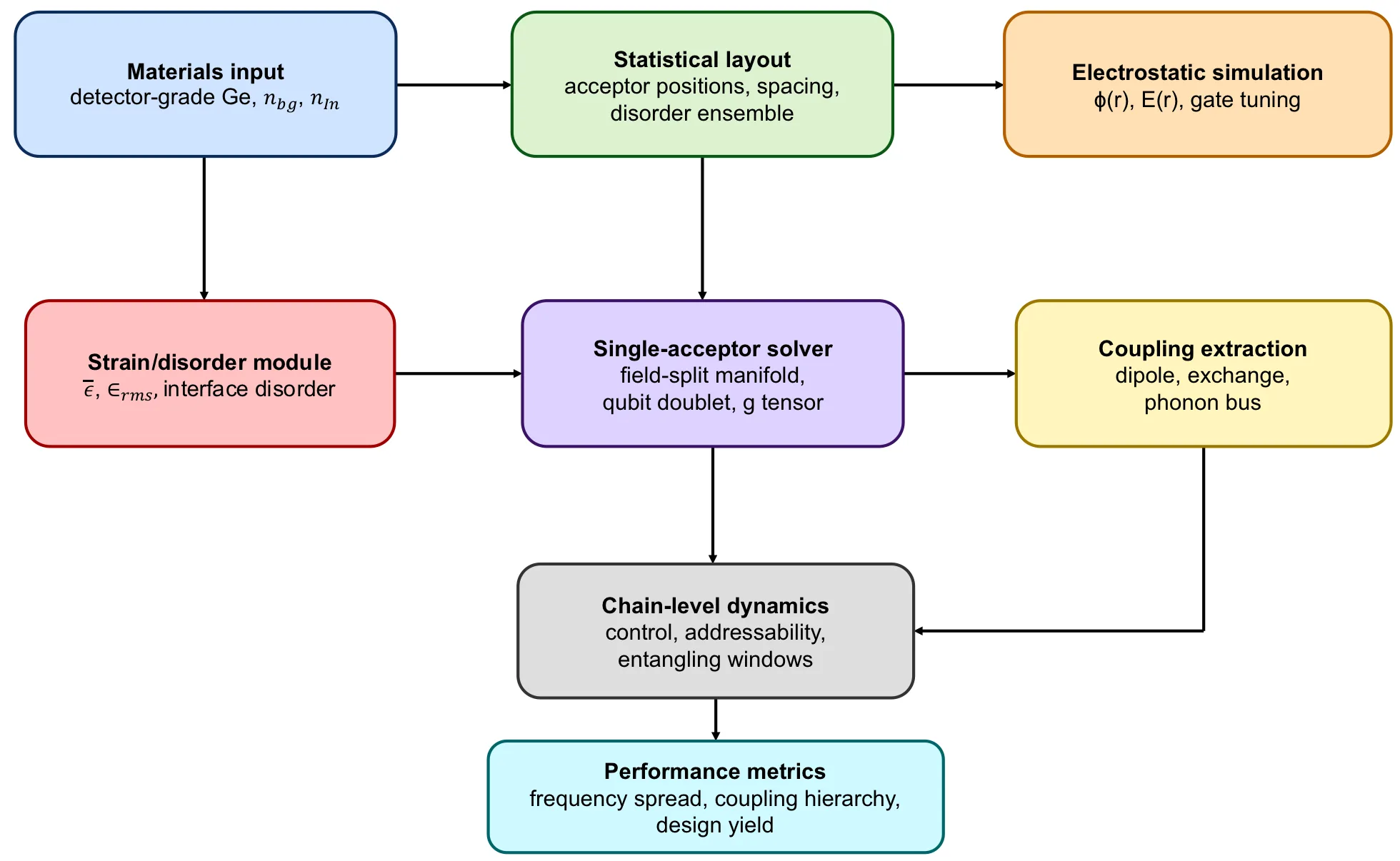
Acceptor-bound hole spins in germanium (Ge) offer a promising but underexplored route to semiconductor quantum information processing. We present a theory-guided design study of a detector-grade Ge acceptor-spin platform based on intentionally incorporated indium (In) acceptors in ultra-high-purity Ge. The proposed materials strategy combines a residual impurity background near $$10^{10} \mathrm{cm^{-3}}$$ with a target In density of approximately $$2\times10^{14} \mathrm{cm^{-3}}$$, corresponding to an acceptor spacing of about 170 nanometer. A 1 $$\mu$$m-long active channel with a suitable transverse mode volume can contain about five acceptors on average, enabling a statistically selected post-fabrication register rather than a deterministically placed chain. We analyze the physical basis, device architecture, strain and disorder limits, coupling hierarchy, modeling workflow, fabrication pathway, and scaling prospects. Our results indicate that detector-grade Ge can suppress uncontrolled bulk electrostatic and strain disorder to levels compatible with acceptor-hole qubits, while the spin--orbit-active valence-band manifold supports all-electrical control and dipolar or phonon-mediated coupling. Direct exchange is treated as a close-pair or gate-enhanced interaction rather than the generic mean-spacing coupling. Phononic crystal engineering is identified as a second-stage enhancement for suppressing unwanted acoustic modes and enabling selected cavity-mediated interactions after baseline control, readout, and nearest-neighbor coupling are validated. Remaining challenges include statistical acceptor placement, interface disorder, charge noise, readout integration, and experimental validation. This work identifies detector-grade Ge In-acceptor qubits as a credible intermediate architecture between donor-based impurity qubits and fully gate-defined Ge hole-spin hardware.
The spin of a hole in germanium can be flipped with a single electric pulse, no magnets needed, because germanium's valence band interacts strongly with spin.