James Webb Fishes Out an Invisible Planet from a Dusty Disk express
Using James Webb, astronomers 'fished out' a third giant planet from the murky dust disk of the star β Pictoris. Two others were already known, but this one was hiding in the bright light, like a fish in muddy water.
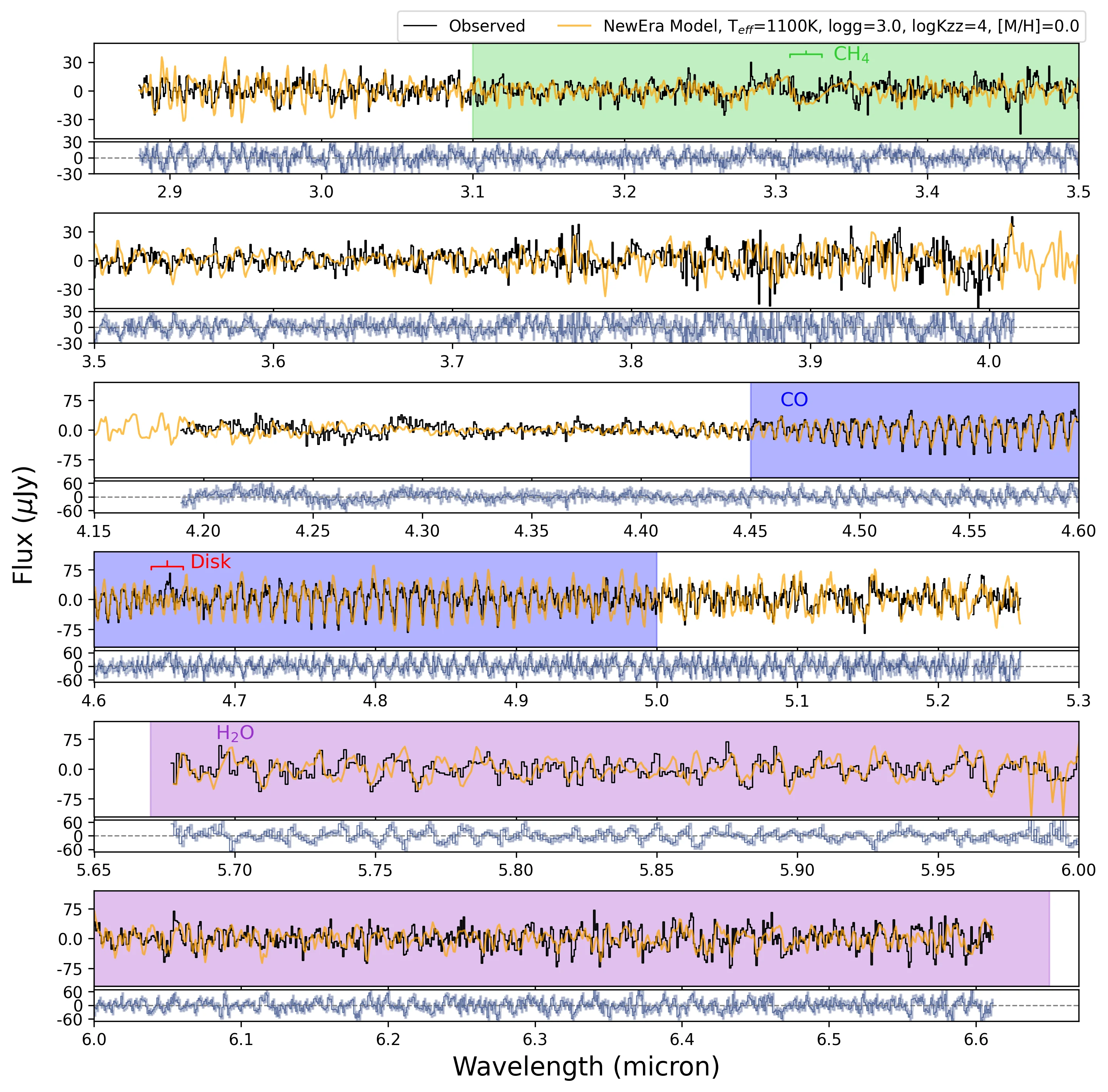
Regular imaging didn't help, so they used splitting light into colors: it revealed the fingerprints of water, methane, and carbon monoxide. It's like fishing by chemical 'scent': instead of casting a net blindly, they used a precise lure — a template of molecular lines.
The fished-out planet β Pic d is 2–4 times more massive than Jupiter and orbits far out — farther than Neptune is from the Sun. With its gravity, it scrapes out the inner edge of the dust disk, like raking silt. A year on it lasts over a hundred Earth years, and the method itself opens our eyes: searching for worlds where before we saw only murk.
Original abstract
as written by the authors arXiv:2606.23789
We report the discovery of $$\beta$$ Pictoris d ($$\beta$$ Pic d), a third giant planet in the $$\beta$$ Pictoris system, which now becomes only the second directly imaged system with more than two confirmed planets. $$\beta$$ Pic d was serendipitously detected in JWST/NIRSpec IFU observations. A second epoch of NIRSpec and MIRI/MRS observations confirm the initial discovery. The extracted spectrum shows clear CH$$_4$$, CO, and H$$_2$$O absorption features, and $$\beta$$ Pic d's measured radial velocity is consistent with its orbital position. Radial velocity and astrometry measurements combined with orbital stability simulations suggest a semi-major axis $$>$$30 au, consistent with $$\beta$$ Pic d being responsible for carving the inner edge of the $$\beta$$ Pictoris debris disk. Using effective temperature estimates from atmosphere model grid fits combined with evolutionary models, we estimate a mass of 2--4 $$M_\mathrm{Jup}$$. $$\beta$$ Pic d is the first planet discovered using spectral template matching with moderate-resolution spectroscopy, highlighting its sensitivity to planetary molecular features hidden within bright extrasolar debris disks that are difficult to access with broadband imaging.
A year on β Pic d lasts at least a century and a half: the planet is so distant that a single orbit takes over 100 Earth years.