Neural Network Learns Climate from Three Notebooks ✛
A student who has spent years solving problems from other people's textbooks suddenly receives three notebooks with real ocean observations. There are few problems, but they have already seen hundreds of similar ones, and now a couple of examples suffice to catch the new teacher's style. In this way, a diffusion model (a neural network that learns to remove noise from data) masters the climate of the Pacific Ocean, where the warm El Niño phase alternates with the cold La Niña and drives weather across the planet.
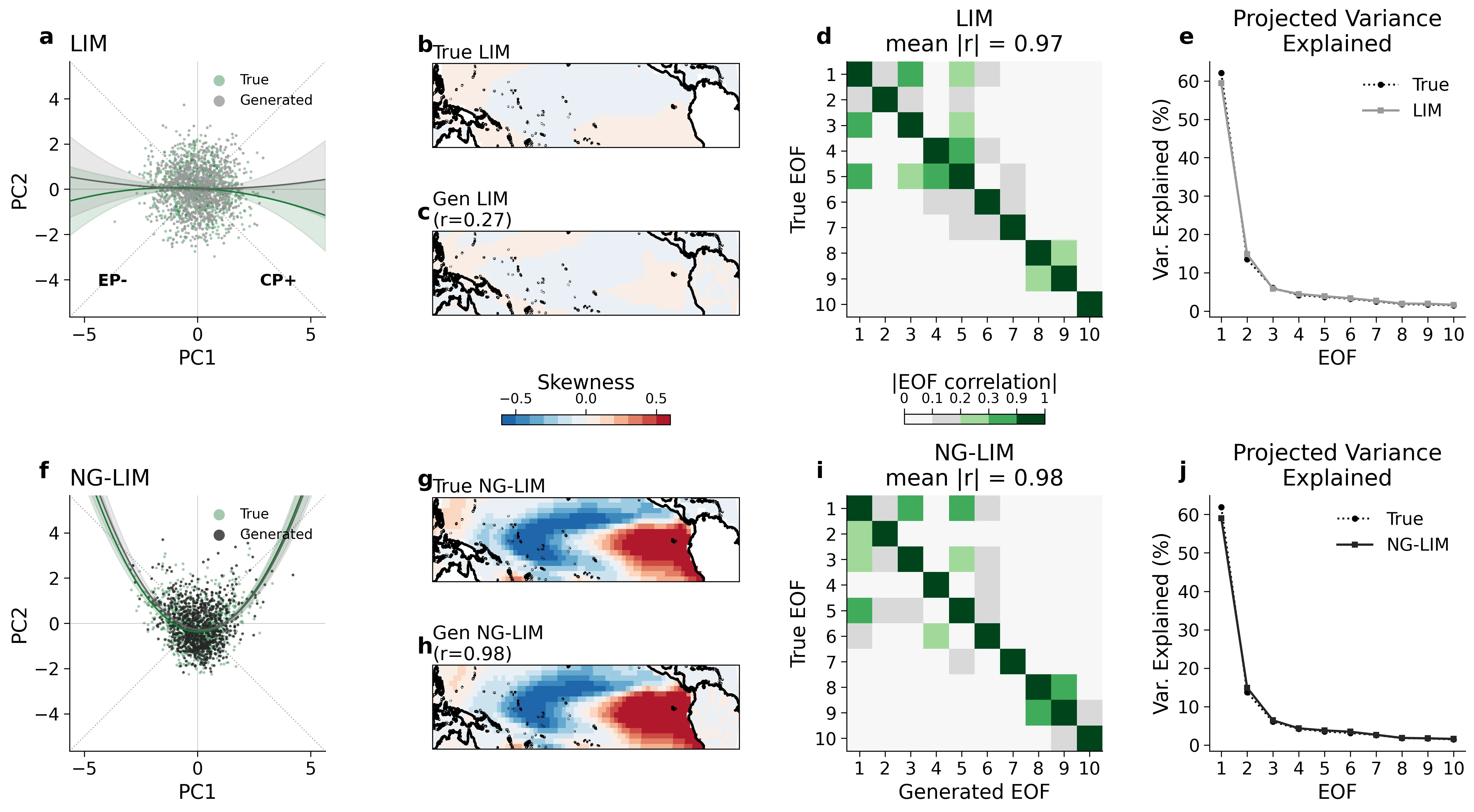
The catch is that satellite and buoy measurements of sea surface temperature only began in the mid-20th century. Since then, about 720 monthly mean maps have accumulated, while neural networks with millions of parameters typically need thousands of examples. To honestly test what the model actually learned, the authors created a benchmark: they generated 120,000 synthetic fields with known structure. On these data, the model accurately reproduced both symmetric and asymmetric variability, but when the sample was reduced to the real size, it started memorizing training examples instead of generalizing.
The solution came from the nature of learning itself. First, the model was pretrained on synthetic fields from 30 climate models of the CMIP6 project, adding an eight-dimensional vector to the architecture that encodes each model's identity. Then, on 720 real observations, only this vector was fine-tuned. This approach achieved pattern correlation above 0.85 and asymmetry correlation above 0.9, surpassing classical linear models. A student trained on many virtual worlds masters the single real one with just a few examples.
Diffusion models, which now generate realistic faces and landscapes, were originally inspired by non-equilibrium thermodynamics, the science of how systems transition from order to chaos. In this work, the same principle is reversed to recover ordered climate structures from noise.
The idea of training a machine on a multitude of virtual worlds and then tuning it to a single real one echoes Ted Chiang's story "Story of Your Life," where a linguist learns an alien language by relying on many hypothetical grammars to understand one actual one.