The Boundary of Two Worlds: A Neutron Star’s Quantum Checkpoint ✛ ✎ ✦
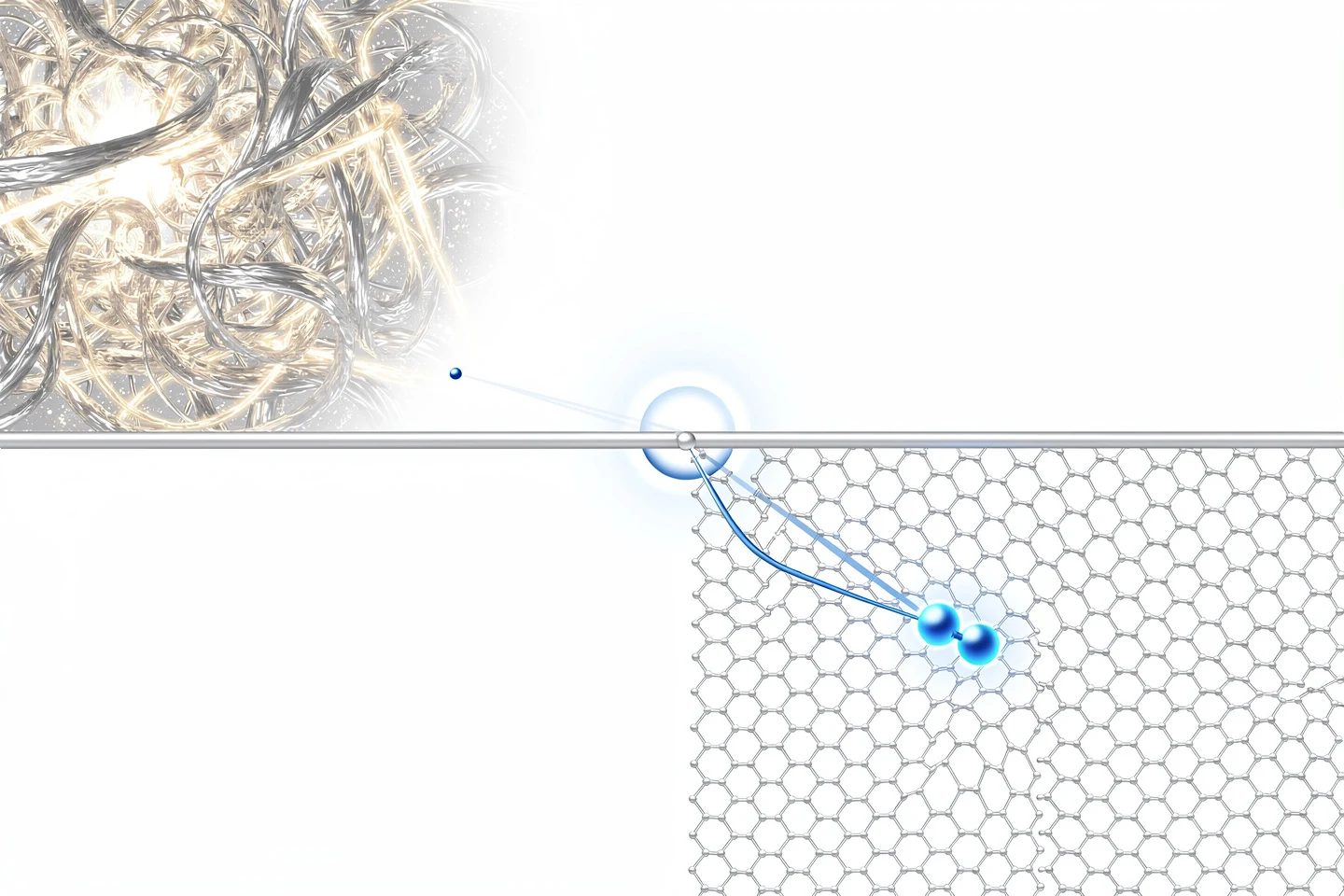
Neutron stars are the ultradense remnants of supernova explosions. In their cores, matter exists in two exotic phases: a hot quark-gluon plasma with quarks careening around wildly, and deeper down — color superconductivity, where quarks are locked in pairs (predicted with contributions from John Bardeen, while the idea of free quarks came from Murray Gell-Mann; the stability limit of stars was determined by Subrahmanyan Chandrasekhar). At the boundary between these worlds, a strict rulebook governs: a lone quark cannot cross: it morphs into an antiparticle (a 'hole') and ricochets back, while only a pair can slip into the superconductor. This is Andreev reflection. Precise calculations using quantum field theory showed that the current across the border skyrockets when the difference in 'voltage' between the phases matches the binding energy of a quark pair, making the boundary act like a pump. An unexpected twist: the reflected solo particles haul heat back into the plasma, so the star cools more slowly than we thought. This helps decode magnetic field evolution and impacts nucleosynthesis of elements in the crust. The full story weaves together the Standard Model of particle physics and the laws of stellar evolution, while future computer simulations will replay a star’s entire life from birth to fading ember, including the quantum thermodynamics of cooling.
A single teaspoon of neutron star stuff tips the scales at a billion tons — if dropped on Earth, it would pierce the planet like a bullet through butter.
Robert Forward’s novel *Dragon’s Egg* imagines life teeming on a neutron star’s surface. Ideas about multilayered interiors and quantum interfaces give such stories a grounding in real science.