Quantum Masquerade at the Boundary of Quark Worlds ✛ ✎ ✦
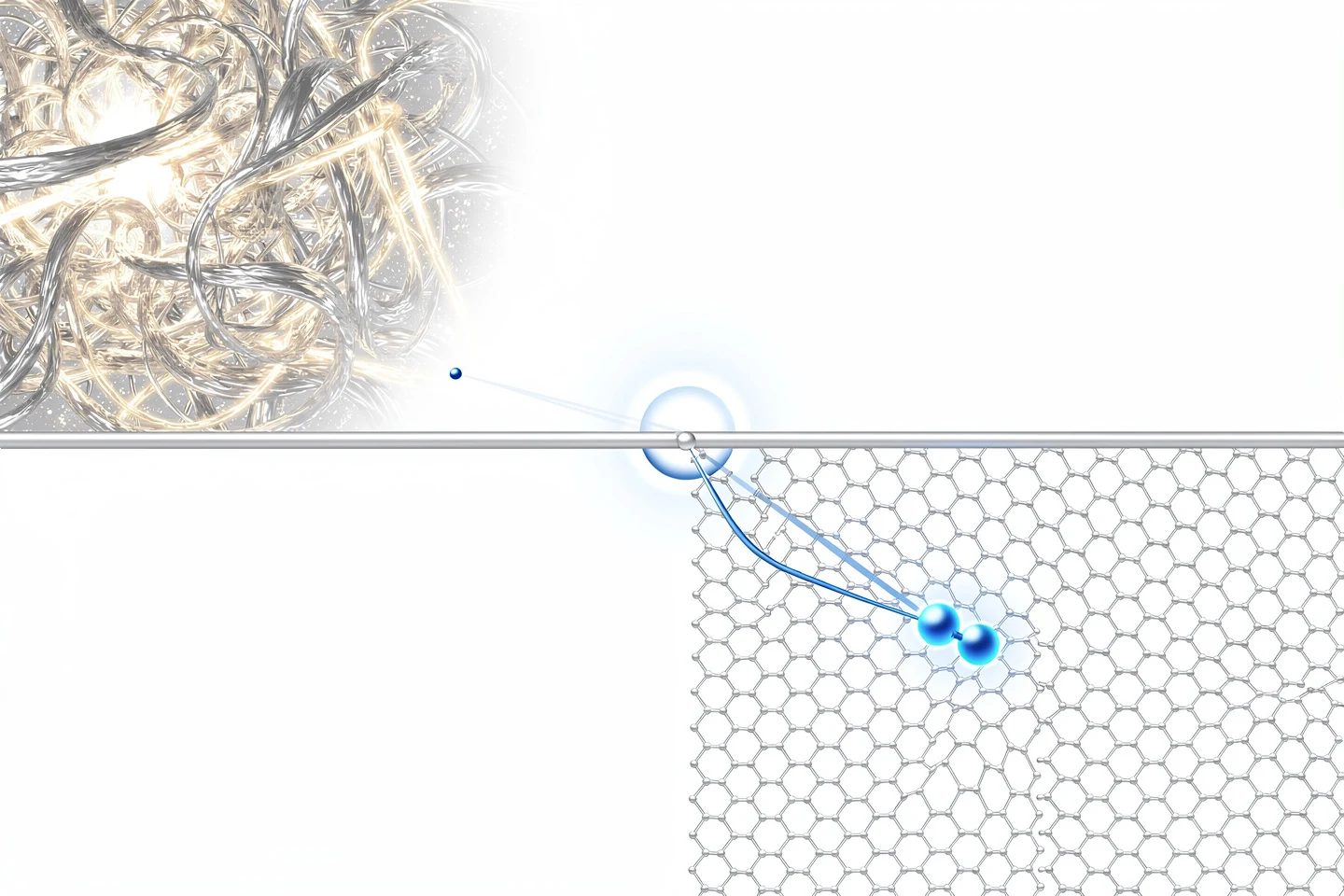
Neutron stars are cosmic alchemical retorts: at supranuclear densities, hadrons melt into quark-gluon plasma (QGP), and at the very core where pressure peaks, a color superconductor (CS) is born. These two phases, like oil and water, coexist, separated by a ghostly boundary, and it is there, at the interface, that a quantum drama unfolds. Building on the insights of Murray Gell-Mann, who first glimpsed quarks, and Subrahmanyan Chandrasekhar, who predicted the stellar mass limit, physicists now peer into this frontier to understand how disequilibrium rewrites the fate of compact objects.
Imagine the boundary as a hall of mirrors at a carnival of quantum entities. A quark from the hot QGP, dressed in color and flavor, approaches the cold CS. It cannot cross the line: Andreev reflection turns it into a hole, and a Cooper pair is injected into the superconducting condensate, as if at a masquerade ball where each guest is assigned a new role. This process, forbidden in ordinary metals without clever tricks, becomes the main transport mode here. The Schwinger-Keldysh formalism for non-equilibrium quantum field theory has choreographed every particle pirouette, taking color and flavor into account. The Andreev current soars when the chemical potential difference Δμ catches up with the energy gap |Δ| (about 100 MeV). The boundary sings like a string only with precise tuning, and that song changes the star’s destiny. The gap itself is comparable to the strange quark mass, so at resonance whole particle families can be born and annihilate, turning the interface into a boiling pot.
There’s a twist worthy of a detective story: quarks of different colors play by different rules. Red and green, paired in the CS, join the masquerade, while blue ones are loners, seeping through the boundary differently. This gives rise to a color-current asymmetry, driving a dynamo of gluon fields. Those fields might explain the mysterious glitches, sudden spin-ups of neutron stars, and the evolution of their magnetars. In the low-temperature limit, where the Pauli principle rules the ball, the hole branch devotes itself solely to the Andreev current, like an actor playing the same role to the end.
Behind these calculations lies more than academic curiosity. By understanding how the density difference relaxes, we can better predict cooling curves and the seismic activity of stellar remnants. The microscopic quark dance ties into macroscopic destiny, carrying forward the spirit of John Bardeen, whose BCS theory gets a second life in the realm of strong interactions. And there’s more: the formalism promises to unveil the three-color CFL phase, color dynamics, and even place constraints on the standard model far from equilibrium — perhaps right there lie keys to new physics.
In a color superconductor, quarks, obeying Bose–Einstein statistics, flow without resistance, but unlike electron pairs they carry color charge — giving rise to gluonic superfluid vortices.
Robert Forward’s novel "Dragon’s Egg" depicted life on the surface of a neutron star — a world of monstrous gravity and magnetic fields. The discovery of multiphase interiors and quantum interfaces adds physical depth to those images, hinting that even more bizarre dynamics lurk inside these objects.