Andreev transport at the boundary between quark-gluon plasma and color superconductor ✛ ✎ ✦
Context
Born in the aftermath of supernova explosions, neutron stars are natural laboratories for studying matter at extreme densities. In their central regions, where density exceeds nuclear density, hadrons can dissolve into quark-gluon plasma (QGP), and further compression, as predicted in the works of Murray Gell-Mann on quarks and Subrahmanyan Chandrasekhar on mass limits, leads to the formation of color superconductivity (CS). In this phase, quarks form Cooper pairs obeying Bose–Einstein statistics, radically altering the properties of matter. Interfaces between QGP and CS may play a key role in neutron star evolution, influencing heat transport, dissipation of rotational energy, and even the generation of magnetic fields. However, a microscopic description of non-equilibrium transport across such boundaries has long been a gap, especially in the relativistic regime accounting for color and flavor degrees of freedom.
Methods
To overcome the limitations of previous approaches based on wavefunction matching, the authors employed the non-equilibrium Green's function method in the Schwinger-Keldysh formalism — a powerful tool of quantum field theory for systems out of equilibrium. The interface was described by an effective tunneling Hamiltonian with coupling constant T, while the two-flavor CS phase (2SC) was treated via a mean field with a gap Δ introduced into the Nambu-Gorkov Green's functions. The current was computed in the frequency representation using Langreth rules, taking into account both single-particle tunneling and fourth-order contributions in T that involve anomalous (pairing) propagators. This approach preserved the Lorentz-covariant Dirac structure and explicitly included the color-flavor pairing matrix, which is crucial for dense quark matter.
Results
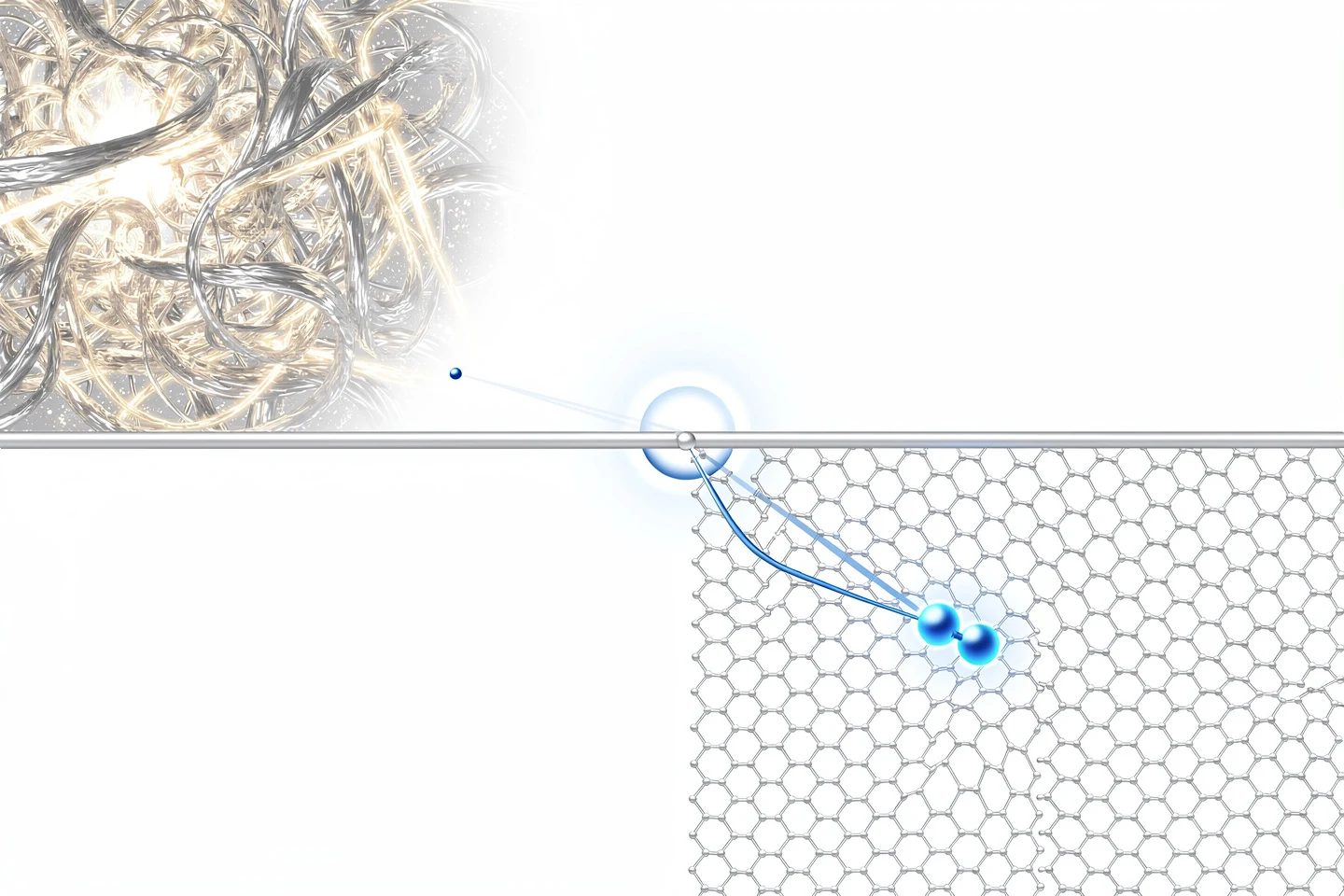
The analysis showed that the Andreev current IA and the intermediate current Iint, associated with virtual pairs, sharply increase when the chemical potential difference Δμ becomes comparable to the gap Δ (about 100 MeV for typical parameters). When Δμ >> |Δ|, Andreev reflection is suppressed, reminiscent of the behavior of ordinary NS contacts. The momentum dependence revealed resonances at k ≈ μQGP − Δμ ± |Δ|, corresponding to the quark energy matching the peak of the anomalous spectral function of the CS phase. In the low-temperature limit (the realm of quantum thermodynamics at T≈25 MeV), the hole branch contributes only to the Andreev current, since for Iint it is blocked by the Pauli principle. The total anomalous current, at small deviations from equilibrium, can dominate over ordinary quasiparticle tunneling, determining the relaxation of the density difference between the phases. Additionally, it was found that due to differences in the tunneling of color charges (red and green quarks are paired, while blue ones are not), color transport occurs, requiring a self-consistent treatment of effective chemical potentials.
Implications
This work provides, for the first time, a microscopic description of Andreev transport across a relativistic interface involving color superconducting phases. This is important for understanding dissipative processes in the interiors of neutron stars, especially shortly after equilibrium-disrupting events — for instance, during accretion or starquakes. The revealed asymmetry of color currents points to a mechanism for generating strong gluon fields, which may influence the evolution of magnetic fields and even observable glitches. Moreover, the results lay the groundwork for studying nucleosynthesis under extreme conditions and contribute to the Standard Model of particle physics, extending it to the non-equilibrium dynamics of strong interactions. The legacy of John Bardeen, the creator of BCS theory, finds new resonance in the context of dense quark matter.
Future development
In the future, the method can be extended to the three-color CFL phase and interfaces with hadronic matter. It would be interesting to investigate the non-equilibrium evolution of color and pressure equilibration due to quantum fluctuations. Combining the developed formalism with numerical simulations of superfluid quark matter hydrodynamics will open the way to predicting cooling curves and seismic activity of compact objects, which can be tested by future astrophysical observations.
Impact
The results will directly impact the theory of compact objects, high-density physics, and quantum transport in relativistic media, and will serve as a starting point for modeling non-equilibrium processes in neutron star astrophysics.
Next steps
Immediate next steps include a quantitative analysis of color charge relaxation, taking into account the back-reaction of gluon fields, and computing the damping time of density imbalance under realistic conditions.
Key open problems
The study touches upon the fundamental problem of the equation of state of cold dense matter and the mechanisms for achieving color neutrality in color superconductors, and also contributes to solving the puzzle of glitches and the thermal evolution of isolated neutron stars.
The knowledge machine's view
This section is addressed to the author of the paper and their colleagues. Neighbouring works were found by meaning-based search across our archive, not by word overlap. We do not review: we show the field around the work.
What the work does
The paper calculates Andreev transport across the interface between quark-gluon plasma and a color superconductor using nonequilibrium Green's functions in the Schwinger–Keldysh formalism. It is shown that the Andreev current sharply increases when the chemical potential difference is on the order of the gap, and is then suppressed, with resonances in the momentum dependence. The contribution of virtual pairs and the low-temperature behavior are also analyzed.
Where its strength is
The strong point is the microscopic calculation of nonequilibrium transport with full account of the color-flavor structure and Lorentz covariance, which allows a quantitative connection between interface parameters and observable effects in neutron stars.
Where it could go next
- It might be interesting to compare the obtained currents with constraints on color superconductivity parameters from neutron star observations, as in recent analyses of massive pulsar data.based on: Quiet Quark Waltz: New Data Tighten Bounds on Color Superconductivity arXiv:2606.03707v2
- Related work exists on the influence of quark matter on neutron star stability; one could examine how Andreev transport at the phase boundary affects the equation of state and maximum masses.based on: How Quarks Help Neutron Stars Avoid Collapsing arXiv:2607.19220
- There is an arXiv paper on magnetic field generation in neutron stars; possibly the dissipation of the Andreev current near the interface contributes to thermal evolution and the magnetic field.based on: Neutron Star's Sleeping Volcano: How Mass, Not Spin, Gives Birth to Magnetic Monsters arXiv:2607.17556v1
Worth trying
- Estimate the contribution of the Andreev current to the cooling rate of a neutron star, comparing with heat transport models.
- Check whether the resonant enhancement of the current leads to observable features in X-ray light curves.
- Consider the interface with three-flavor color superconductivity (CFL) and compare with the 2SC results.
Why this may matter
Such calculations can link microscopic parameters of quark matter to macroscopic manifestations in neutron stars, helping to interpret future observations.
Nearby works in our archive
- Neutron Star's Sleeping Volcano: How Mass, Not Spin, Gives Birth to Magnetic Monsterssimilarity 0.71
- Quiet Quark Waltz: New Data Tighten Bounds on Color Superconductivitysimilarity 0.67
- Cosmic Kitchen: How Neutron Star Collisions Cook Goldsimilarity 0.66
- Neutrinos as Waves in Stellar Firesimilarity 0.66
- Stellar Tuning: Why Gravity Suddenly Changes Its Charactersimilarity 0.65
- Light That Goes the Wrong Waysimilarity 0.64
- How Quarks Help Neutron Stars Avoid Collapsingsimilarity 0.64
The archive is crowded around this work: 4 reviews nearby, closest at 0.71. This ground is well walked — and there is plenty to compare against.
A tablespoon of neutron star material weighs about a billion tons: if you could bring it to Earth, it would punch right through the planet under its own weight. In quark matter, this madness is compounded by exotic quantum processes like Andreev reflection.
In Robert Forward's novel 'Dragon's Egg', life is depicted on the surface of a neutron star, where monstrous gravity and magnetic fields create an incredible world. The ideas of multiphase interiors and quantum interfaces add realism to such visions, hinting at the complex internal dynamics of these objects.
Key numbers
- 2SC energy gap (|Δ|): ≈ 100 MeV (typical value)
- Quark chemical potential (μ_QGP): ≈ 500 MeV
- Temperature inside a neutron star: ≈ 25 MeV (~2.9×10¹¹ K)
- Enhancement of Andreev current at Δμ ≈ |Δ|: up to several times
- Order of tunneling current expansion: fourth (T^4) for anomalous processes