The Very Large Telescope (VLT) is an array of four individual optical telescopes, each with a main mirror 8.2 meters in diameter, operated by the European Southern Observatory (ESO) at the Paranal Observatory in the Atacama Desert of Chile. It is one of the most powerful and productive ground-based astronomical facilities in the world. The VLT can work as four independent telescopes or as a single giant interferometer, combining the light from all four to achieve the angular resolution of a telescope with a mirror up to 200 meters in diameter.
History
The VLT was conceived in the 1980s, with the first Unit Telescope seeing first light in 1998 and the fourth in 2000. The project was a flagship endeavor for ESO, establishing the Paranal Observatory as a premier site for ground-based astronomy.
How it works
Each of the four Unit Telescopes (UTs) collects light with its large primary mirror, which is then directed to a suite of sophisticated instruments for imaging, spectroscopy, and polarimetry. In interferometric mode, the light from the separate telescopes is combined using a system of mirrors and delay lines in an underground cavern, allowing astronomers to measure the fine details of celestial objects, such as the surfaces of stars and the environments around black holes.
In practice
The VLT has been instrumental in a wide range of discoveries, from imaging exoplanets directly to measuring the acceleration of the universe's expansion and observing the first light from gravitational wave counterparts.
Fun fact
The VLT's adaptive optics systems use a laser to create an artificial star in the Earth's atmosphere, allowing the telescope to measure and correct for atmospheric blurring in real time.
A network of radio telescopes scattered across the planet catches the whisper of a distant black hole. Each antenna records a signal, but how do you combine these recordings if the clocks at the stations tick at different rates and the atmosphere distorts incoming waves?
When an orchestra of thousands of musicians plays in harmony, the credit goes not only to each player's talent but also to the invisible work of the conductor.
In the Galactic bulge, where the light of billions of stars merges into a continuous glow, four cold giants passed unnoticed. You can't see them through a telescope — too far, too dim.
The Universe is a giant labyrinth of curved mirrors. The mass of galaxies and clusters distorts the light of distant quasars, as if toying with our perception of the cosmos. Hidden in this hall of mirrors is the key to the greatest mystery: dark energy, which is pushing space apart ever faster.
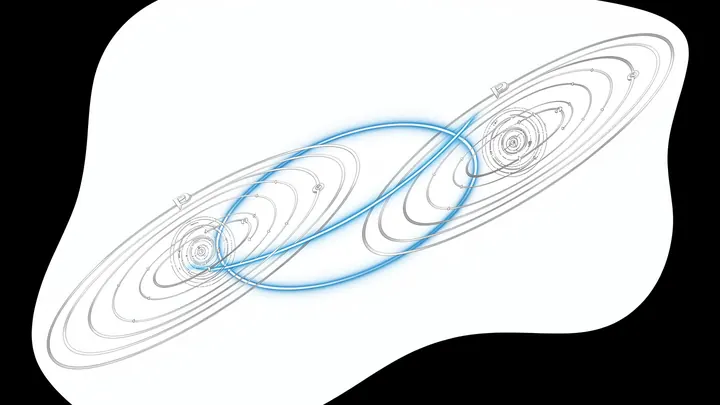
Two beams of light race around a closed loop, heading toward each other. Since the speed of light is constant, when the ring turns, one beam has to catch up with a moving finish line, while the other meets it sooner. Their meeting creates a pattern, and from that pattern we can tell how fast the whole system is spinning.
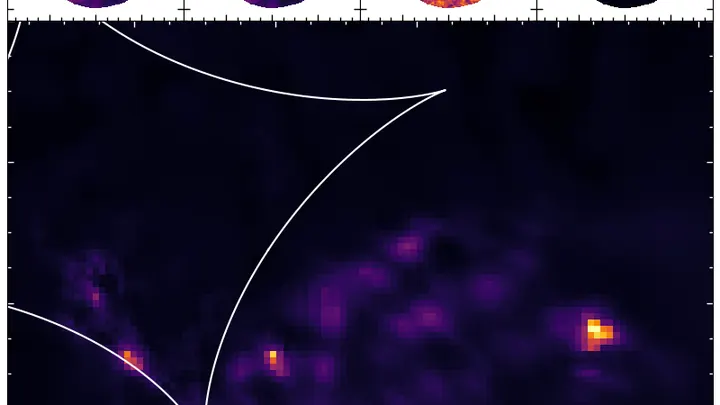
A magnifying glass focuses sunlight into a bright point. If the glass has a tiny flaw, the spot of light becomes distorted. Gravitational lensing works in a similar way: a massive galaxy bends light rays from a more distant source, creating an enlarged and sometimes distorted image.
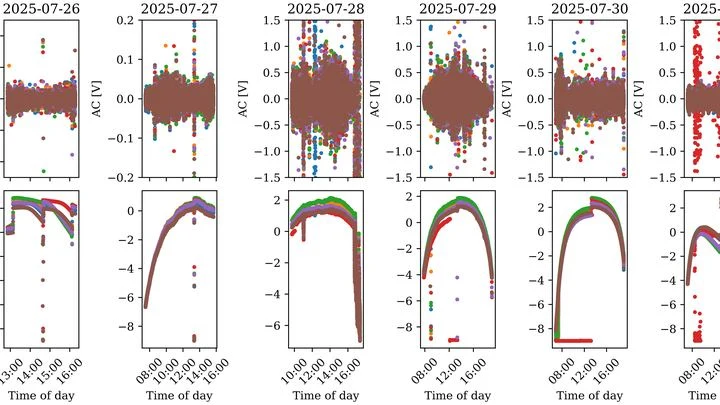
By day in Chile's Atacama Desert, the air shimmers with heat like the haze above a hot skillet. Sunlight passing through this shimmer begins to dance and flicker. Astronomers call this airy trembling "seeing" — and it keeps telescopes from getting a sharp view of the stars.
To fight this nuisance, engineers have built a special instrument — a solar seeing monitor.
Cosmic rays are not light but charged particles bombarding Earth from all directions. Most of them are protons (hydrogen nuclei), but heavier nuclei also show up: helium, nitrogen, iron.
In October 2022, the cosmos put on a fireworks show that every detector on Earth noticed. The explosion, named GRB 221009A, was so bright that it was called the brightest ever observed. It's a gamma-ray burst — a short but incredibly powerful flash that releases as much energy in seconds as the Sun will produce in its entire lifetime.
Titan, Saturn's largest moon, is wrapped in a thick orange haze. It's made of hydrocarbons and other organic molecules that are born when sunlight breaks apart methane and nitrogen in the upper atmosphere.
Light from a star travels for millions of years, yet in a telescope it still appears as a point: it's just too far away. To see a star's surface, you need an instrument the size of a city. In Chile, such a giant is already under construction: ELT with a 39-meter mirror made of 798 hexagonal segments.
In a tropical village, a lab technician peers through a microscope eyepiece, hunting for tiny worm eggs in a drop of fluid. The work is monotonous, the eyes tire, and it's easy to miss a parasite. Yet the outcome determines whether a person gets treatment.
A new approach hands the search to a neural network that understands both text and images.
Thanks to gravitational lens — an effect predicted by Fritz Zwicky, where a galaxy cluster acts like a magnifying glass — the James Webb Space Telescope spotted two red dots in a galaxy 800 million years after the Big Bang.
The farther apart the antennas, the finer the details they pick up. By merging signals, astronomers effectively turn multiple dishes into a single telescope as big as the distance between them. Add a lunar antenna to the Earth-based array, and you get a virtual eye 384 000 km wide.
At the heart of many galaxies lies an invisible beacon — a supermassive black hole. As it devours matter, it blasts a dazzling beam of gamma rays into space. If that beam points towards Earth, astronomers see a blazar — a bright but fickle point.
The Atacama Desert in northern Chile is the driest non-polar place on Earth. The sky is almost always clear, and the air is so devoid of moisture that even distant galaxies are visible without interference.
Every clear night, a telescope in the Chilean desert records light from distant stars, and in those recordings, like old ship logs, traces of weather remain. The thin dark bands in the spectrum are imprints of water vapor that hung over the observatory at the moment of observation.