Stellar spectroscopy is the analysis of light emitted or absorbed by stars and other celestial objects to determine their physical properties, such as temperature, composition, density, and motion. By spreading starlight into its constituent wavelengths, astronomers can read the fingerprints of chemical elements, measure Doppler shifts to find exoplanets, and even probe the tenuous outer layers of the Sun. This technique is fundamental to modern astrophysics, as it turns a point of light into a rich dataset of physical conditions.
History
The foundations were laid in the 19th century by Joseph von Fraunhofer, who mapped dark lines in the solar spectrum, and later by Gustav Kirchhoff and Robert Bunsen, who showed that these lines correspond to chemical elements. The first exoplanet discovered around a Sun-like star in 1995 was found using stellar spectroscopy to measure the star's radial velocity.
How it works
A spectrograph disperses incoming light using a prism or diffraction grating, creating a spectrum with bright emission lines or dark absorption lines. Each element has a unique set of spectral lines, so their presence and strength reveal the chemical composition of the star's atmosphere. The exact wavelengths of these lines shift if the star is moving toward or away from us (Doppler effect), which allows the detection of wobbling caused by orbiting planets. For the Sun's corona, specialized techniques measure the broadening of emission lines to infer density and temperature, or use the polarization of light to map magnetic fields.
In practice
Stellar spectroscopy is used to classify stars, measure the expansion of the universe, and search for habitable exoplanets. It also provides the primary method for measuring the chemical evolution of galaxies over cosmic time.
Fun fact
The density of the Sun's corona can be measured from the way certain spectral lines are split by the magnetic field, a technique that works even though the corona is millions of times less dense than the Earth's atmosphere.
Picture a guitar string stretched between two frets. When you pluck it, a standing wave forms: some points on the string oscillate strongly, while others, the nodes, remain almost still. The chromosphere, a layer of the solar atmosphere sandwiched between the photosphere and the corona, behaves in much the same way.
Starlight passing through the atmosphere and telescope optics shimmers like sunlight dancing on water. Hidden in that ripple are planets — faint sparks next to a blinding glare. To see them, you have to freeze the ripple: make the light as smooth as glass.
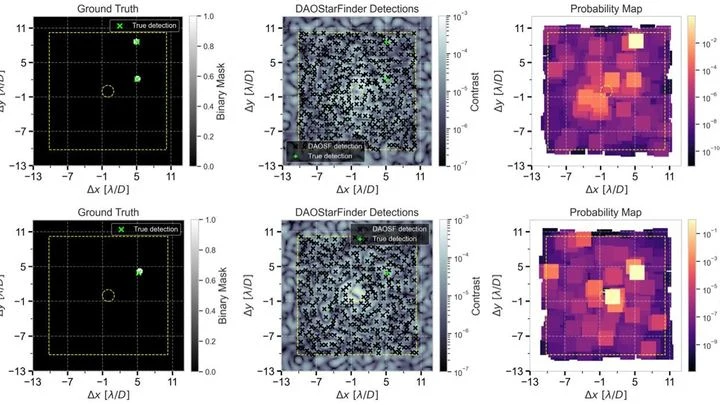
Photographing an exoplanet orbiting another star is like trying to spot a firefly in front of a spotlight. Earth's atmosphere is constantly churning, which makes stars appear as dancing speckles through a telescope.
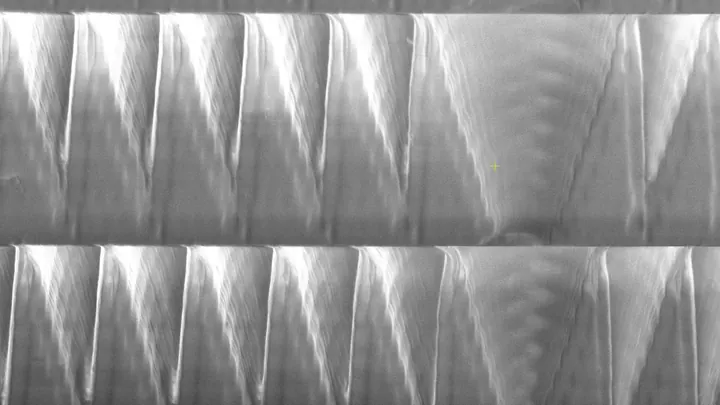
Each morning, dozens of telescopes swing toward the Sun. Their cameras catch a narrow band of red light — the Hα line, discovered by Johann Balmer. The images reveal dark, whimsically curved threads. They look like stitches in a giant tapestry sewn through the blazing corona.
A pebble on a streambed lies still as sunlight sparkles dance on the water's surface. In astronomy, the contrast is similar: a real exoplanet is the stone, while myriad speckles (patches of scattered starlight) are the ripples trembling in instruments.
The universe sounds with silence. The lion's share of matter — about 85%—remains invisible, manifesting only through gravity. Back when Vera Rubin Vera Rubin showed that galaxies spin as if wrapped in unseen mass.
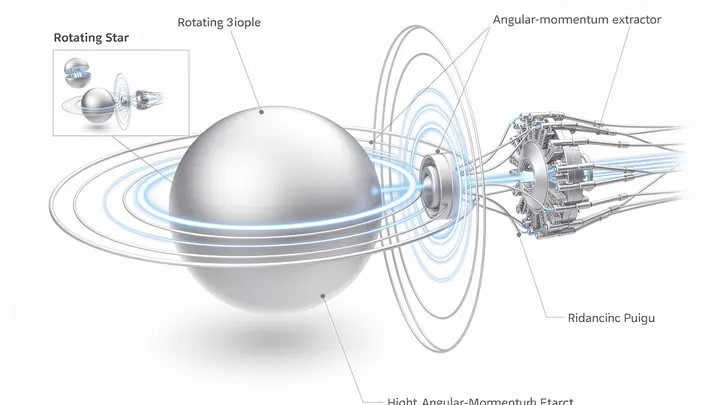
For decades, SETI has hunted for Dyson spheres — hypothetical shells that capture a star's light stars and re-radiate it in the infrared. But the cosmos remains silent. Perhaps an alien intelligence operates more elegantly: instead of collecting light, it tames the rotation of a sun, like a giant flywheel.
The Universe is a giant labyrinth of curved mirrors. The mass of galaxies and clusters distorts the light of distant quasars, as if toying with our perception of the cosmos. Hidden in this hall of mirrors is the key to the greatest mystery: dark energy, which is pushing space apart ever faster.
For decades, the search for extraterrestrial intelligence has waited for quiet, coherent signals from space — a kind of 'whistle' in the radio silence. However, our own technosphere has created a continuous radio background — the hum of a vast metropolis, emitted by all communications, radars, and broadcasting stations.
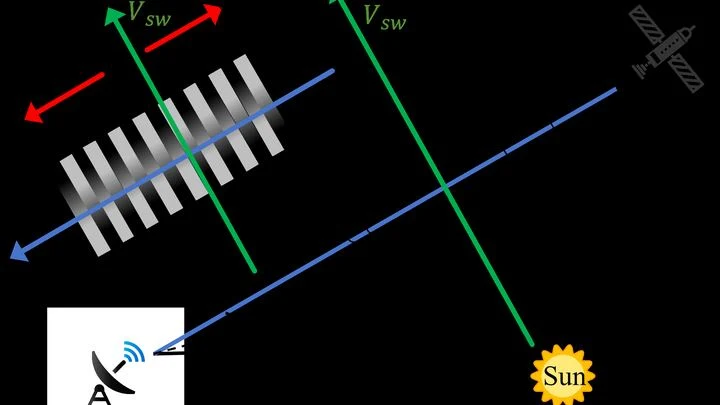
A radio signal travels from Mars to Earth, but on the way it has to push through the invisible "wind" of charged particles blowing from the Sun. This wind, like ripples on water, slightly distorts radio waves.
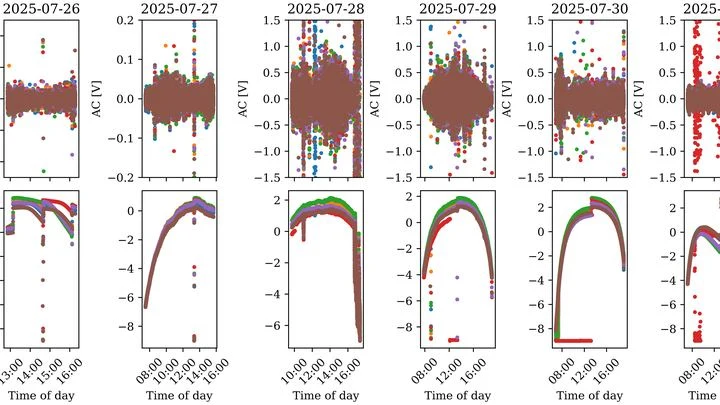
By day in Chile's Atacama Desert, the air shimmers with heat like the haze above a hot skillet. Sunlight passing through this shimmer begins to dance and flicker. Astronomers call this airy trembling "seeing" — and it keeps telescopes from getting a sharp view of the stars.
To fight this nuisance, engineers have built a special instrument — a solar seeing monitor.
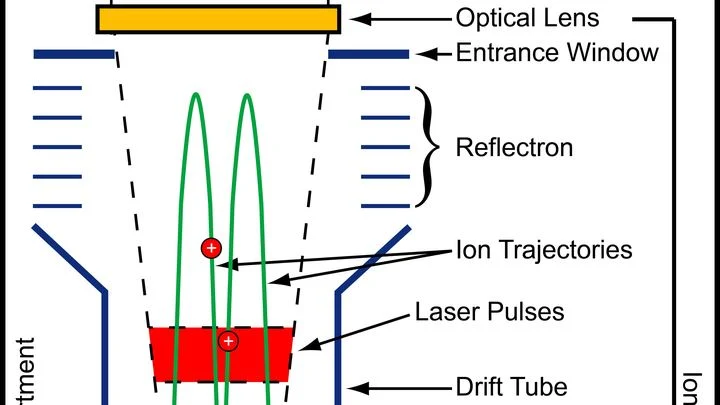
Light from distant stars travels for millions of years, but X-rays can't be caught with ordinary glass: they pass right through it like a bullet through paper. That's why X-ray telescopes need special lenses: stacks of tiny prisms that gently deflect the rays and focus them to a single point.
Hot massive stars are the kitchens of the Universe, where heavy elements are cooked up. They end their lives in supernova explosions. To understand their recipe, astronomers use spectroscopy — the analysis of the rainbow band of light passed through a prism. Previously, deciphering such a 'menu' took hours.
Long before a star ignites in a gas cloud, chemical life is already bustling. In cold, dense clumps of gas, called starless cores, atoms stick together to form molecules, both simple and complex. To peer into this invisible kitchen, astronomers aimed a 40-meter radio telescope in Yebes at 23 such clouds in the Orion Nebula.
Radio waves passing through the solar corona, the outer atmosphere of the Sun, are distorted just like the air shimmers over scorching asphalt. This haze is caused by seething streams of charged particles — the solar wind.
A star like the Sun doesn't just shine: it hums quietly. Inside, plasma churns, and these motions make the surface rise and fall rhythmically. Catching such a tremor from Earth is nearly impossible: it gets lost in the noise of the atmosphere and the instrument itself. That's why astronomers listen to stars from space, where it's quieter.
For six straight years, the HARPS-N telescope on La Palma island stared at the Sun as if it were a distant star — taking spectra, tracking brightness, and recording every quiver of spectral lines. All this was to understand how to distinguish a star's subtle sway from a genuine planetary signal.
A star doesn't sit still: its surface boils like a pot of soup.
The solar corona, the Sun's outer atmosphere, stretches millions of kilometers, yet it's visible only during a total eclipse or with specialized instruments. Typically, we gauge the corona's density by how it scatters white light, but that method relies on simplifications that can skew the results.
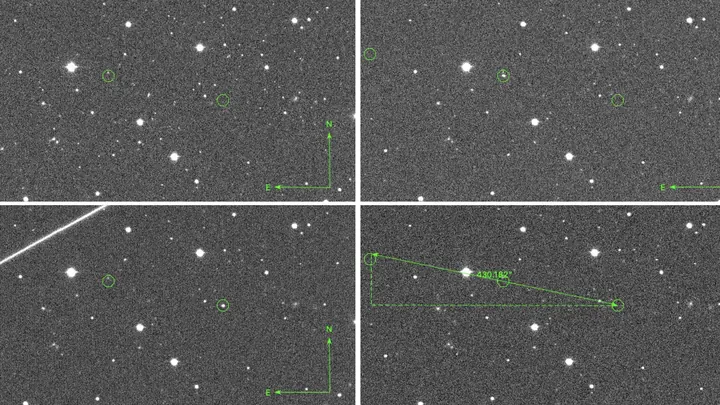
Back in the 18th century, William Herschel was searching for life on Mars. Today, astronomers are targeting not planets but artifacts — for example, alien probes lurking in the Solar System. The problem is that spotting a tiny object next to the blinding Sun is nearly impossible.