Graphene Detector: Protein Under Voltage express
In a drop of blood float millions of albumin molecules — the main transport protein. Its level drops in kidney and liver diseases, so doctors need a fast and accurate way to measure it. Engineers have proposed a detector the size of a dust particle: a graphene transistor that works directly in liquid.
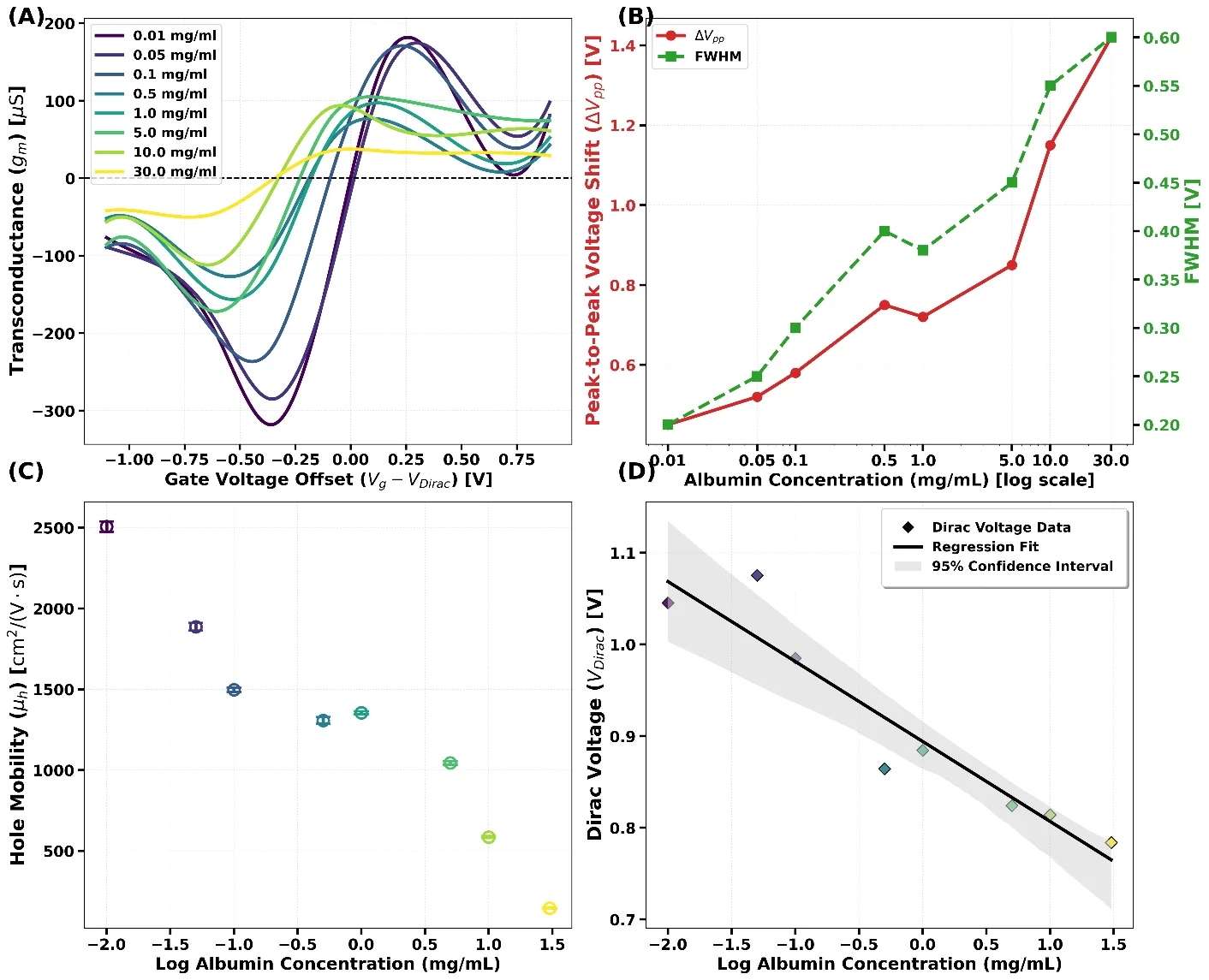
Graphene is a sheet of carbon one atom thick. It is so sensitive that even a single attached molecule changes its electrical resistance. In the new sensor, graphene is placed in a protein solution, and a weak voltage (less than a volt) is applied from above. Albumin molecules are negatively charged and, as they settle on graphene, act like a tiny chemical gate: they shift the point of minimum conductivity — the so-called Dirac voltage. The more protein, the stronger the shift.
Computer modeling showed that the protein lands on graphene in different orientations, like a key that can be inserted into a lock in several ways. But it is held not by chemical bonds but by weak van der Waals forces — the same ones that allow a gecko to run across a ceiling. Despite this softness, the sensor detects concentrations from 0.01 to 30 milligrams per milliliter, with a detection limit of just 0.0087 mg/mL. That's like finding a grain of salt in a bathtub of water.
The main secret of sensitivity is disorder. When protein sits on graphene, it creates irregularities in the electric field, and electrons scatter more strongly. This effect amplifies the signal, making even small concentrations noticeable. This "noisy" mechanism resembles the operation of an amplifier in an old radio: a weak signal modulates a more powerful current. Engineers used this principle to squeeze the maximum out of a simple device.
In the end, the graphene transistor becomes a pocket guardian of health: a drop of blood, a second, and the albumin level is known. And along the way, we better understand how molecules interact with two-dimensional materials at the liquid-solid interface.
Graphene is 200 times stronger than steel, yet so thin that light passes through it almost without loss, a single layer absorbs only 2.3% of light.
In Philip Dick's novel "Minority Report," criminals are identified by a drop of blood long before the crime, such sensors could be a first step toward instant medical diagnostics of the future.