How to Draw a Black Hole with Quantum Corrections express
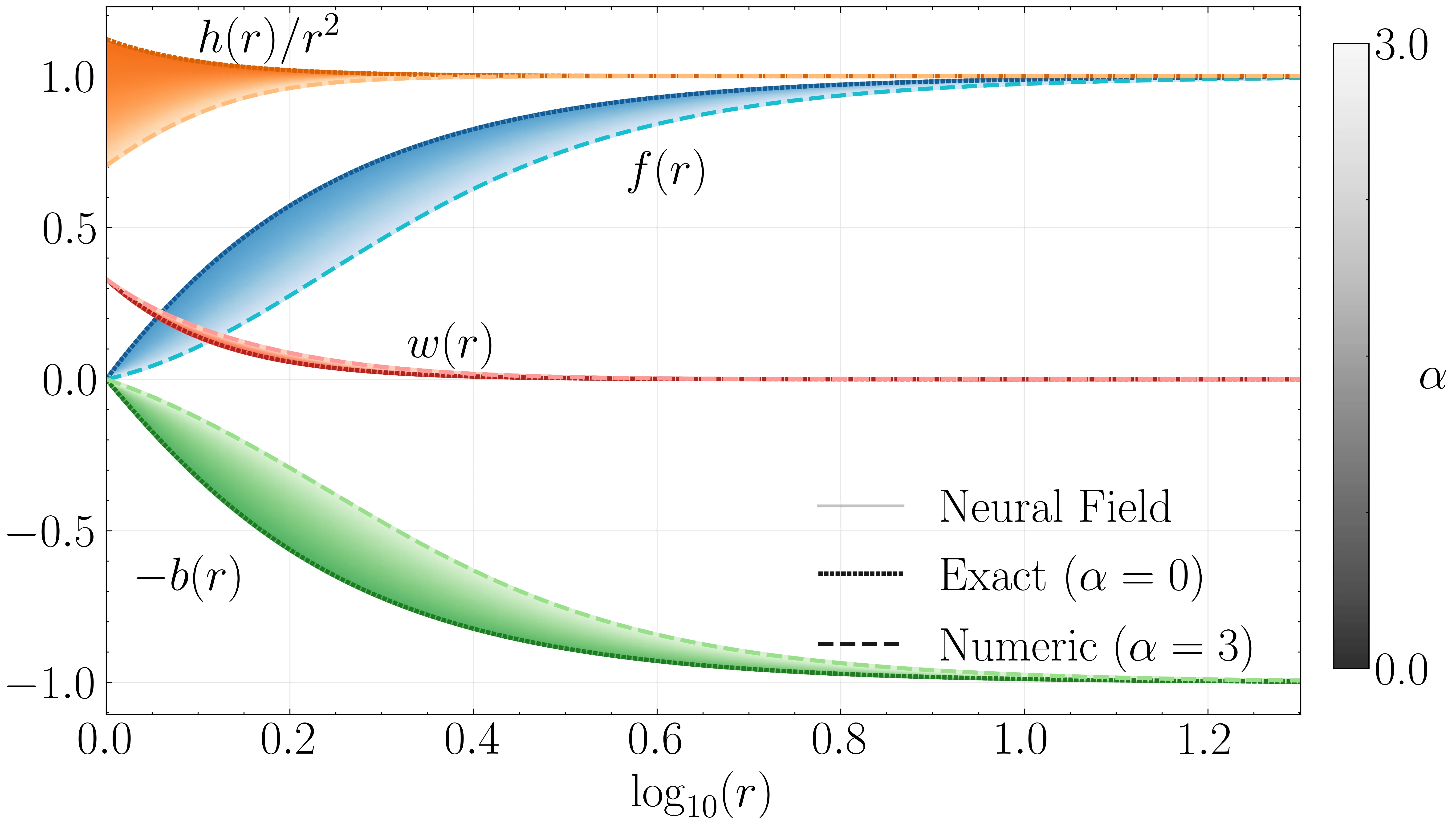
A black hole is not just a dark spot. It rotates, drags space along with it, and can carry imprints of the quantum world. To describe such a hole, one must solve gravitational field equations. This is extremely complex mathematics that becomes nearly impassable when quantum corrections, extra terms with higher powers of curvature, are added to the laws of gravity.
Previously, each case was calculated by hand, and no general method existed for rotating holes. The authors devised a tool called Akribeia — a hybrid approach. First, a neural network guesses the shape of the solution, then a spectral algorithm refines it to an accuracy comparable to a numerical benchmark. This allowed them, for the first time, to construct families of rotating black holes in theories with quadratic and cubic curvature, including cases with multiple rotation axes.
The method is not tied to a specific theory. It can be applied to other problems with partial differential equations — from gravitational waves to cosmology. Physics has gained a tool that turns unsolvable equations into blueprints of reality.
In five-dimensional space, a black hole can rotate in two independent planes at once, like a top that spins around its axis and tumbles simultaneously.
In "Interstellar," the rotation of the black hole Gargantua causes giant tidal waves on the planet Miller — an effect of frame dragging that can now be precisely calculated with quantum corrections.