The SYK model, named after Subir Sachdev, Jinwu Ye, and Alexei Kitaev, is a simplified quantum mechanical model of strongly interacting fermions with random, all-to-all couplings. It is a theoreticaltoy model that exhibits many properties expected of black holes, such as maximal chaos and a specific pattern of energy level statistics. The model has become a central tool in the study of holography, the idea that a quantum theory without gravity can describe a higher-dimensional gravitational system.
History
The model was developed in the early 1990s by Sachdev and Ye as a model of quantum spin liquids, and later independently by Kitaev in 2015, who recognized its deep connection to black holephysics and holography. Kitaev's work sparked a surge of interest, leading to many theoretical advances.
How it works
The model consists of N fermions (particles with half-integer spin) that interact through random couplings involving four particles at a time. The randomness and all-to-all nature of the interactions make the model solvable in the limit of large N, while still retaining rich physics. It is exactly solvable and exhibits a property called 'maximal chaos,' meaning that information scrambling occurs at the fastest possible rate allowed by quantum mechanics, a feature also found in black holes. The model is also dual to a nearly AdS2 spacetime, a two-dimensional anti-de Sitter space, making it a concrete example of holography.
In practice
The SYK model is used to design and interpret experiments in condensed matter physics, particularly in systems of ultracold atoms or quantum circuits, where its properties can be simulated. It also provides a theoreticalframework for understanding quantum chaos and information scrambling in many-body systems.
Fun fact
The SYK model is so simple that it can be solved with just a few lines of mathematics, yet it reproduces the same chaotic behavior as a real black hole, making it a 'black hole on a chip.'
A black hole is a maze with no way out. But what happens to the information inside? To test this, physicists didn't fly to the nearest hole; instead, they built a tiny replica on a quantum processor. The maze was played by a chain of 32 superconducting qubits, where each step leads only forward, like a one-way corridor.
In the far reaches of space, there exists a hypothetical object: an ultracold black hole. It is charged and resides in an expanding universe (de Sitter space). Its temperature hovers just above absolute zero — about one trillionth of a degree above it.
In 1973, Jacob Bekenstein proposed that black hole possess entropy — a measure of hidden disorder. Stephen Hawking later confirmed this by adding radiation, but the microscopic origin of entropy remained obscure.
After a hit, a black hole rings like a bell. But instead of sound, it emits gravitational waves whose frequency rapidly decays: these are called quasinormal modes. From such a 'ring,' you can infer the hole's mass, spin, and other properties.
A black hole's horizon is not a wall but rather a one-way membrane. Anything that crosses it disappears forever. Stephen Hawking showed that this boundary should glow faintly, emitting particles. But catching such radiation from a real black hole is impossible: it's too far and too dim.
Physicists have found a workaround: build a "toy" black hole out of magnetic atoms.
A black hole is not just a dark spot. It rotates, drags space along with it, and can carry imprints of the quantum world. To describe such a hole, one must solve gravitational field equations.
In classical theory, a black hole is where matter collapses to a point of infinite density. Such a 'singularity' looks like an error in the equations: nature hardly tolerates infinities. Many physicists seek ways to 'smooth out' this flaw, and one idea is to modify the theory of gravity itself at small distances.
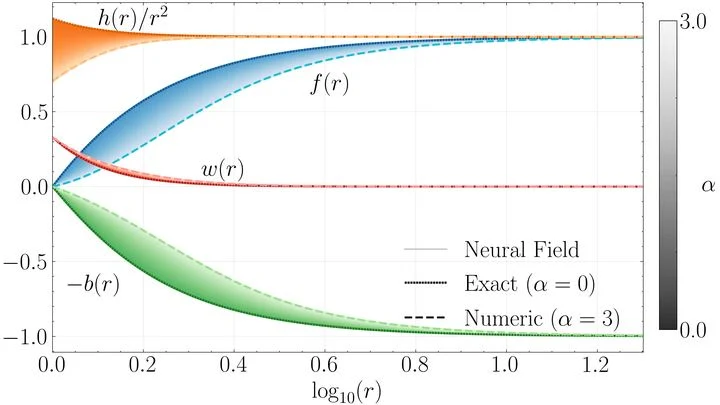
A black hole's interior is layered like an onion. In the new model, instead of an infinite point at the center, there are three regions: a dense core, a transition layer, and a crust just below the horizon. All arise from a single field that interacts with itself.
Dim the lights. The stage belongs to a shadow theater, with just r puppeteers, but the screen obeys the laws of hyperbolic geometry. Every wave of the hand births a pattern that mathematicians call a discrete group of isometries.
The quantum world is full of transformations. Sometimes a system made of one type of particle starts behaving as if it harbors completely different ones. For example, in a chain of bosons, sociable particles that like to crowd into the same state, fermions from the Standard Model may unexpectedly appear, even though they usually keep to themselves.
Drop a pebble into a pond, and ripples spread across the water. A black hole 'sounds' much the same when matter falls into it or when its spacetime gets a gentle jolt. These fading oscillations are called quasinormal modes, like the tolling of a bell that gradually fades away.
A black hole can be compared to a bell: after being struck, it vibrates, emitting a decaying 'ring.' This ring is the gravitational waves that detectors on Earth pick up.
When a car on cruise control hits a bump, the speed jumps for a moment, but the engine runs smoothly. Something similar was recently noticed with dark energy — the force that makes the Universe expand faster and faster.
An ordinary kettle: you heat it up — temperature rises, molecular chaos grows, and steam shoots out. But in the lab, they've created a peculiar "kettle"—an analog black hole made from superconducting circuits cooled to the extreme.
A stone falls into a pond, and ripples spread across the water. If the pond is choppy, with waves coming from all directions, the pattern gets more complicated. That's roughly how spacetime behaves around a black hole when something perturbs it: it vibrates, emitting gravitational waves.
Gas falling into a black hole spirals inward like water down a drain. In this flow, magnetic loops constantly form and pop — somewhat like solar flares, but far more powerful. Each loop is a tiny magnet living its own life. When many of them are present, they start to influence each other: their north and south poles attract and repel in turn.
A drop of cream falls into a cup of coffee, and within a minute, the entire drink turns beige. This mixing process can be quantified: how much "stirring" is needed to transform one distribution of particles into another? In mathematics, this approach is called optimal transport, and the measure of effort is the Wasserstein distance.
The authors applied this idea to quantum systems.
Physicists found out: to open a wormhole, you have to shake it hard. Not literally — but on a quantum chip, they simulated a system of 8 particles, so chaotic and entangled that it turned into a vibrating hologram of a black hole.
Two layers of a magnetic material, rotated relative to each other by fractions of a degree, like two slightly offset screens on a window. In their normal state, they don't produce anything special, but at a certain twist angle, an unexpected effect emerges.
From the center of a galaxy, where a black hole lurks, narrow jets of hot gas shoot out in opposite directions. They shine across vast distances, sometimes longer than the galaxy itself.
When two particles collide and scatter, physicists record the outcome as a complex mathematical formula. There are many such formulas, and invisible connections exist between them, like different recipes for the same dish: change the order of steps, and the taste stays the same. Previously, these connections were derived by hand, taking months or years.
A quantum walk is like a drunk person who turns randomly at every intersection. Except instead of streets, there are graph nodes, and instead of steps, there are quantum transitions. Scientists have discovered that such a walk has a hidden measure — Krylov complexity.
Two tiny magnetic vortices, called skyrmions, drift across a thin film. As they approach each other, the force between them isn't a simple attraction or repulsion, but an alternation of the two, as if two floats on water were converging and diverging, obeying an invisible wave.
In 1979, Su, Schrieffer, and Heeger proposed a model that explained the strange electrical properties of polyacetylene, an organic polymer that conducts electricity almost like a metal. Their chain consisted of carbon atoms connected alternately by single and double bonds.