Cosmic Mirages: What Was Really Behind the 'Dyson Spheres' express
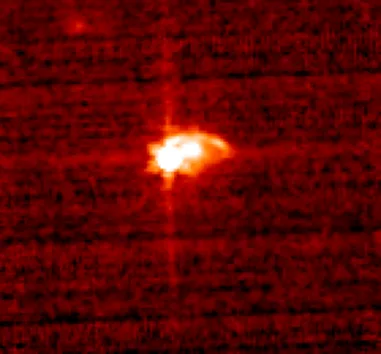
In 2024, the Hephaestus project sifted through millions of stars and flagged a few dozen suspicious ones: they shone brighter in the mid-infrared than a normal red dwarf should. Two of these candidates, labeled D and E, looked especially tantalizing, as if an invisible heater were working next to the star. That is exactly the signature a Dyson sphere might leave: a hypothetical shell that an advanced civilization builds around its star to capture its energy.
The James Webb Space Telescope aimed its MIRI infrared spectrograph at both objects and exposed the trick. Instead of a single source, the instrument saw two images separated by a tiny angle: the star itself and a neat dot nearby. That dot is a distant galaxy projected almost exactly along the line of sight from the star to Earth. The older WISE telescope blended their light into one blob, creating the illusion of an excess.
Candidate E turned out to be different: its background galaxy is twice as close, has a clumpy shape with bright knots, and shows a spectrum typical of a galaxy undergoing a starburst. No megastructures, just a trick of cosmic perspective. Astronomers now have direct proof that the infrared excesses around these stars originate not in their vicinity but billions of kilometers behind them.
The companion galaxy of candidate D (a Hot DOG) is so hot that its dust is heated to tens of kelvins — roughly like the surface of a distant asteroid, even though the galaxy itself is hundreds of billions of times more massive.
The idea of a Dyson sphere first appeared in Olaf Stapledon's science fiction in 1937, and was later popularized by physicist Freeman Dyson — hence the name for these hypothetical astroengineering structures.