A Black Hole in Polarized Glasses express
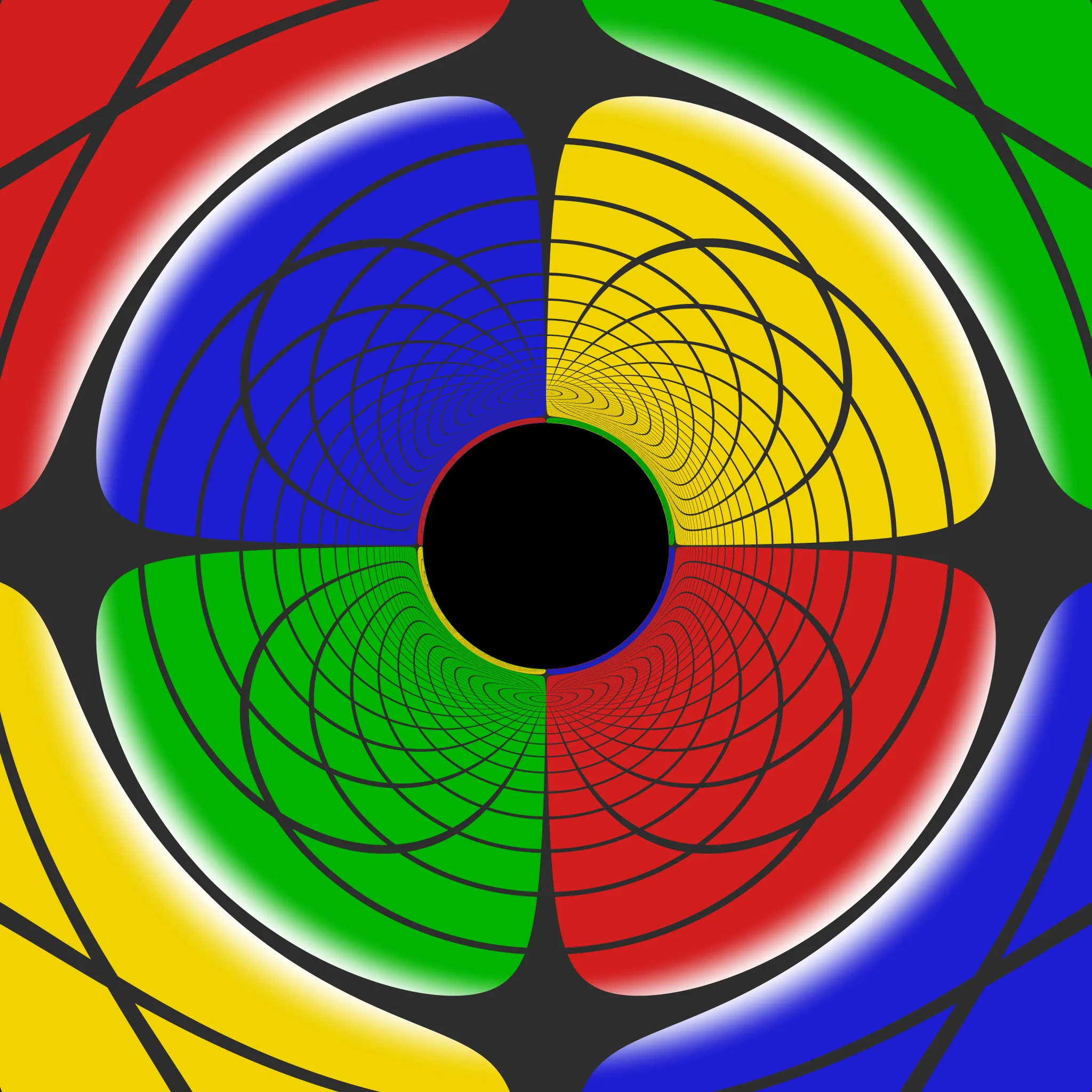
A black hole is not just a dark silhouette against the stars. Its shadow is surrounded by a thin glowing ring of photons that loop around the event horizon before escaping to an observer. Usually, this picture does not depend on the polarization of light: that is, on the direction in which the wave's electric field oscillates.
But everything changes if photons feel not only gravity but also the curvature of spacetime directly. Such a special coupling, called the Weyl tensor coupling, turns the space around a black hole into a kind of birefringent crystal. Light with one polarization bends around the hole along a wider arc, while light with the other polarization takes a narrower path. The shadow splits: instead of one dark spot, two appear, nested inside each other. Their edges can be separated by more than half the radius.
The authors calculated the full set of observable signals: from absorption and scattering of waves to the fine structure of photon rings. They verified their calculations using three independent methods. The most reliable signature of the effect is light reflected directly backward. In standard theory, such a ray does not exist, but here it appears and does not depend on the orientation of polarization. This 'backward ray' could become a key to searching for new physics in future observations of the event horizon.
Original abstract
as written by the authors arXiv:2607.10658
A photon coupled non-minimally to the Weyl tensor propagates differently in its two linear polarization states: the vacuum around a black hole becomes a birefringent medium. On a Schwarzschild background the coupling $$\alpha$$ splits the photon sphere and the critical impact parameter of the two polarizations, producing a double shadow and a polarization-dependent photon ring; the two shadow edges separate by $$62\%$$ of the shadow radius at $$\alpha/M^2=0.75$$. We compute a unified set of wave-optical and geometric-optical observables for both polarizations across a range of $$\alpha$$: greybody factors, absorption cross sections, differential cross sections and their glories, a backward birefringence signal, shadows, photon rings, and null trajectories. The two-polarization scattering matrices are extracted with a Riccati--Hankel matching scheme that keeps the phase-sensitive observables reliable, and the geometric-optics chain is cross-validated with three independent ray tracers. The cleanest diagnostic is the backward signal: it is protected by parity and vanishes identically at $$\alpha=0$$.
Double refraction is a property of some crystals, such as calcite, through which a single inscription appears twice. Around a black hole, this effect is created by gravity itself, if photons are specially coupled to it.
In the movie 'Interstellar', the shadow of the black hole Gargantua was calculated taking rotation into account, but polarization splitting could add a second, shifted ring to it.