Birefringence is the property of a material in which light travels at different speeds depending on its polarization. In an anisotropic crystal, such as calcite or quartz, the refractive index differs for light polarized along different crystallographic axes. This causes a single incoming beam to split into two rays — the ordinary ray and the extraordinary ray — that travel at different velocities and are polarized perpendicular to each other. Birefringence is a fundamental phenomenon in optics, explaining natural effects like the double image seen through certain crystals and the colorful patterns observed in stressed plastics.
History
The phenomenon was first discovered by Erasmus Bartholin in 1669 when he observed double refraction in calcite crystals. Christiaan Huygens later explained it using his wave theory of light in 1690.
How it works
In a birefringent material, the electric field of light interacts differently with the atoms depending on the direction of the field relative to the crystal lattice. This anisotropic response means that the material has two distinct refractive indices. When light enters such a material at an angle, the two polarization components experience different phasevelocities, causing them to diverge. The difference in refractive indices (Δn) determines the strength of the effect. This can be exploited to manipulate polarization states, create phase delays, or split beams.
In practice
Birefringence is used in wave plates (quarter-wave and half-wave plates) to control polarization, in optical modulators, in liquid crystal displays, and in geological microscopy to identify minerals.
Fun fact
Birefringence is also observed in stressed transparent plastics, which is why you see rainbow patterns when you hold a plastic ruler between crossed polarizers.
A slice of eucalyptus a tenth of a millimeter thick is placed under a polarized light microscope, and the wood suddenly blooms: blue, yellow, and pink bands twist into spirals, forming rings and swirls. This is not paint but the play of light: the cellulose fibers that make up cell walls transmit light differently depending on their orientation.
A thin section of eucalyptus lies under the microscope objective, and white light, passing through two polarizing filters, turns the wood into a mosaic of purple, yellow, and blue patches. These colors are not random: like letters on a map, they show the direction of the invisible cellulose threads inside the cell walls.
Light born when a fast electron enters a material is usually assumed to be the same in all directions. But in crystals where optical properties depend on direction, that's not the case. Run your hand over velvet: one way it's smooth and shiny, the other — dark and rough. Similarly, a crystal responds differently to light depending on how it's oriented.
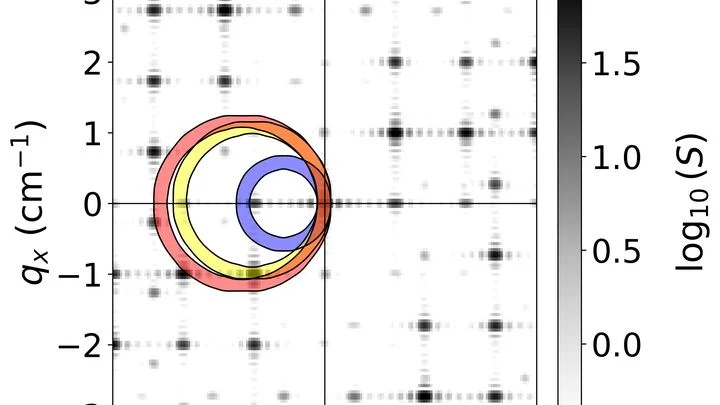
Waves on the water's surface usually break against any obstacle — a rock, a piling, an island. But what if you arrange obstacles so cleverly that the wave barely notices them? In a new study, scientists assembled a pattern of many points on the water, arranged according to special mathematical rules, and sent waves through them.
On the wall: light and dark fringes. That’s what light looks like when it cancels itself out.
Way back in the 17th century, Christiaan Huygens suggested that light is a wave.
A thousand years ago, Vikings took Iceland spar to sea. The translucent crystal split light into two rays. By their brightness, they could find the sun even in fog. Birefringence — the physical term for this phenomenon — now helps hunt for the most elusive force in the cosmos.
A black hole is not just a dark silhouette against the stars. Its shadow is surrounded by a thin glowing ring of photons that loop around the event horizon before escaping to an observer.
In the brain's white matter, the signal travels along axons — long neuronal processes wrapped in an insulating myelin sheath. Water fills the space inside axons and outside, in the narrow gaps between fibers.
In a close binary system, the hot star, like a searchlight, illuminates its cooler companion. Some of the light scatters off free electrons in its atmosphere — this is Thomson scattering — and acquires linear polarization. As the stars orbit each other, this polarization rotates, like the hand of a peculiar cosmic metronome.
Imagine a carousel with two types of seats: some spin clockwise, others counterclockwise. If you push all of them at once, the carousel jerks but stays in place. That's how a Weyl semimetal crystal works: electrons are born in pairs—'left' and 'right'—and their contributions to current cancel each other, like two identical motors running in opposite directions.
Light loves symmetry: in an open channel, it flows equally both ways. To steer it one way, physicists often use magnets. A new approach does without, using rotation — just the speed of a vinyl record — and interference from two atoms. Rotation changes the “pitch” of light for different directions, just as a siren’s tone shifts when a car approaches or recedes.
In superfluid helium, friction disappears — the liquid flows like a mountain stream, but without a single eddy. A short laser pulse rippled this smooth surface, and scientists using spectroscopy captured the spreading ripples — quantum waves with many speeds.
Gravitational wave detectors work like sensitive microphones, picking up the trembling of space from distant cosmic catastrophes. When two black holes merge into one, the newborn object rings like a bell, and that ringing is a unique 'voice' of gravity.
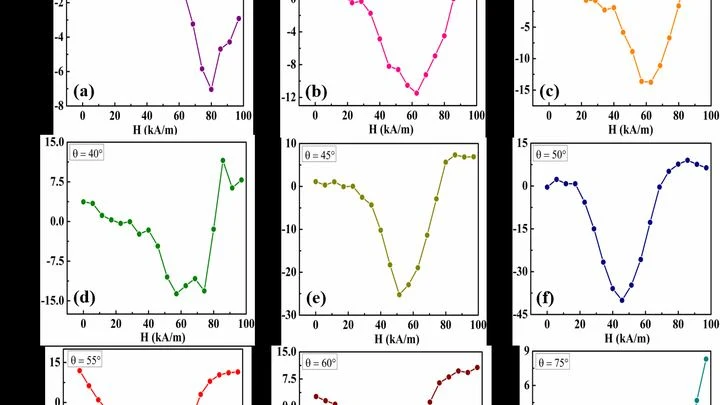
A piece of zinc oxide film lies on a table. A magnet is brought near, and slowly rotated around the film. The film, thinner than a human hair, begins to change its dimensions: now contracting, now stretching. This property is called magnetostriction — the ability of a material to deform under a magnetic field.
Entangled photons are like two couriers marching in lockstep: their quantum states, particularly polarization, are synchronized so that measuring one instantly determines the state of the other, even at a distance. In a material, this synchronization gets disrupted.
Light from the star HD 163296 passes through the surrounding gas-and-dust disk like a flashlight beam through murky water. The disk's particles scatter the light, giving it a special property — polarization: the waves begin to oscillate in a single plane, like a rope shaken strictly up and down.
Terahertz radiation sits between microwaves and infrared light. It passes through clothing, paper, and plastic but is blocked by water and metal. That's why these waves are used in security scanners and for quality control of materials.
An ordinary wave in a magnet is like ripples on water: the shorter the wavelength, the higher the energy. Physicists call such waves magnons. But in a thin film of bismuth yttrium iron garnet, they managed to create waves with the opposite behavior: their energy decreases as the wavelength gets shorter. These are antimagnons.
A solar cell is like a layered cake: thin films of different materials are stacked on top of each other, and when light enters, it knocks out an electric current. One promising material for such films is a compound of cesium, lead, and iodine.
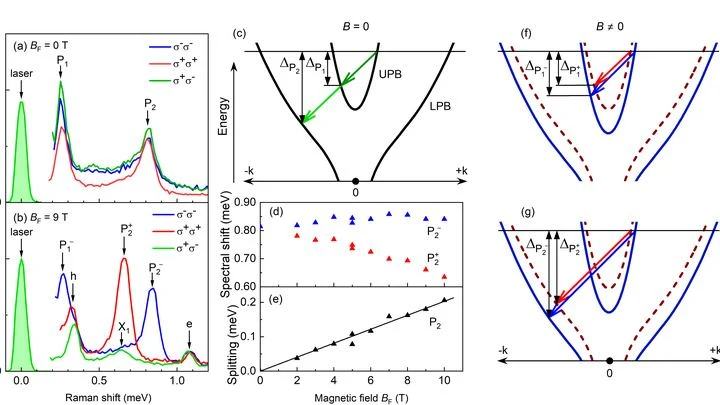
A laser beam hits a shiny crystal, and comes back different: slightly shifted in color, with a different polarization. In a magnetic field, this transformation of light becomes especially noticeable.
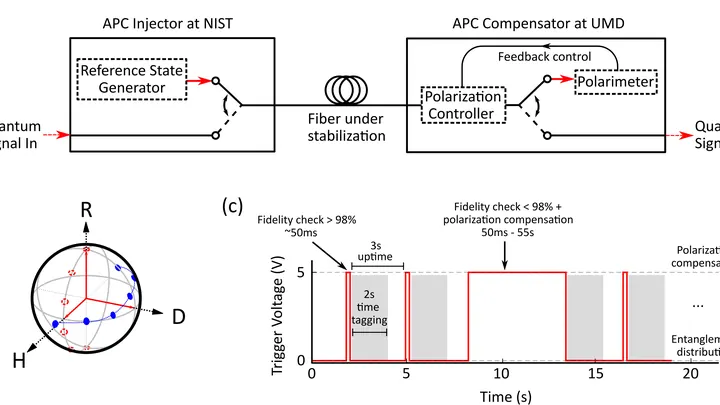
Two photons, like two halves of the same coin, fly tens of kilometers apart but remain linked: measure one, and you instantly know the state of the other. This property is called entanglement, and it underpins quantum communication.
Light from distant galaxies passes through telescope lenses like through a stack of window panes. Each pane is coated with a thin film to reduce glare. But this film acts as a polarizing filter: one component of the light wave passes a bit more freely, the other a bit worse. As a result, the wave rotates slightly, and the telescope sees a different picture than what is in the sky.